




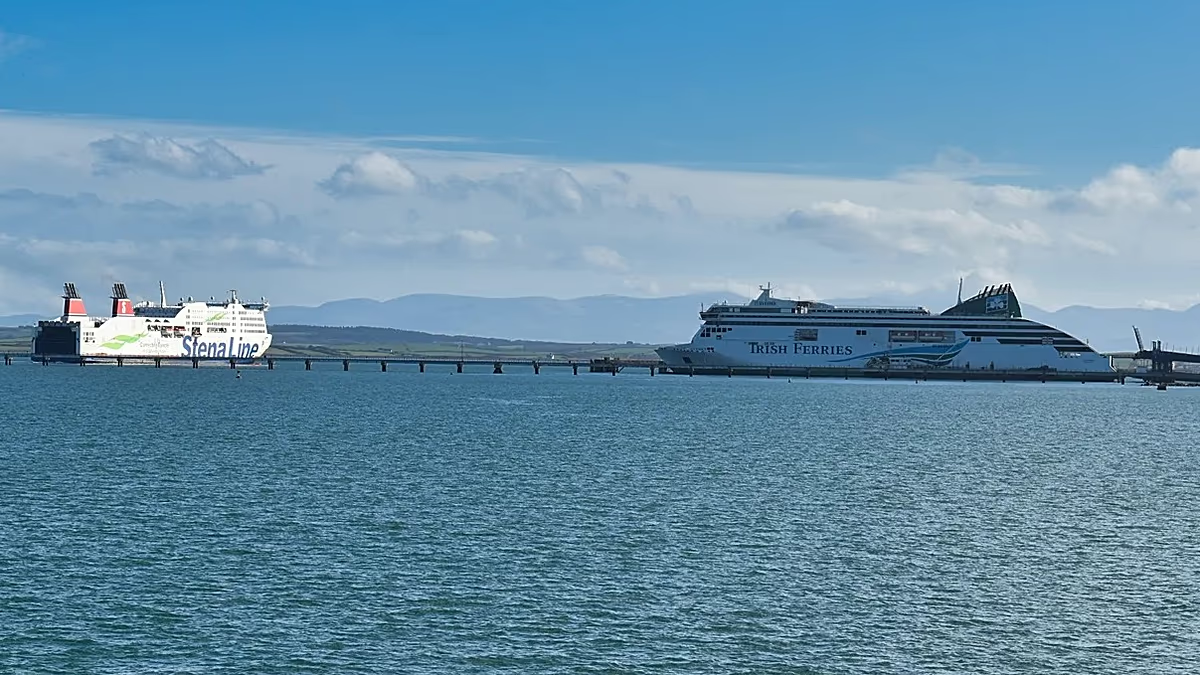
Planning a ferry trip between Great Britain and Ireland is about to feel a little less carefree. For years, the journey across the Irish Sea has had a wonderfully old-fashioned, almost nostalgic quality to it: you buy a ticket, drive or walk aboard, find a seat by the window, watch the coastline slip away, and perhaps enjoy a coffee or a pint while the ship makes its crossing. Passports were something you packed just in case, but more often than not they stayed buried at the bottom of a bag. That era is ending. From 28 September 2026, passengers on several major ferry routes will be required to present a valid passport before boarding. The change has been quietly announced by ferry operators and the UK Border Force, and it represents a significant shift in how ordinary people travel between two neighbours that have always treated each other as a kind of extended family. The news may come as a surprise to many, especially those who have grown used to crossing the Irish Sea with nothing more than a driver’s licence or an ID card. But the message is clear: the informal, trust-based days of ferry travel between Britain and Ireland are giving way to a more regulated, security-conscious world.
The practical details are straightforward, though they will require a bit of planning. Stena Line, one of the biggest operators on the Irish Sea, has confirmed that from the end of September, all passengers on its routes from Holyhead to Dublin and from Fishguard to Rosslare must carry a valid passport. These are among the busiest crossings between the two islands, carrying thousands of passengers, families, lorry drivers, and holidaymakers every week. The company has said that customers with existing bookings are already being contacted by its customer service team, so that no one is caught off guard when the new rules take effect. Interestingly, not all Stena Line services will be affected at once. Routes via Belfast, Liverpool, Cairnryan, or Heysham can, for now, still be travelled without a passport, although it would be wise to expect that these exemptions may not last forever. Meanwhile, Irish Ferries has gone a step further, announcing that it will require a valid passport on all of its routes between the Republic of Ireland and Britain. Taken together, the messages from these two companies, along with the quiet endorsement of the UK Border Force, suggest a coordinated move toward stricter documentation across the entire Irish Sea corridor. The official explanation given is the need to ensure the “accuracy and integrity of passenger data before boarding.” That bureaucratic phrase, printed in statements and repeated by customer service representatives, masks a genuinely important shift in how the border between these two countries is imagined and enforced.
What makes this change particularly striking is the legal backdrop against which it is happening. Irish and British citizens do not, in fact, legally need a passport to travel between the two countries, thanks to the Common Travel Area, an agreement that has been in place for more than a century and also covers the Isle of Man and the Channel Islands. Under this arrangement, citizens of the UK and Ireland have enjoyed the freedom to move between the two nations with minimal bureaucratic interference, a unique arrangement in a world where passports have become the default requirement for almost any international travel. That is why, until now, ferry passengers were often able to travel with other forms of photo identification, and many were not asked for any identification at all. The new rules do not change the legal position; the Common Travel Area remains intact, and Irish and British citizens are still not legally obliged to hold a passport. But they do change the practical reality. What used to be a right exercised with almost no documentation will now be a privilege that requires official proof of identity. It is a subtle but meaningful distinction, and one that will be felt most acutely by those who have never owned a passport, or whose passports have expired without notice because they never expected to need them for a short hop across the Irish Sea.
The move has not happened in a vacuum. Indeed, the ferry companies are following a path already worn smooth by the airlines. In February, Aer Lingus joined Ryanair in enforcing the rule that passengers travelling between Great Britain and Ireland must carry passports. For air passengers, this was already becoming standard practice, but the enforced policy marked the end of a more relaxed era in the skies as well. The alignment of ferry and airline rules suggests that we are witnessing not a temporary measure, but a permanent tightening of the travel regime between the two islands. For passengers, the implications are significant. It means that before booking a ferry, you need to check not only that you have a passport, but that it is valid for travel. For British and Irish citizens, this does not mean checking the six-month validity rule that applies to many other countries; a passport that is valid for the duration of your trip and for your return is generally sufficient. But for non-European nationals, or those with residence permits and visas, the situation may be more complicated, and the advice to check requirements well in advance has never been more important. Families with children should also take note, because children now need their own passports, and these must be obtained before travel. There is something poignant about this: parents who once simply added their children’s names to a family ticket must now ensure that even the youngest traveller has an official identity document. It adds a layer of preparation to what used to be a spontaneous adventure.
The broader significance of this change goes far beyond the practicalities of queuing with your documents at the ferry terminal. It is another small but unmistakable sign of how the relationship between the United Kingdom and Ireland has evolved, particularly since Brexit. The Common Travel Area survived the UK’s departure from the European Union, but the atmosphere around it has changed. Borders that were once almost invisible are now being digitised, monitored, and more carefully controlled. The requirement to show a passport before boarding a ferry is not simply about security; it is also about data, about knowing who is arriving and departing, about creating a trail that can be analysed, stored, and potentially shared. The phrase “accuracy and integrity of passenger data” hints at this deeper purpose: the information on a passport is considered more reliable, more standardised, and more easily verifiable than a driver’s licence or an identity card, which can vary in format and quality. But this shift also raises questions about the nature of travel between two countries that share so much history, family ties, and economic interdependence. For many people, the ferry has been a symbol of connection, a bridge between two worlds that are separate but intimately linked. Requiring a passport changes the symbolism, even if the journey itself remains the same. It makes the crossing feel more like an international border, and less like a move from one part of a shared space to another.
As the 28 September deadline approaches, travellers will need to adapt, and that will not be difficult for most. The passport requirement is not onerous; it does not require visas, or biometric checks, or lengthy interviews. It simply asks that you carry a document that many people already have. But for those who have relied on the flexibility of the old system, the change will be felt as a loss of innocence. There is something about the ability to travel without a passport that feels like freedom, a reminder that not every journey needs to be documented and approved in advance. The new rules are a gentle nudge toward a more cautious, more formal way of moving through the world. They are also a reminder that the world is smaller and more controlled than it used to be. Still, there is consolation in the fact that the ferry between Great Britain and Ireland remains one of the most pleasant ways to travel in Europe. The sea air, the slow pace, the sense of leaving one land and approaching another: these things will not change. The passport check will add a few minutes to the boarding process, and it will require a little more foresight when planning a trip. But it will not diminish the beauty of the crossing, nor the warmth of the welcome on the other side. So check your passport, renew it if you need to, and then go. The Irish Sea is waiting, and the journey, while more documented, is still a journey worth taking.