



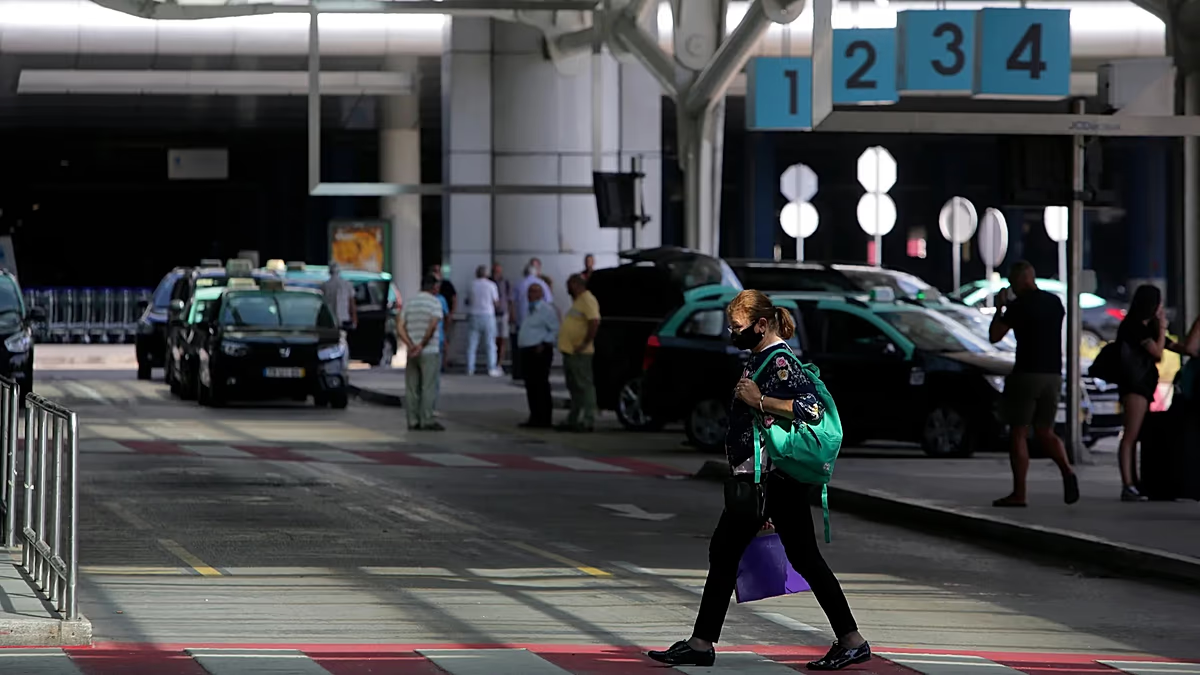
Picture this: you’ve just landed at Lisbon’s Humberto Delgado Airport, tired after a long flight, and all you want is to get to your hotel without a headache. You walk outside to the taxi rank, and instead of a simple, reassuring ride, you’re met with hesitation, a shrug, or a driver who tells you the meter is “broken” and names a price that sounds suspiciously high. This is not an isolated nightmare—it’s become a familiar story for countless visitors over the last few years. Reports have piled up from tourists about excessive fares, creative scams, and even drivers outright refusing to take passengers from the airport. Social media is full of complaints about tampered taximeters, strange detours that magically add kilometers to the trip, and drivers who only accept cash, conveniently avoiding any record of the transaction. In August, Josien Nation, a Dutch citizen living in Portugal, summed up the frustration in a video for the Facebook page Nations Without Borders, calling the whole situation a “tourist trap.” She was careful to say that not all taxi drivers are crooks, but she described a troubling pattern: some drivers try to negotiate the fare before the car even moves, then make the journey with the meter switched off—something that is explicitly banned in Portugal. The cumulative effect has been a growing sense of distrust, not just among tourists but also among locals, and it’s this climate of suspicion that finally pushed authorities to act.
The stories behind the statistics are what really make the problem feel real. One passenger, sharing in a Reddit group, described a journey from Lisbon airport to Rossio that should have been simple and straightforward. The meter showed 13 euros, but the driver demanded 18.50 euros. When the passenger asked why, the driver pointed to an “additional luggage fee” that had never been mentioned before. To make matters worse, he refused to accept card payment, leaving the passenger with no real choice but to pay up or argue in a foreign country. Another account, this time from a Portuguese resident, tells a similar tale. He got into a taxi after a trip, but when the driver said he didn’t take card payments, the passenger started to get uneasy. He asked how much the ride from the airport to his home might cost, since he had cash on him, but the driver wouldn’t give a straight answer. Instead, he mumbled something about the price depending on traffic, the exact route, and how long the journey would take—which, as the passenger noted, was just a bunch of nonsense designed to leave the door open for overcharging. Other users chimed in with their own experiences, noting that some taxi drivers deliberately take less direct routes to their destination, stretching out the ride and inflating the fare. What’s striking is that these complaints don’t only come from tourists. Yes, tourists and foreign residents are frequent targets, but locals who use the service have shared similar frustrations. The problem had become so widespread that it was no longer just about a few bad apples—it was about a system that seemed to tolerate, or even encourage, this kind of behavior.
Faced with all this, a protocol was signed last September to set fixed fares for taxi journeys from Lisbon airport, and on Thursday, the new mechanism finally came into force. The idea is simple: instead of relying on the meter, passengers pay a set price depending on their destination, so everyone knows what they’re getting before they get in. Travelers heading to areas within “zone 1” pay 16 euros during the day, from 7:00 to 22:00, and 20 euros at night, from 22:00 to 7:00. For trips to “zone 2,” the fare is 19 euros during the day and 23 euros at night. These fixed rates also apply on weekends and public holidays, which is meant to eliminate the surprise surcharges and arbitrary justifications that passengers have been complaining about. The fares include luggage, which is a welcome change—previously, bags larger than 55x35x20 centimeters carried an extra fee of 1.60 euros, and that fee was often stretched or invented on the spot. Destinations outside these two zones are still charged using the meter, so the system isn’t perfect yet, but it’s a start. Carlos Silva, president of the Portuguese Taxi Federation, explained to Portuguese news agency Lusa that the system will only be fully operational from November, and that a price still needs to be set for areas outside the capital, such as Moscavide, Sacavém, and Prior Velho. He made a fair point: it doesn’t seem right that someone pays 16 euros to go to Parque das Nações, but if the destination is a little further, already in another municipality like Loures, and just a short distance from the airport, the service is suddenly charged by the meter again, with all the uncertainty that brings.
As you might expect, reactions to the new price list were immediate and mixed. On social media, many people branded the fixed fares far too high, especially for short trips. Take the journey from the airport to the parish of Alvalade or to Parque das Nações—both are barely two kilometers away, and paying 16 euros for such a short ride feels steep. One Instagram user said she regularly takes a taxi to Oriente station, which is in Parque das Nações, and used to pay between 7.50 and 10 euros. She asked, with obvious frustration, why the fixed fare had to be so high. Others pointed out that alternative transport platforms, like TVDE services, are probably rubbing their hands with glee, because these new rates might drive even more passengers to ride-hailing apps. Some accused the authorities of setting “tourist prices” or simply rubber-stamping the high fares and questionable practices that many taxi drivers have already been using for years. One comment went straight to the point: “They are going to legalise what some have already been doing for years: turning off the meter.” That’s a harsh take, but it reflects a deep suspicion that the new rules might not be about protecting passengers so much as legitimizing a broken system. Yet there are also voices in support of fixed prices, acknowledging that knowing the cost upfront is a form of transparency. One Reddit user noted that having seen similar systems in other countries, it’s actually useful to have fares set in advance for each destination, without depending on the meter. The debate also touched on public transport, with some suggesting the metro or bus as cheaper alternatives. But others pointed out practical barriers—large, heavy suitcases, unfamiliar routes, or traveling with children—that make public transport less appealing, especially after a long flight.
The new fares are just one part of a broader effort to clean up the taxi industry at the airport. The protocol, which was signed in September by Lisbon City Council, ANA – Aeroportos de Portugal, the Lisbon Tourism Association, the Portuguese Taxi Federation, and ANTRAL, the national association for light vehicle road transport, also lays out other important rules. For one, taxi drivers are no longer allowed to refuse service. That might sound like common sense, but it’s a direct response to the widespread reports of drivers picking and choosing passengers based on where they want to go or whether they look like easy targets. Drivers are also obliged to accept vouchers and electronic payments, which means the payment terminal must be operational. No more “sorry, the card machine is broken” excuses. In this first phase, the fixed fares cover all taxi drivers, even those who are not yet accredited to operate at the airport taxi rank. Accreditation will also begin on Thursday, according to officials. Carlos Silva believes these new rules could attract more drivers to the airport, ensuring more taxis are available at the rank. He said that many drivers avoid the airport for various reasons, but they might reconsider if there are clear rules, because at the moment they don’t feel comfortable. Fixed prices, he argued, could be more advantageous and offset the time they might have to wait in line. Still, if you arrive at Lisbon airport today, you can already expect these prices on taxi services, but there’s a catch: the information panels that are supposed to display this information in the arrivals area and outside are still missing. That’s a crucial part of the plan, because transparency only works if passengers can actually see the rules and know what they should pay. The hope is that with these changes, the quality of service will improve and users will feel protected rather than preyed upon.
If there was any doubt that regulation was needed, a major inspection operation by the Public Security Police at the airport’s arrivals area at the end of August removed it. The PSP inspected around 100 taxis at Humberto Delgado Airport and detected 67 offenses related to taxi activity. The most common issue was the “incorrect positioning of the taximeter,” which accounted for 32 of the 67 offenses. That’s a huge red flag, because a taximeter that isn’t properly positioned is easier to manipulate, and it’s often the first step in an overcharging scam. But the problems didn’t stop there. Officers also found eight offenses related to the lack of a Taxi Driver Certificate, six for missing mandatory documents, six for fire extinguishers past their expiration date, three for lack of vehicle inspection, and three for drivers lacking the required Group 2 certification on their license, which is mandatory for taxi drivers. Two offenses were recorded for taximeters past their validity period, two for taxis in poor condition, one for failure to use restraint systems, one for lack of insurance, one for driving under the influence of alcohol, and one for parking in a private car park. The PSP also issued two warnings to present documents and complied with two requests for external action that were pending against one of the drivers. This snapshot of a single operation shows just how deep the problems run, and it’s hard not to see it as a reflection of a broader culture of impunity. The new fixed fares, the ban on refusing service, the requirement to accept card payments, and the promise of better oversight are all steps in the right direction, but they won’t fix everything overnight. The system will only be fully operational from November, and there are still gaps to fill, both in terms of coverage and enforcement. For now, the message to passengers is clear: know your rights, check the fares, and don’t be afraid to speak up if something feels off. Lisbon is a beautiful city, and the last thing anyone wants is for the first impression to be ruined by a dishonest taxi ride. With these changes, there’s hope that the journey from the airport will finally become as smooth and welcoming as the destination itself.