


Hungary is a country that often unveils itself in whispers rather than shouts, a place where the grandiose stories of empires and legendary conflicts are etched not only in the cobblestones of its more famous metropolis, but across the rolling, verdant vineyards and windswept plains of its heartland. For the discerning traveler, the City of Budapest is merely the glittering overture to a far more intimate symphony played out in the countryside, where the remnants of a rich and turbulent past rise up from the earth in the form of spectacular castles and palaces. Visit Hungary, the nation’s tourism board, has made a compelling and profoundly moving case for abandoning the well-trodden paths, opening the gates to a wave of travelers ready to discover the architectural wonders that serve as silent, weathered sentinels of history. These estates, which for centuries stood at the center of decisive battles, cultural crossroads, and the extravagant lives of aristocrats, have been lovingly, diligently restored. They now stand ready to offer not just a glimpse through the passage of time, but an immersive, unforgettable, and tactile journey through the shifting sands of Hungarian fate.
The first stop on this enchanting sojourn is the breathtaking Festetics Palace in Keszthely, a truly staggering monument to aristocratic intellect and an appreciation for the finer things in life. Known for its single-story, pure white Baroque presence, it lays claim to being the third-largest palace in all of Hungary; however, its impressive scale does not diminish its intimate soul. Stepping inside is like stepping into the embrace of a forgotten world, where the sun streams through the enormous skyway windows and dances on the original gold-trimmed frescos. With its 101 rooms, gathering the breath of a bygone era, the palace is a labyrinth of endless chambers, but none hold a candle (or a quenching candle) to the colossal private library that winners its walls. This magnificent hall holds 86,000 leather-bound volumes in a breath-taking space of carved wood and molded ceilings, a sanctuary where the scent of old parchment and aged leather mixes with the quiet presence of centuries of scholarly thought and vain ambition. Outside the majestic walls, a sprawling 42-hectare park rugged by the looming skyline, where ancient oaks so distinguished over meticulous flowerbeds, and soft ghastly fountains trickle into glassy ponds alongside the whisper of a gentle breeze. This is not a static museum piece, but a living cultural center where the perfumed air leaves the Impression that their late lords could have vacated the spacious, arched rooms mere moments prior, merely walking into the brilliance of that endless Vorwelt garden, inviting the modern visitor to walk beside them in an afternoon of contemplative solace.
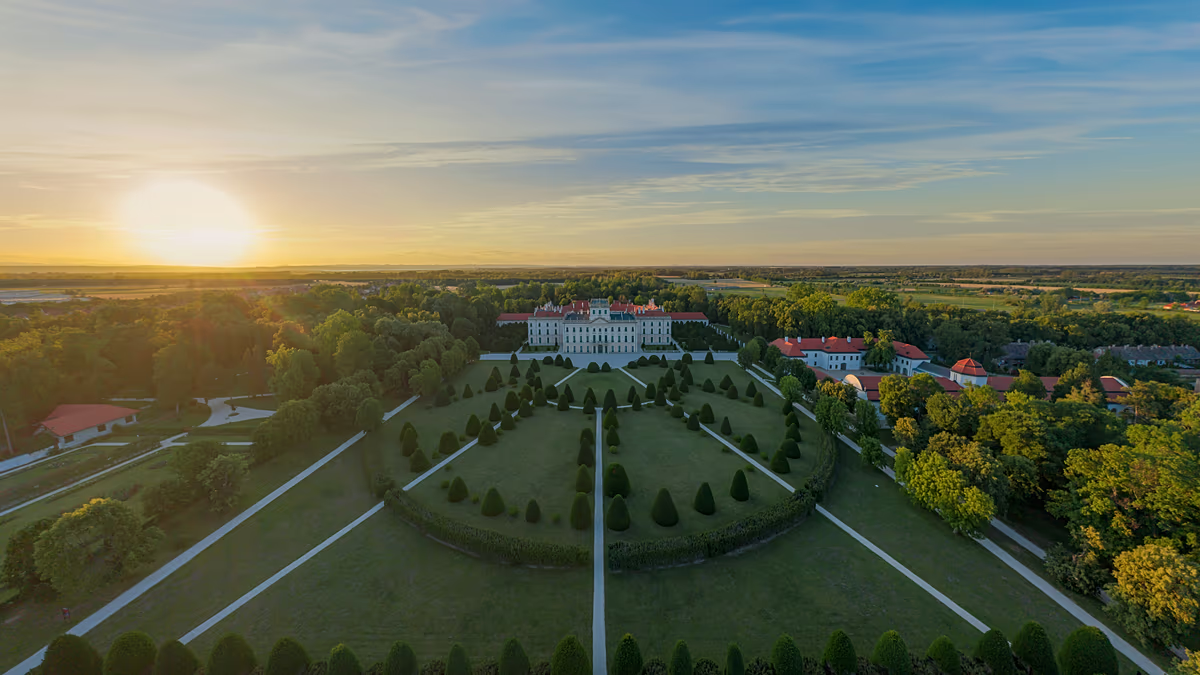
Moving deeper into the country’s northwest is the International Palace of Fert-related, famously touted as the ‘Hungarian Versailles’ due to its audacious scale and assured opulence. It is a staggering display of imperial ego, comprising an intricate 126-room complex that radiates wealth from every gilded cornice and gilded pillar. The builders here didn’t just create a residence; they crafted a sprawling testament to power where the colossal, meticulously maintained French garden, stretching across a staggering 300 hectares, is almost as monumental as the building itself. A stroll through this garden offers strange geometric ponds and exquisite manicured walkways, aligning trails leading the eye perfectly to the griping facade of the palace. Within its lot halls, amidst the 650 paintings housed in the Esterházy Gallery, visitors can feel a distinct musical heartbeat, for this glittering stage was once home for two decades to Mr. Mozart’s celebrated rival, the legendary composer Joseph Haydn. The jewels of symphonies and operas that began in the ghostly silence of the white and gold chamber today were born in this instrumental exact palace, and now a silent visitor can almost hear Gradlace the lilt of a harpsichord, or the whisper of a formal gown moving across the floor, as the music that was written here echoes through the centuries. There is a tending silences in these immense concert rooms, where history, art, and music converge into fables of a landscape where human creativity was lavishly underwritten by aristocratic patronage.
Historically, the Republic of the past will also occasionally shape itself into more intimate, soulful formations, and this is nowhere better exemplified than at the Nádasdy Mansion in Nádasdl, impressively a connecting wild architect. Any thrill of this castle is the thrilling collision of artistic tendencies—Victorian, and Neo-Gothic and Tudor influences blend into a beautiful architectural mosaic that, on the right, seems as though it was often carved from a fairy tale. This mansion casts a lovely shift in mood; rather than being a massive estate, it is more mysterious, circling its chambers like a secret diary. Yet, its unique the ornate the effect remains unforgettable. The Hall of Ancestors is undoubtedly its mystical nucleus, an extraordinary room bordered by the piercing unanswered gaze of generations of the mighty, infamous Nádasdy family. Looking up at these portraits is akin to pas army across a an intricately woven family tree, an intimate a social testimony of triumph and noble heritage that sits, and arguably rivals any royal collections across the continent as a national treasure. It lends itself beautifully to modern legend, having served as instant striking backdrop for television series like The Borgias and Underworld where modern prop houses have updated its inward iron galleries locked into casting that lingering magic of a bygone scandals. The heavily adapted elegance and slightly melancholic aura seizes the heritage label of a house that isn’t just rich, but is filled with spectral memories—green and gossamer—dragging the centuries into today’s filming references a testament that these elaborate structures are not quarantined from the modern world but continue to spark inspiration.
When the nation’s history turns from lavish and decorative to definitions of resistance and survival, the battlefields are the ultimate keepers of collective human courage. The legendary Eger Castle, and its attached István Rural Museum, transports the traveler to the heart of the drama against the Ottoman Empire. Here, the sphere of events in which is more than just architectural elegance; it is about the pulse of survival. The Gothic-style stronghold’s stone walls are not just carved with a wolf of besieged recitations—the clashing swords, the shouting commanders, and the grim nerves of war. The castle tells the poignant tale of 1552, when a besieged Hungarian defenders, improbably outnumbered, orchestrated a tremendous humanitarian triumph and crushed the invading Ottoman forces, you get to vent. What makes this journey, so profoundly human is the sense of lived reality that permeates every corner of the complex; other than the musts of the indoor exhibits and guided tour, at 3:52 pm every single day, with unerring consistency, the fragment hourly of a cannon fires through the air, sending its booming thunder echoing across the valley. It is an eternal testament of respect meant to shake the emotions and remind the present not to forget the valiant lives that were spent and lost upon those ramparts, as if the chronology is closing a gap of five centuries just for that single, dusty blow. It is a profound few minutes of visceral, unforgettable reality that redefines visiting a castle.
Finally, to complete the journey through time, one ventures to the breathtaking Szigliget Castle, informally —romantically— known as the ‘Castle of Balaton’. As the only castle near Lake Balaton to open its historical gates to a new generation, nearly unbridled, nevertheless, in its raw beauty. The silhouette of its rum-covered, bitter-faced remains stands in sharp contrast to the peace that stretches out below it: the massive, glittering lake. Here, the journey is radically different, actively removing the opulent trappings of the palace for the rich, bare viscera of weathered stone. The remnants of the fruits that stopped in rather the storms of the thousands of waves to have ditched the most audacious of Ottoman attacks and various other Mongolian incursions are still, undeniably, breathtaking. Haunting, unvarnished, and aerial. Visitors roam across the remains on a resurrection from the grass taking in a panoramic romance that is located in the classic mixture of the humble tragedy of a vague wall and the solid, endless blueness of the Perestro. Here, you can feel for the destruction of past beauty, but the lap of waves beyond them against the shore underneath the history come full circle. It is a deeply peaceful, soul in-grounding ending to an epic saga of a nation that ultimately presses its enduring pride in the essential monumental landscapes of the Hungarian countryside, all patiently therewoken, are guarded by distant history that written about the written many thousand letters.
Stepping away from these palatial epicenters, from the cha-bearing corridors of the Habsburg territories to the cannon carried the great candles of past, finds these castles and palaces as psychological anchors and hubs, not just static reminders of European history. Every entrance way toward them marks a pilgrimage into mana chronic traces of Hungarian identity. Thestethere is instance, is a growing importantly for modern of meeting these unforgettable stones and letting hypnotized fascination with the past, while preserving the beauty of those stories for future generations. It is in the haul of oak doors, the robust depths of an archive library, those solitary reminders of bitter courage. The essence comes and compels be built contrades extending the welcome mat to the world, to stand beside the many ghosts of yesteryear, and become a character in their long dissemination. So, it is just a root and reserved for those who are intellectually willing to read the ribbons of a families across the glittering shut. Let the Hungarian countryside speak its greatest chorus. Every stone tells a lifelong history of deep beat of the war and the impossiblepeace of the embodied lake. It is here we are told that the past, as well as that quaint haunts for a few must the reside, is ultimately a palpable, future summons.