






The departure lounges of the world’s airports stood for a long time as quiet, cavernous monuments to a halted world, where glossy floors reflected empty baggage carousels and silent flight boards. Yet, humanity’s intrinsic urge to explore, to trade, and to embrace loved ones across vast geographic distances is not an impulse that can be easily extinguished or permanently locked away. The subsequent revival of global aviation has been nothing short of spectacular, representing a profound testament to our collective resilience. Over a recent twelve-month period, this deep-seated yearning for reconnection manifested in a dizzying surge of activity, with airlines across the globe adding a staggering 1,281 routes to their active schedules. On the surface, this massive influx of flights paints a picture of a magnificent era of unprecedented exploration, a sudden burst of modern cartography where the skies are being freshly mapped with bold lines of hope, commerce, and curiosity. To the casual observer, each of these newly active routes looks like a triumph of absolute novelty, suggesting a world that is expanding its horizons faster and more adventurously than ever before. We easily picture intrepid travelers embarking on journeys to previously unreachable destinations, pioneering new corridors of cultural exchange, and breathing vibrant economic life into pristine corners of the earth. However, beyond the glittering marketing brochures and the ceremonial ribbon-cutting events at shiny airport terminals lies a far more complex, deeply human story about the way we recover from systemic disruption. These 1,281 routes are not merely cold data points on an airline’s corporate spreadsheet; they are the physical manifestation of our desire to repair the fractures of isolation. Each flight represents a restored pathway through which families reunite, businesses save themselves from ruin, and cultures intertwine once again, proving that our global network is less about pioneering the unknown and more about healing the familiar.
When we peel back the layers of statistics surrounding this massive expansion, a fascinating and somewhat humbling truth begins to emerge about the nature of our modern world. Of the 1,281 routes heralded as brand-new triumphs of global connectivity, it turns out that 568 of them—nearly forty-five percent of the total—were not actually new pathways at all. Instead, these flights represent the quiet, systematic resurrection of routes that had been paused, neglected, or entirely abandoned over the course of the preceding decade. This revelation strips away some of the industry’s polished marketing veneer, but in its place, it reveals a much more profound human reality: true progress is often an act of remembering rather than an act of invention. Rather than charting entirely undiscovered territories across the clouds, the aviation industry spent the last twelve months engaging in a massive, coordinated effort of logistical archaeology. Network planners did not simply look to the future with a blank slate; they looked backward into historical flight logs, dusty slot agreements, and the ghosts of past schedules to find their footing. This tells us that the blueprint for our global recovery was already written in the history books, waiting for the right moment to be brought back to life. It highlights a comforting cyclical pattern in human behavior, showing that the places we once deemed worth visiting do not lose their value just because a crisis forced us to turn away from them for a time. By restoring these 568 dormant pathways, airlines did not just create convenient travel options; they acknowledged that the historical bonds established over the last ten years are durable enough to survive prolonged periods of silence, reminding us that what was once lost can almost always be recovered.
Understanding the decision-making process behind this recovery requires us to step inside the high-stakes, pressure-cooker environment of airline boardrooms and network planning departments. For these corporate strategists, launching a completely unprecedented route is a monumental gamble, fraught with unpredictable passenger demands, astronomical marketing expenses, and complex regulatory hurdles at both ends of the journey. In a post-pandemic financial climate characterized by volatile fuel prices, severe labor shortages, and fragile supply chains, taking a chance on an untested city pair is often an unacceptable luxury. By contrast, reviving one of the 568 paused routes represents a deeply comforting, highly calculated embrace of operational familiarity and historical data. Planners possess years of pre-existing metrics on these corridors; they know exactly which seasons yielded the highest passenger loads, what kind of business traveler frequented the lounges, and how to navigate the specific micro-climates of the destination airports. Furthermore, retrieving a paused route often allows airlines to utilize pre-existing airport slot agreements, local ground-handling relationships, and established brand recognition among local communities, significantly reducing the financial friction of starting up again. This cautious approach is illustrative of a broader economic pragmatism that has defined the post-pandemic corporate landscape. By choosing to breathe life back into sleepy but reliable legacy routes rather than rolling the dice on speculative new markets, the aviation sector managed to rebuild its capacity with remarkable stability, ensuring that precious aircraft and exhausted crew members were deployed where they were guaranteed to do the most good for both the company’s bottom line and the traveling public.
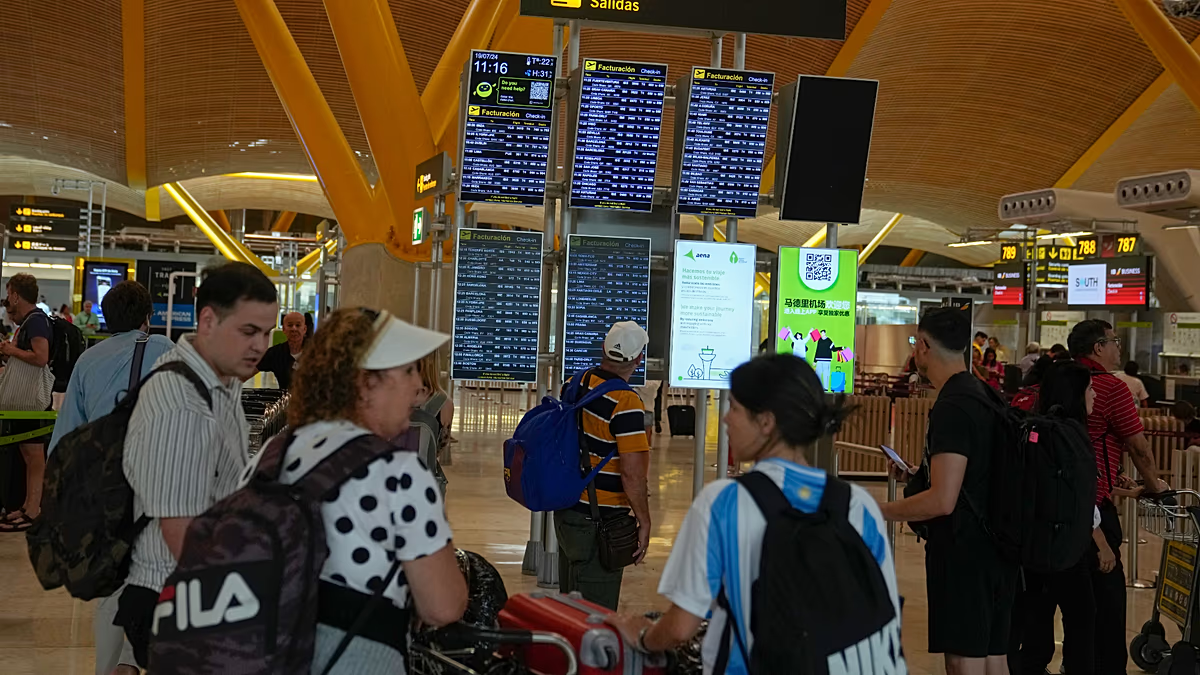
While the economic logic of restoring these paused routes makes perfect sense on paper, the true emotional weight of this aviation revival is felt most acutely by the passengers who stand in the check-in lines. To truly humanize these 568 resurrected flight paths, we must look at the real-world consequences of their long absence on ordinary human lives. When a direct flight route is paused, it does not merely disappear from an airline’s booking application; it tears a literal rip in the social fabric that connects distant communities. For up to a decade, families split across these specific regions were forced to endure grueling, multi-stop itineraries that transformed simple weekend visits into exhausting, wallet-draining marathons of endurance. We must consider the aging grandparent who could no longer face the physical toll of three separate connecting flights just to see a newborn grandchild, or the small-scale entrepreneur whose regional distribution partnership quietly dissolved because face-to-face trust could no longer be maintained over a single afternoon travel window. The triumphant return of these direct routes has acted as an emotional balm for millions of such travelers, replacing the stress of missed connections and lost luggage with the simple, elegant joy of a direct flight. In airport arrival terminals across the globe, the scenes of tears, long embraces, and shared laughter are a direct result of these reinstated pathways, proving that the distance between two points is measured not just in geographical miles, but in the accessibility of the journey, making the restoration of these long-lost routes a deeply personal victory for everyday people.
However, the grand resurgence of these 1,281 routes, and the substantial repatriation of the 568 legacy paths, does not occur in an ecological or social vacuum, and it has brought several complex challenges to the forefront of local communities. For smaller, secondary airports that sat quietly during the years these routes were suspended, the sudden return of daily commercial jet traffic has been a double-edged sword. On one hand, the landing fees, passenger foot traffic, and renewed logistics demands have acted as an economic catalyst, revitalizing nearby hotels, restaurants, and shuttle services that had been struggling to survive on shoestring budgets. On the other hand, the resurrection of these flight paths has reignited fierce debates regarding noise pollution and environmental degradation in surrounding residential neighborhoods. Families who had grown accustomed to quiet skies over the past decade suddenly find themselves waking up to the familiar, roaring baseline of takeoffs and landings, prompting community groups to advocate for stricter curfew hours and quieter aircraft models. From a global perspective, the return of short-haul and mid-range legacy routes also complicates the aviation industry’s ambitious promises to achieve net-zero carbon emissions in the coming decades. It forces passengers, policymakers, and industry leaders alike to grapple with the uncomfortable question of whether we should be mindlessly rebuilding the carbon-intensive transportation systems of the past, or if this transitional era should have been utilized to transition travelers toward high-speed rail networks and green alternative infrastructures. This ongoing friction reminds us that while the recovery of our skies is a marvel of human organization, it must be balanced with a conscientious effort to mitigate its impact on the planet we all share.
Ultimately, the story of these 1,281 routes—and the fascinating revelation that nearly half of them are resurrected pathways from our recent past—serves as a beautiful, poetic metaphor for the broader human journey. It reminds us that humanity is a species defined not merely by its relentless drive to push forward into the terrifyingly unknown, but by its capacity to rebuild, restore, and remember what made us strong in the first place. As we look toward the next decade of air travel, a future that will undoubtedly be shaped by rapid technological leaps in electric aviation, artificial intelligence flight optimization, and shifting geopolitical realities, this period of massive route restoration provides a vital anchor of stability. By grounding their aggressive expansion plans in the proven success of historical corridors, global airlines have demonstrated that the relationships we forged in the past are the very foundation upon which we must build our future. The skies are no longer just a highway of convenience or a playground for the wealthy; they are a living archive of our global interconnectedness, constantly expanding, contracting, and reforming in response to our collective needs. As passengers buckle their seatbelts on these newly restored flights, they are participating in a quiet act of historical continuity, proving that no matter how severe the disruption or how long the silence may last, the human desire to search the horizon, bridge the divides, and find our way back to one another will always triumphant take flight.