





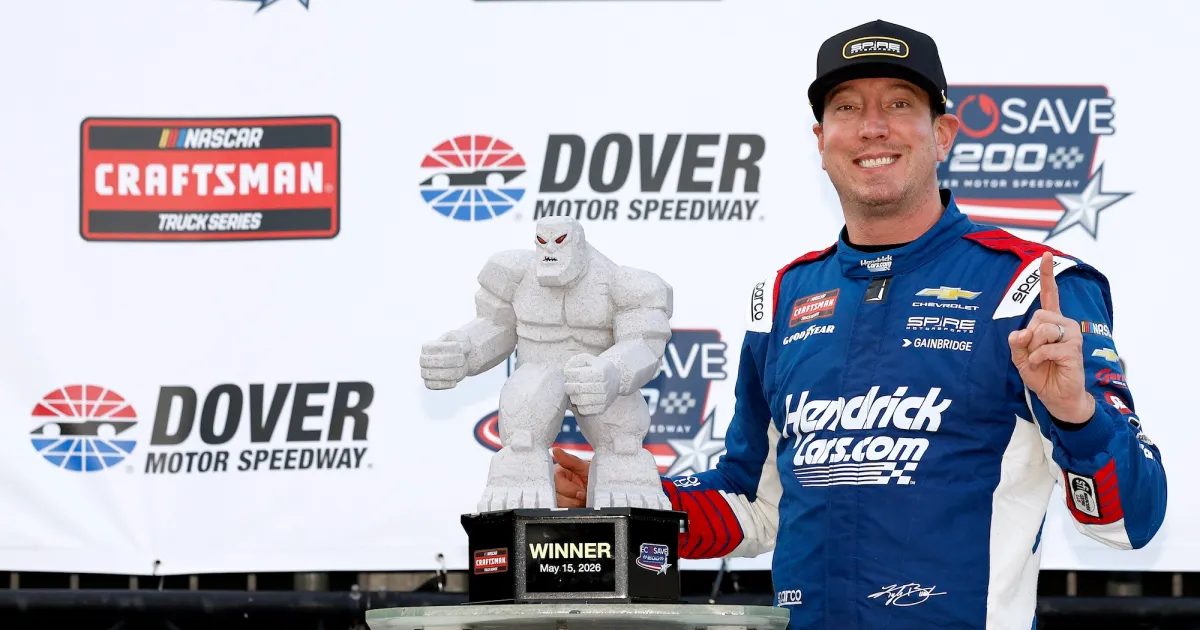
In the high-velocity, high-stakes world of professional motorsports, moments of triumph are fleeting, transient sparks of light that are quickly swallowed by the relentless pursuit of the next race, the next trophy, and the next physical boundary to break. Yet, few moments in the modern era of the sport have carried as haunting, prophetic, and deeply humanized a weight as the final trackside interview given by NASCAR legend Kyle Busch. Standing on the asphalt after a masterfully executed victory in the NASCAR Craftsman Truck Series’ Ecosave 200 on Friday, May 15, the legendary driver was approached by Fox Sports 1 reporter Amanda Busick. Bathed in the post-race adrenaline and surrounded by the deafening hum of celebration, the exhaust fumes, and the cheering crowds, Busick, thirty-nine, asked him a deceptively simple question that would soon reverberate across the global sports community with agonizing significance: “Why do these moments never get old, Kyle?” Busch, a man famously defined by his brash confidence, uncompromising competitiveness, and relentless drive, paused for a moment of raw, uncharacteristic vulnerability and replied with quiet gravity, “Because you never know when the last one is.” At the time, his words were received as the classic, appreciative remarks of an aging gladiator who understood the finitude of athletic dominance; in retrospect, however, they have transformed into a deeply poetic, devastatingly prescient elegy for a life cut short just days later. This sudden, heartbreaking juxtaposition between peak physical performance and the abrupt silence of mortality has left the racing world, and the countless human beings who followed his journey, grappling with a profound, unanchorable sense of grief that transcends the sport itself. It reminds us that behind the flame-retardant suits, the high-speed maneuvers, and the ironclad personas of our sports heroes lie fragile human hearts that are forever subject to the same sudden, unpredictable winds of fate that govern us all. Ultimately, this heartbreaking realization forces fans and observers alike to reconsider the true nature of glory, reminding us that athletic immortality is merely a transient illusion.
The fragile thread of existence was severed with shocking suddenness just days later, tracing a painful arc from athletic glory to an unimaginable medical tragedy. On Thursday, May 21, the devastating announcement was made that Kyle Busch had passed away at the age of forty-one, a mere six days after his final victorious ride. The sequence of events that led to this catastrophic loss began to unfold on Wednesday, May 20, when the champion was reportedly found completely unresponsive inside a racing simulator at the Charlotte Motor Speedway in North Carolina—a high-tech sanctuary where he spent countless hours perfecting the craft that defined his existence, making the location of his collapse both bitterly ironic and deeply tragic. A newly released, chilling 911 emergency call painted a terrifying picture of his final hours, revealing that around 5:30 p.m., Busch was experiencing severe “shortness of breath” and was “coughing up some blood,” indicating a rapid and violent decline in his physical health. Despite the swift intervention of emergency medical personnel and his subsequent transport to a local hospital, the situation deteriorated rapidly, casting a dark, heavy shadow of anxiety over the entire NASCAR community. By Thursday morning, his family issued a brief, tense update stating that he was battling a “severe illness” and would be unable to compete in the highly anticipated weekend race, the Coca-Cola 600. The agonizing suspense culminated that evening when NASCAR officially confirmed the unthinkable, sending massive shockwaves of grief through millions of fans worldwide. Their poignant public statement mourned the loss of a two-time Cup Series champion, describing him as one of the sport’s greatest and fiercest competitors, while extending deepest condolences to his wife Samantha, his children, Richard Childress Racing, and a bewildered motorsports community. This sudden transition from a symbol of peak physical dominance to a patient succumbing to a silent, unseen medical emergency underscores the terrifying fragility of human life, reminding us that no level of athletic achievement or physical strength can shield a person from the suddenness of mortality.
To fully comprehend the magnitude of this loss, one must look beyond the cold, hard numbers of his career, though those statistics alone are staggering enough to guarantee his immediate induction as a first-ballot Hall of Famer. As an iconic two-time Cup Series champion, Kyle Busch was a titan of modern racing, a driver whose sheer talent, tactical aggression, and unmatched tenacity earned him more victories in the Truck Series and the NASCAR O’Reilly Auto Parts Series than any other driver in the sport’s storied history. Yet, the true measure of his humanity lies not in the trophies he hoisted or the records he shattered, but in the domestic sanctuary he built away from the track, where he transitioned from a feared, unyielding competitor into a deeply devoted family man. He is survived by his loving wife, Samantha Busch, who stood by his side through the tumultuous highs and lows of his high-profile career, and their two young children: eleven-year-old Brexton, who was already beginning to follow in his father’s legendary footsteps on the dirt tracks, and four-year-old Lennix, who brought a soft, playful joy to his life. Off the asphalt, Busch was a father who prioritized bedtime stories, school drops, and family vacations over the accolades of his profession, cherishing the quiet, normal moments of parenthood that provided a vital anchor to his chaotic, high-speed public life. The unspeakable tragedy of his premature passing lies heavily in this domestic reality; a young family has been abruptly shattered, a wife has lost her life partner, and two young children must now navigate a complex world without the guiding hand, protective presence, and warm love of their father, leaving an empty seat at the dinner table that no amount of sports legacy, racing trophies, or public adulation can ever hope to fill. For Samantha, who was not just a supportive spouse but his teammate in life, this loss represents the end of an era of shared dreams and deep companionship. Brexton and Lennix must grow up carrying a legendary name, but more importantly, the memory of a father who loved them fiercely.
As the reality of his passing settled over the racing world, a profound wave of tribute and recollection began to pour in, revealing how deeply Busch had impacted even those who spent their entire careers trying to defeat him on the track. Perhaps no tribute captured the complex, humanizing nature of competitive rivalry more acutely than the words shared by his long-time rival, Brad Keselowski. Writing on social media, the forty-two-year-old Keselowski offered a raw, introspective look at the psychological bond that forms between two elite athletes who push each other to the absolute brink of their capabilities. “I made him earn every victory and stole a few from him along the way,” Keselowski candidly reflected, acknowledging the fierce, often tempestuous relationship they shared both in the media spotlight and on the asphalt. He noted that deep down, beneath the public barbs and aggressive driving, there was a quiet, mutual appreciation for the way they forced one another to perform at the absolute highest level of the sport. In a particularly moving and poignant metaphor, Keselowski confessed, “Tonight, I feel a little like the coyote with no more roadrunner to chase,” a sentiment that beautifully humanized the silent dependency of great rivals, who often realize too late how much of their own identity, focus, and drive was fueled by the formidable adversary across the starting line. By turning the focus back to Busch’s family and expressing his deep sorrow for Samantha, Brexton, and Lennix, Keselowski demonstrated how the shared brotherhood of racing ultimately transcends the fierce divisions of the sport, uniting competitors in a collective, humanized grief that recognizes the ultimate value of life, family, and shared history over trophies and race day triumphs. In expressing this deep sense of loss, Keselowski spoke for an entire generation of drivers who understood that while they fought like enemies on the track, they were bound together by a unique, perilous lifestyle that only they could truly understand.
In a similar vein of deeply personal reflection, legendary driver Dale Earnhardt Jr. provided a touching, humanized glimpse into the complex emotional landscape of his relationship with Busch, illustrating the powerful truth that time and maturity can heal even the deepest of professional divides. Earnhardt, fifty-one, openly admitted that they had shared a “really challenging existence for many years,” characterized by fierce professional tension and interpersonal friction. However, in a testament to Busch’s evolving character and inner growth, Earnhardt revealed that it was actually Kyle who initiated a crucial, healing conversation inside his motorhome bus, focusing on the shared vulnerabilities and immense pressures of managing their respective racing teams. This act of mature vulnerability paved the way for a genuine, hard-won friendship, allowing them to participate in joint media appearances where they could look back and laugh together at the dramatic conflicts they had put each other through in their younger years. Most heartbreakingly, Earnhardt shared that they had recently been planning a highly anticipated, nostalgic collaboration, with Busch set to drive Earnhardt’s Late Model car at the historic North Wilkesboro Speedway this upcoming summer. The plans had progressed to the point where they were scheduled to meet the following Thursday for a personal seat fitting at the shop, a meeting where they had spent time laughing over the comedic irony of their historically polarized fan bases being forced to cheer in unison for the very first time. The sudden, permanent cancellation of this future project underscores the tragic arbitrariness of death, leaving Earnhardt profoundly devastated and grappling with a broken heart for the Busch family, while remaining deeply grateful that they had actively chosen the path of reconciliation and warm friendship before their time ran out. In a world where rivalries are commercialized and manufactured, their struggle and subsequent peace was authentic, reflecting the maturity of two men who lived under the microscope of fame. Their reconciliation stands as a powerful reminder that our competitors are often the very mirrors of our own souls.
As the motorsports community prepares to move forward without one of its most defining and charismatic icons, the legacy of Kyle Busch will endure not merely as a collection of record-shattering statistics in the history books, but as a living testament to the burning intensity of the human spirit. He was a highly polarizing sports figure who demanded attention, who raced with a fierce, unapologetic passion that made him both loved and feared, and who ultimately reminded us that the true measure of a life is found in the unyielding devotion we bring to our crafts and our loved ones. The profound mourning expressed by both fierce rivals and close friends alike serves as a powerful reminder of how deeply we are all interconnected, and how the competitive arenas we build to test our limits are ultimately spaces where deep, lifelong human bonds are forged. As the engines roar to life at the next race and the green flag drops, there will be a palpable, heavy silence in the air, a collective acknowledgment of a giant who has left the track for the last time. Yet, the powerful lessons of his remarkable life and the haunting, beautiful clarity of his final trackside words will continue to guide the entire sport and its wonderful people, encouraging everyone to always cherish each victory, to actively mend broken fences, and to hold loved ones close. In the end, Kyle Busch ran his race with an unbridled, magnificent fury, leaving behind a family who adored him, a sporting world that respected him, and a timeless, human reminder that the moments we share are precious, fragile, and never to be taken for granted. We must honor his incredible memory not simply by weeping at the final finish line of his life, but by living every single lap of our own shared earthly journey with the same relentless, beautiful, and uncompromising courage.