





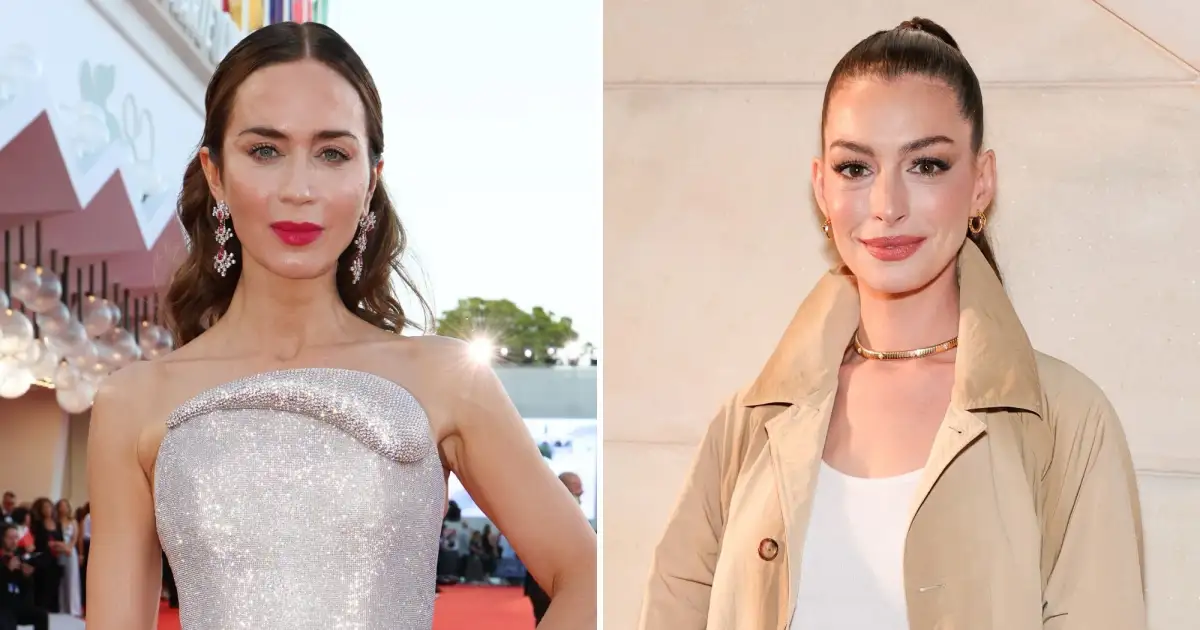
Almost two decades after its theatrical release, the cultural footprint of The Devil Wears Prada continues to expand in ways that the filmmakers could have never predicted in 2006. Recently, during an appearance on Watch What Happens Live, host Andy Cohen presented the charismatic Emily Blunt with a provocative fan question that has been circulating in internet subcultures for years: has her legendary character, the high-strung fashion assistant Emily Charlton, secretly become a lesbian icon? Cohen noted that a massive contingent of the film’s dedicated fanbase has spent years “shipping” Charlton with her on-screen rival and eventual ally, Andy Sachs, played by Anne Hathaway. With her signature warmth, quick wit, and endearing candidness, the 43-year-old Oppenheimer star did not hesitate to embrace the modern theory, immediately delighting the audience by joking that she would absolutely love to explore a romantic storyline with Hathaway in a future installment. Blunt’s enthusiastic response—declaring with a laugh that “there’s a love story there”—not only electrified the show’s live audience but also validated years of creative fan art, fan fiction, and online discourse that has fundamentally reimagined the dynamics of the beloved film. This playful exchange highlighted a larger, incredibly heartwarming phenomenon of modern pop culture, where classic cinematic relationships are continuously reinterpreted through a contemporary lens, allowing audiences to find representation, humor, and deeper human connections in stories that are decades old.
Beyond the initial humor of her response lies a fascinating dynamic that speaks to the real-life bond and deep professional chemistry shared between Emily Blunt and Anne Hathaway. The “enemies-to-lovers” trope is one of the most celebrated and enduring narratives in romantic fiction, and the corporate tension between the hyper-focused, calorie-counting Emily Charlton and the initially disheveled, intellectually distant Andy Sachs provides the perfect, fertile ground for this kind of creative interpretation. During the 2006 film, their relationship evolves from icy contempt and competitive sabotage to a quiet, unspoken mutual respect, culminating in a poignant moment where Emily acknowledges Andy’s unexpected competence in the ruthless world of high fashion. By leaning into the fans’ desire to see this professional friction transform into literal romance in a sequel, Blunt demonstrated an admirable understanding of how modern fanbases interact with media. Rather than dismissing the suggestion as mere internet eccentricity, she embraced it with genuine affection, acknowledging that the underlying emotional tension between the characters is precisely what made their journey so compelling to watch. This open-mindedness reflects a broader, highly endearing trend in Blunt’s career, where she consistently treats her audience’s imagination with respect, understanding that once a film is released into the world, it belongs to the people who love it just as much as it belongs to the creators who made it.
This refreshing conversation on late-night television also allowed Blunt a moment of deep reflection regarding how she originally constructed the character of Emily Charlton, particularly concerning the common perception of her as one of the movie’s primary antagonists. In a deeply humanizing moment of self-analysis, Blunt explained to Andy Cohen that she never viewed her character as a simple, malicious comic-strip villain, but rather as a profoundly vulnerable and desperate individual who had completely anchored her self-worth to the volatile approval of her demanding boss, Miranda Priestly. “I never saw her as a bitch,” Blunt mused, offering a masterclass in character empathy, “I saw her as just desperate, and that person who kind of defines her entire self on their job and their success.” She went on to describe the character as a “delusional lunatic,” but immediately followed up by emphasizing how deeply she felt for her, pointing out the inherent tragedy of spending one’s youth starving and stressing for a corporate machine that would replace you in a heartbeat. Cohen astutely pointed out that it was precisely this undercurrent of vulnerability that Blunt brought to the performance that prevented Emily from being genuinely disliked by the audience. Blunt agreed, pointing out the existential sadness of the character’s life: “She’s tragic though. Think of how empty that life is.” This empathetic approach to acting explains why the character remains so incredibly beloved; Blunt did not play her with cruel intent, but with a frantic, fragile desperation that anyone who has ever felt overwhelmed by professional pressure can deeply understand and relate to.
Blunt’s embrace of her status within the LGBTQ+ community is not a recent development or a convenient public relations strategy, but rather a long-standing pattern of genuine appreciation and demographic awareness that she has voiced for over fifteen years. Looking back at her archival interviews, the actress has historically shown an eagerness to connect with her queer fanbase, playfully predicting her ascent to “gay icon” status as early as 2009 during an interview with The Guardian. In that conversation, she mused on her own experiences growing up, recalling the intense, magnetic “girl crushes” that are so common during adolescence, describing the overwhelming power and cool demeanor of teenage girls that can make anyone feel small yet completely captivated in their presence. By 2014, while speaking with The Advocate, Blunt explicitly recognized that the LGBTQ+ community formed a core pillar of her audience, warmly stating, “I know that’s my demographic… I love it. I think it’s so cool, because one day I hope to be a gay icon.” Her consistent, affectionate acknowledgment of this fanbase over the decades shows a level of comfort and allyship that feels entirely authentic, proving that her recent comments on Watch What Happens Live are part of a continuous, loving dialogue with a community that has championed her career from her very first breakout performances.
The enduring legacy of The Devil Wears Prada and the evolution of its characters carry a profound cultural significance, illustrating how much public attitudes toward careerism, ambition, and gender dynamics have shifted since the mid-2000s. When the movie first premiered, Emily Charlton was largely framed as a cautionary tale of shallow obsession, a girl who cared too much about belts, scarves, and Paris fashion shows, while Andy Sachs was framed as the moral center of the film for rejecting that world. However, modern retrospect has complicated this simplistic binary, with many audiences arguing that Emily was actually a dedicated, hardworking professional who was unfairly treated, and that her intense passion for her industry was entirely valid. Reinterpreting her character as a queer icon fits beautifully into this contemporary shift, transforming her from a punchline about extreme dieting into a complex, resilient, and highly stylized figure of camp and survival in a hostile corporate environment. A hypothetical modern sequel that openly explored a relationship between Emily and Andy would not only be a triumph of fan service, but it would also serve as a profound artistic correction to the often rigid, heteronormative romantic-comedy structures of the early 2000s, showing that two ambitious women can find solace, partnership, and love in one another after surviving the crucible of Runway magazine.
Ultimately, Emily Blunt’s warm and candid nature during her interview serves as a wonderful reminder of why she remains one of Hollywood’s most universally respected and down-to-earth stars. Her journey from playing the frantic, high-fashion assistant in 2006 to earning critical acclaim and an Academy Award nomination for her dramatic work in Christopher Nolan’s historical epic Oppenheimer has been characterized by an unwavering sense of humor, humility, and accessibility. Even as she reaches the absolute pinnacle of cinematic prestige, she remains entirely willing to laugh at herself, engage with her fans’ wildest creative theories, and fondly revisit the comedic role that launched her into superstar status. By validating the “lesbian icon” status of Emily Charlton, Blunt does more than just generate fun internet headlines; she active participates in the joyful process of audience storytelling, demonstrating that the relationship between an actor and their fans is a collaborative, ever-evolving conversation. In a world where celebrity culture can often feel distant, manufactured, and emotionally detached, Blunt’s authentic joy, sharp intellect, and profound empathy shine through, proving that she is indeed the absolute icon her fans have always known her to be.