


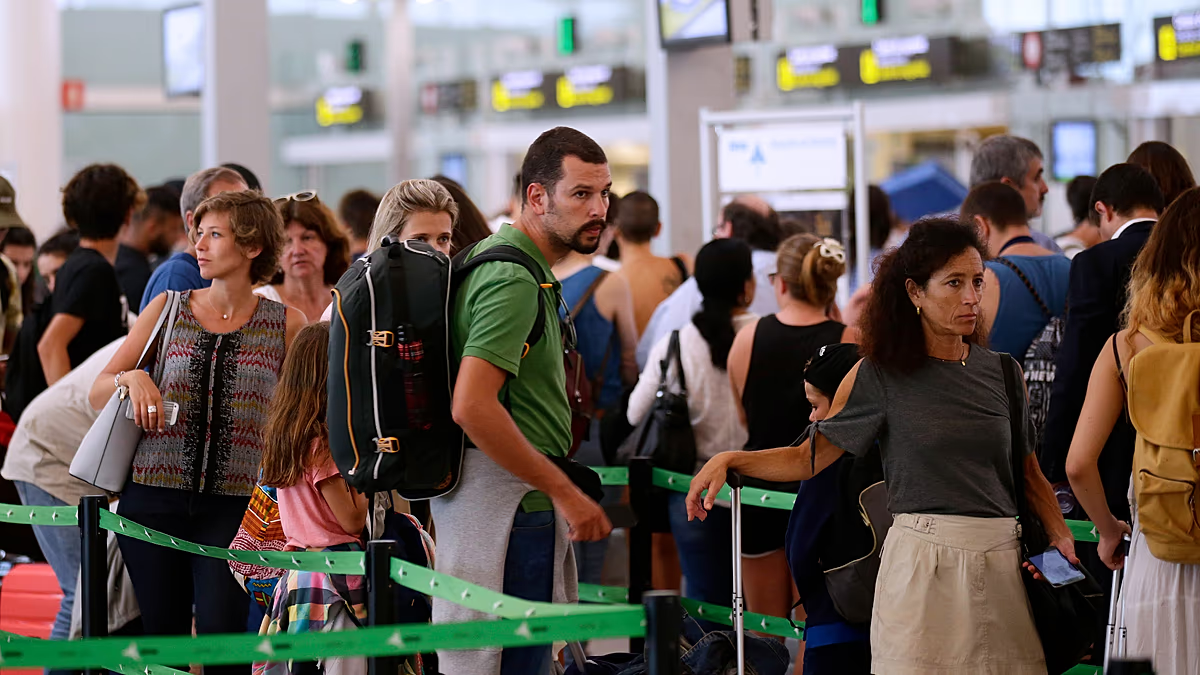
For millions of passengers, the most difficult part of air travel has nothing to do with cramped seats, long security lines, or crowded airports. It is the quiet, churning anxiety that begins long before the plane leaves the ground. For people who are afraid of flying, every announcement at the gate can feel like a warning, every change in the weather can feel like a threat, and every unexpected delay can become a doorway to dread. That is why a new analysis from AirAdvisor is so interesting. The travel assistance company looked at 26 major European air routes and tried to identify which ones are most likely to make anxious passengers feel even more unsettled. The study did not measure safety, and it did not claim that any airline or airport is dangerous. Instead, it focused on the experience of flying: delays, cancellations, weather conditions, and flight duration. According to AirAdvisor’s chief executive, Anton Radchenko, fear of flying is rarely caused by one single factor. “Long waits at the boarding gate, unexpected last-minute cancellations and tricky weather conditions can significantly increase a passenger’s anxiety,” he said. In other words, it is not simply the flight itself that frightens people. It is the uncertainty, the helplessness, and the feeling that events are completely out of their control. For nervous flyers, knowing which routes tend to be more disrupted can be a way to prepare, to plan, and to reclaim at least some sense of control before stepping onto the airplane.
According to the study, the route that generates the most stress for anxious passengers is the one connecting Amsterdam Schiphol with Barcelona El Prat. With a stress score of 75.1 out of 100, this route tops the ranking of the 26 European connections analyzed between September 2025 and August 2026. The numbers behind that score are revealing. More than 7 percent of flights on this route were delayed by over an hour, and nearly 3 percent were cancelled altogether. About 0.83 percent of flights were delayed by more than three hours, which is the kind of delay that can turn a short trip into an exhausting marathon. On top of those disruptions, passengers also have to deal with the weather at Amsterdam’s Schiphol Airport, where fog, wind, and unpredictable conditions can create a ripple effect of chaos throughout the day. For someone who is afraid of flying, this combination can be deeply unsettling. It is not just the fear of turbulence or takeoff; it is the long wait at the gate, the repeated announcements of new departure times, the sight of other passengers looking worried, and the creeping feeling that something is wrong. A delayed flight, especially one delayed for hours, gives an anxious mind too much time to imagine worst-case scenarios. The Amsterdam–Barcelona route is not the longest or the most dangerous route in Europe, but for nervous passengers, it can feel like one of the most emotionally demanding.
The second most stressful route, according to AirAdvisor, is the one between London Heathrow and Amsterdam. It scored 63.8 points, and it had the highest cancellation rate of any route analyzed, with 3.69 percent of flights being cancelled. That may not sound like a huge percentage, but for someone who relies on that flight to get home, to a meeting, or to a holiday, a cancellation is more than an inconvenience. It is a nightmare. The route connects two of the busiest airports in Europe, which means heavy air traffic, crowded terminals, and constant pressure from other delayed and cancelled flights. When something goes wrong at Heathrow or Schiphol, the effects are felt quickly. The other routes in the top ten include Manchester to Dublin, Lisbon to Madeira, Paris Charles de Gaulle to Nice, Oslo to Stavanger, Barcelona to Rome Fiumicino, London Heathrow to Frankfurt, Oslo to Trondheim, and Madrid to London Heathrow. Some of these are short domestic hops, while others are major international connections. What makes them stressful is not necessarily their length or the type of aircraft used. It is the overall experience of unpredictability. A short flight that is cancelled can leave a traveler stranded; a longer flight that is delayed can make a traveler feel trapped. For someone who is already afraid of flying, the route itself becomes associated with anxiety, even if the actual time spent in the air is fairly short.
Spanish travelers and tourists flying through Spanish airports will notice that several connections appear in the ranking. The route between Madrid Barajas and London Heathrow ranks tenth, with a score of 40.8 points. On this route, 3.38 percent of flights were delayed by more than an hour, and 1.15 percent were cancelled. The route between Barcelona El Prat and Rome Fiumicino ranks seventh, with 45.2 points, showing that even popular Mediterranean routes can create stress for nervous passengers. Another connection, between Barcelona and Palma de Mallorca, ranks thirteenth. That route stands out for its delays, with 6.89 percent of flights affected. For Spanish passengers, this is particularly important because these are not only leisure routes; they are also essential links for business travelers, families, and students. A stressful flight between Madrid and London can be especially difficult for a passenger who has to give a presentation or attend an important event after landing. The uncertainty of whether the flight will depart, whether it will be delayed, or whether it will be cancelled can make the entire journey feel like an obstacle course. For anxious flyers, these disruptions are not just logistical problems. They are emotional experiences that can trigger panic, frustration, and even shame. Many nervous passengers feel that they should be able to handle a simple delay, but when the delay is combined with a fear of flying, the emotional weight becomes much heavier.
It is important to understand how the study reached these conclusions. The index used by AirAdvisor took into account cancellations, delays, weather conditions, and journey duration, and then weighted those factors to create a single stress score. The goal was to measure the predictability of a flight, not its safety. That distinction is crucial. A route can be extremely stressful from a passenger’s point of view and still be perfectly safe. In fact, the study did not assess air safety at all. Air travelers should understand that a high stress score does not mean a route is dangerous. It simply means that passengers are more likely to experience disruption, uncertainty, and long waits. For a person who is afraid of flying, this kind of knowledge can be strangely comforting. When you know that a particular route has a higher chance of delays, you can plan your travel accordingly. You can book earlier flights, choose connections with longer layovers, pack extra snacks, download movies, and prepare yourself mentally for the possibility that you might have to wait. According to Radchenko, knowing what incidents have been recorded on a route can help passengers who are afraid of flying to prepare better for their journeys. The idea is not to frighten people by highlighting statistics. The idea is to give them information so that they feel less helpless. Fear often grows in the unknown. When the unknown is replaced by clear, factual information, the anxiety can become more manageable. That does not mean the fear will disappear, but it means the passenger can face the journey with a better understanding of what might happen and why.
Ultimately, the AirAdvisor analysis is a reminder that flying is an emotional experience as much as a physical one. For many people, the fear of flying is not about logic. They may know that air travel is statistically very safe, but their bodies still react with racing hearts, sweating palms, and racing thoughts when they sit in a plane seat. The stress of a delayed or cancelled flight only makes those reactions stronger. This is why it is so important to treat anxious flyers with compassion, and why it is useful to know which routes are more likely to test their patience. If you are someone who feels nervous about flying, especially on a route like Amsterdam–Barcelona or London Heathrow–Amsterdam, you are not alone. Your anxiety is real, but it does not mean you are in danger. You can prepare by checking flight status before leaving home, arriving at the airport early, giving yourself extra time for connections, and telling the cabin crew that you are anxious. You can use breathing exercises, listen to calming music, and remind yourself that disruption is not the same as danger. Every delay you experience is happening to people all over the world, and it is happening in a system designed to keep you safe. The plane will take off when it is ready, and it will land when it is ready, and the discomfort of waiting is temporary. The fear of flying may never fully disappear, but it does not have to control your life. The more you know, the more you can prepare. And the more you prepare, the easier it becomes to remember that even the most stressful route in Europe is still just another journey, and you are capable of completing it.