





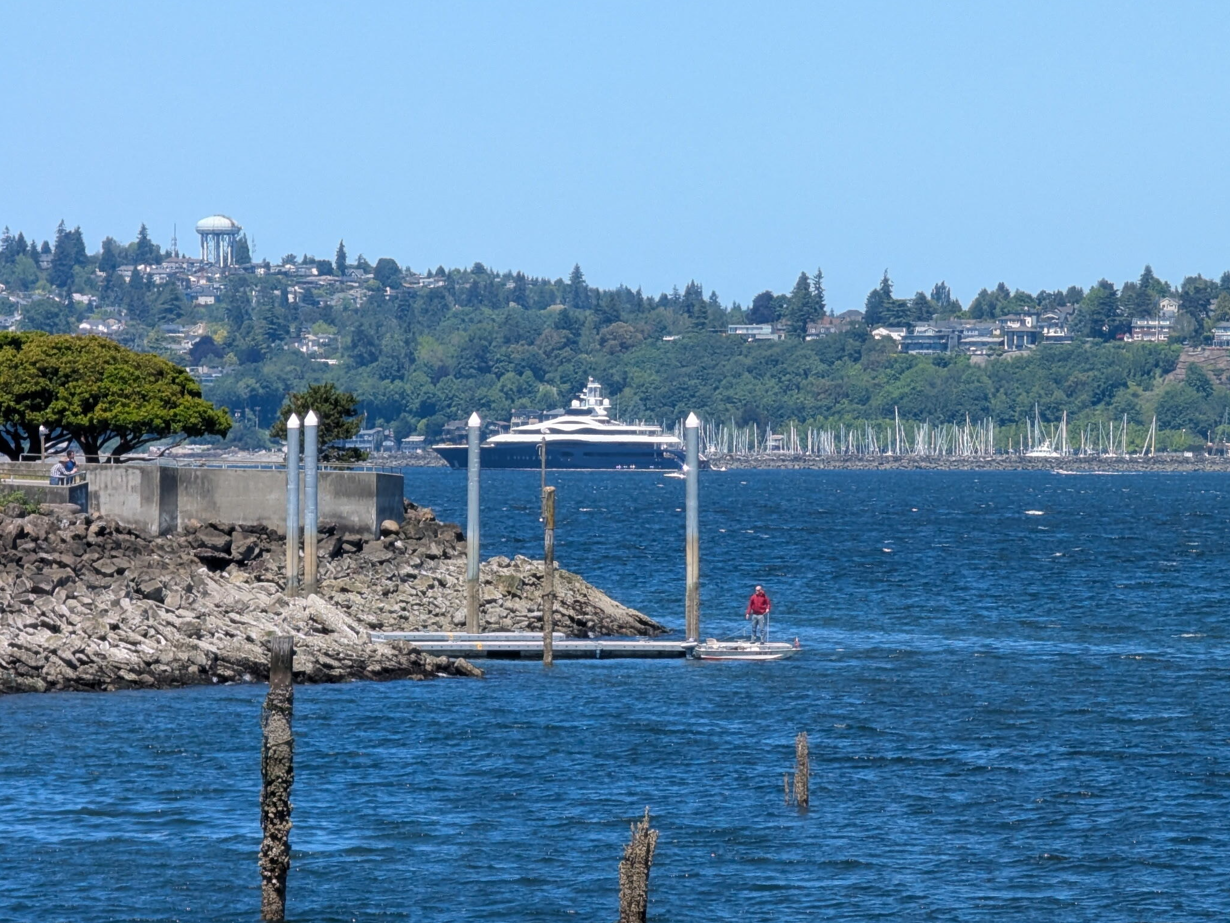
On a quiet, overcast Sunday morning, a massive and deeply controversial vessel made a silent, strategic retreat from the heart of Seattle’s urban center. Mark Zuckerberg’s astronomical superyacht, poetically but perhaps ironically named Launchpad, slipped away from its highly visible anchorage on Lake Union, where it had spent several days drawing intense public scrutiny. For nearly a week, the multi-million-dollar behemoth had served as a glaring, unavoidable centerpiece on the city’s central freshwater lake, attracting a steady stream of curious onlookers, disgruntled tech workers, and passionate local activists who voiced their displeasure through direct heckling and dramatic, glowing protest art on the water—including a memorable floating paper-boat fire sculpture that lit up the night. Seeking a reprieve from this highly localized public anger, the vessel slowly navigated its way back through the historic Chittenden Ballard Locks—a tight, mechanical squeeze for a ship of such immense scale—and quietly transitioned into the deep, saltwater expanse of Elliott Bay. Now riding the gentle, rolling tides of Puget Sound, Launchpad rests in a significantly more isolated and less conspicuous position, anchored more than a mile offshore where the city’s immediate frustrations cannot easily reach its pristine, multi-story hull. The boat currently sits a short distance from Pier 90 and the Smith Cove Cruise Terminal, where its equally imposing shadow-support vessel, Wingman, has been docked since its arrival. By transferring from the intimate, amphitheater-like setting of Lake Union to the vast, open bay, the yacht has successfully placed physical distance between its wealthy occupants and the community it so thoroughly disrupted. Yet, even as a distant silhouette against the grey, moody Pacific Northwest horizon, the towering vessel remains an impossible-to-ignore monument to the dizzying heights of modern tech wealth, symbolizing a strategic retreat of the ultra-rich whenever the heat of public accountability becomes too uncomfortable to bear.
The timing of Launchpad’s grand entry into the waters of the Emerald City could not have been scripted with a more brutal or tone-deaf sense of modern irony. On the exact same Tuesday that the luxury superyacht first glided through the Ballard Locks, Zuckerberg’s corporate conglomerate, Meta, announced a devastating localized economic blow, disclosing plans to lay off nearly 1,400 workers in Washington State. Representing a staggering twenty percent cut to Meta’s local workforce, the layoffs were part of a broader, systemic reduction of roughly 8,000 positions company-wide, leaving thousands of local tech professionals suddenly facing an uncertain and terrifying future. For the engineers, designers, administrators, and support staff who had spent years dedicated to building the platforms that made Zuckerberg a billionaire, the physical presence of their employer’s brand-new corporate trophy moored just miles from their office desks felt like a visceral, mocking betrayal. This stark, heartbreaking juxtaposition transformed what would have normally been a standard, albeit decadent, display of elite status into an emotionally charged lightning rod for community outrage, fueling a storm of frustrated social media posts and shared grief. As families across the Seattle metropolitan area sat around their dining room tables trying to decipher complex severance packages, restructure mortgage budgets, and navigate a suddenly hostile tech job market, they could look out of their windows and see the polished decks of a $300 million playground glistening in the spring air. The profound human cost of corporate restructuring was laid bare against the cold steel of the billionaire’s personal vessel, igniting an outcry of local resentment that manifested in public demonstrations and symbolic burns, proving that no amount of corporate public relations can mask the painful human reality of being cast aside while the executive suite sails away in luxury.
Throughout this entire high-profile maritime saga, both Meta’s corporate communications division and Zuckerberg himself have remained aggressively silent, offering absolutely no official explanation for why the superyacht has taken up residence in the Pacific Northwest. This complete vacuum of official information has fueled a frenzy of local speculation, with many residents and industry analysts playing detective to uncover the true purpose behind the visit. The most prominent and logical theory links the superyacht’s prolonged presence to the upcoming FIFA World Cup matches, with a highly anticipated USA vs. Australia match scheduled to take place at Seattle’s Lumen Field on June 19. With Launchpad positioned as a luxurious, hyper-secure floating fortress and its support vessel Wingman acting as a massive depository for helicopters, personal watercraft, and elite security details, the setup is perfectly optimized to serve as the ultimate, ultra-exclusive VIP basecamp for the global tournament. From this offshore sanctuary, Zuckerberg and an elite roster of hand-selected international guests could theoretically bypass the chaotic urban traffic of Seattle’s streets, commuting securely of their own accord from the bay to the stadium to enjoy the matches in absolute luxury, completely insulated from the ground-level struggles of the city. While using majestic superyachts as self-contained, mobile embassies during major international sporting events has become a staple of the global elite, doing so in a community that is actively mourning the sudden loss of 1,400 middle-class jobs highlights a profound psychological disconnect. By choosing absolute silence over transparency, the meta-billionaire has only deepened the community’s sense of alienation, turning what might have been an exciting international sports visit into a stark reminder of the massive wall of privilege that separates the ultra-wealthy from the average struggle.
To fully comprehend the deep-seated emotional pain and hostility triggered by the yacht’s presence, one must understand the complex, evolutionary struggle that has defined Seattle’s relationship with the tech industry over the past three decades. Long before it became a gleaming, hyper-expensive playground for multi-national technology corporations, Seattle was a rugged, blue-collar maritime city and aviation sanctuary, defined by Boeing machinists, commercial fishermen, and a gritty, independent arts and music scene that prized authenticity over wealth. The rapid, unchecked rise of homegrown tech giants like Microsoft and Amazon, followed closely by the massive influx of Silicon Valley giants like Meta requiring immense local office space, triggered an unprecedented economic boom that brought vast wealth to the region, but also unleashed rapid gentrification, skyrocketing housing costs, and a visible, painful widening of the wealth gap. For many lifelong Seattleites, the sight of Launchpad dominating Lake Union—a historic, beloved waterway once defined by industrial lumber mills, working classic boatyards, and modest, creative floating home communities made famous by films like Sleepless in Seattle—felt like the ultimate, final insult of corporate colonization. It represented a physical manifestation of a city that has seemingly traded its artistic heart and working-class soul for speculative tech capital, only to be abandoned by those very same corporate entities when the market fluctuates. Under the looming shadow of the iconic Space Needle, this clash of cultural identities was beautifully and tragically illustrated on the water, showing a colossal monument of digital wealth physically overshadowing the historic natural landscape, reminding residents of how easily their community’s history and people are pushed aside to make room for the playthings of the world’s richest developers.
This glaring divide highlights a deeply troubling paradox at the very core of modern tech capitalism, one that has been brought into sharp, painful focus by Meta’s highly publicized corporate transition into what Zuckerberg coined the “Year of Efficiency.” Over the last several fiscal years, executive leadership across the tech sector has aggressively championed a philosophy of lean operations, structural downsizing, and massive head-count reductions, arguing to Wall Street that trimming human labor is an absolute operational necessity to foster innovation, streamline development, and fund next-generation investments in artificial intelligence. Yet, as thousands of highly skilled engineers, creative designers, and essential support staff are systematically laid off under the sterile banner of corporate discipline, the personal fortunes of the executives pushing these narratives continue to scale to unimaginable heights, resulting in physical properties of unparalleled luxury. Launchpad, along with its specialized shadow-support ship Wingman, represents a level of wealth that requires tens of millions of dollars in annual maintenance, docking fees, fuel, and crew salaries alone—funds that could easily secure the financial stability of the 1,400 laid-off Washington workers and their families for years to come, or be reinvested in local economic development. The reality that a single billionaire can effortlessly acquire and maintain a custom, high-tech naval armada while simultaneously stripping the livelihoods and healthcare from a fifth of his local workforce exposes the profound ethical systemic rot within the modern digital economy. It illuminates a troubling classic dynamic where optimization is aggressively weaponized to benefit those at the very top, while the human brains that actually construct the digital empires are treated as disposable liabilities on a quarterly balance sheet, leaving communities to bear the true cost of executive excess.
Ultimately, as the evening sun dips below the rugged outline of the Olympic Mountains and casts a warm, golden glow across the rolling waves of Elliott Bay, the distant, silent shape of Launchpad continues to cast a long and deeply complicated shadow over the city of Seattle. For the 1,400 local workers currently polishing their resumes, navigating the confusing bureaucracy of unemployment websites, and trying to explain to their families what the future holds, that glittering yacht floating peacefully offshore will forever remain an indelible symbol of corporate heartlessness of the grandest scale. The ship may have successfully escaped the direct, localized heat of Lake Union’s angry onlookers and creative protest art, but the profound questions of equity, responsibility, and human value it raised cannot be so easily washed away by the tides of Puget Sound. It stands as an enduring, silent monument to a moment when the human cost of digital progress became impossible to ignore, visual proof of the widening chasm between those who build the future and those who simply own it. As Seattle looks out towards the bay, watching the gentle lights of the superyacht twinkle against the dark waters, the community is left to contemplate not just the astonishing scale of Zuckerberg’s personal playground, but the true human cost of the technology that built it. In the end, Launchpad’s quiet departure from Lake Union is not just a tactical shift in municipal coordinates; it is a profound baseline reminder that behind every glittering piece of advanced technology and every astronomical display of wealth, there is an army of real, hardworking human beings whose lives, families, and contributions deserve to be valued far more than the steel, aluminum, and glass of a billionaire’s floating escape pod.