





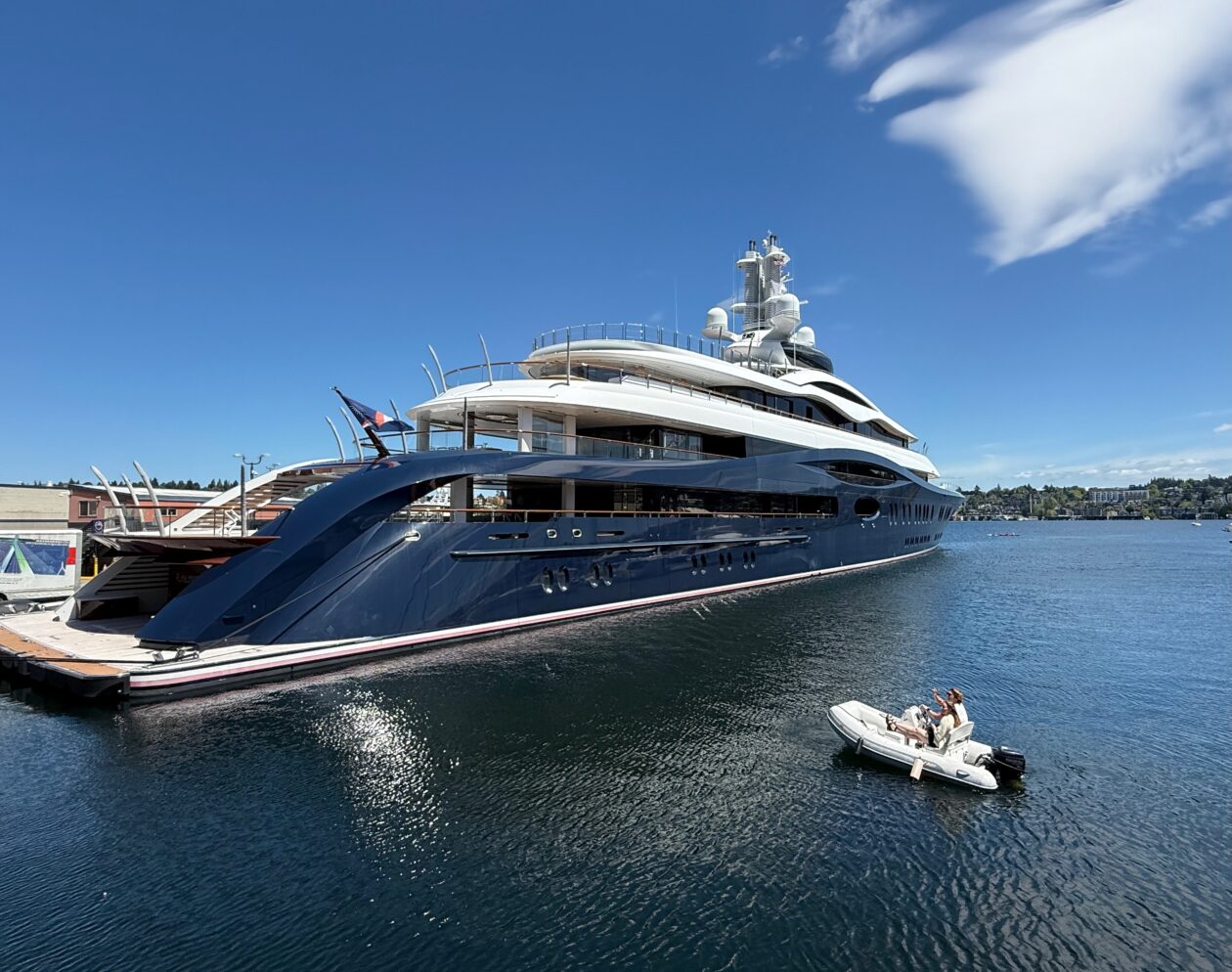
The transition from virtual spectating to real-world observation unfolded on a remarkably bright mid-May afternoon in Seattle, as residents who had spent their mornings scrolling through their social media feeds suddenly found themselves standing on the wooden piers of Lake Union, staring in disbelief at the physical manifestation of the very digital algorithms they engage with daily. Resting majestically in a sprawling, deep-water slip along Westlake Avenue North, Mark Zuckerberg’s newly acquired superyacht, Launchpad, dominated the freshwater basin like an ultra-modern, floating fortress. Valued at an astonishing $300 million and measuring a massive 387 feet in length, the custom Dutch-built vessel presented an imposing combination of midnight-blue steel and gleaming white aluminum that seemed entirely out of scale with the historical houseboats and maritime character of the surrounding harbor. This visual incongruity was not lost on Tony Witek, a seasoned Seattle boat broker who has spent thirty-five years selling watercraft along Lake Union and who openly declared this to be the most colossal private vessel he had ever witnessed on these waters in his entire professional career. Having sold high-end boats topping out at ninety feet, Witek gazed up at the towering multi-deck structure, describing it not as a mere yacht, but as a personal cruise ship of unprecedented luxury and architectural ambition. To Witek, the vessel represented an astronomical financial realm, joking that if he could commission a single sale of this magnitude, he could immediately abandon the brokerage business and comfortably drift into a permanent, luxurious retirement. For the crowds gathering on the shoreline, the vessel was more than just an engineering marvel; it was a physical monument to the immense wealth generated by the modern digital age, drawing a steady stream of curious onlookers who were eager to see if the virtual empire could be reconciled with physical reality, transforming a casual Wednesday stroll into a fascinating sociological study.
As the midday sun warmed the Seattle air, the pedestrian and bicycle trail wrapping around the western shore of Lake Union morphed into a bustling, slow-moving gallery of curiosity and collective wonder. The standard rhythm of lunchtime joggers, power-walking tech workers, and casual cyclists ground to a halt at a crowded pinch point where the best views of Launchpad could be secured, and the air filled with the sounds of snapping camera shutters, laughter, and animated chatter. On the water itself, the spectacle became even more intimate, as a fleet of humble watercraft sought to measure themselves against the giant; kayakers in plastic hulls, paddleboarders balancing precariously with smartphones in hand, and small dinghies drifted within whispering distance of the yacht’s sleek hull. This close-range fleet of onlookers was quickly met with the watchful eyes of private security personnel stationed on the dock, who firmly but politely signaled for the curious boaters to maintain a safe and respectful distance from the billionaire’s property. Even the commercial traffic of the lake succumbed to the gravitational pull of the vessel, as the classic Argosy Cruises sightseeing boat visibly slowed its engine during its route to give tourists a lingering look at the towering bow, while electric rental boats spun in slow, mesmerized circles below the towering decks. People held up their phones to FaceTime friends and relatives across the country, eagerly pointing their cameras toward the sky to capture the scale of the ship against the background of small seaplanes taking off into the blue. This spontaneous gathering highlighted a profound human instinct to witness the extraordinary up close, transforming a simple walk by the lake into a community event centered around awe, curiosity, and the simple desire to say, “I saw it with my own eyes.” Many stared in absolute silence, admiring the polished finish of the hull as it caught the warm afternoon light, capturing memories of a truly singular maritime event.
However, the arrival of Launchpad was cloaked in a layer of profound irony and architectural dissonance that left a bitter taste in the mouths of many local observers. The vessel slipped through the historic Ballard Locks and entered Lake Union on a Tuesday evening, arriving almost doors-away from the somber announcement that Meta was cutting nearly 1,400 technology and administrative jobs across Washington state. This sharp contrast between the acquisition of a $300 million luxury plaything and the sudden loss of livelihood for hundreds of local families cast a somber shadow over the yacht’s glistening exterior, turning what might have been viewed as a technological triumph into a controversial symbol of corporate disconnect. Standing on the lake’s edge, Tim Peterson, a resident of nearby Renton, expressed a sentiment shared by many when he noted that the timing of the vessel’s grand entrance felt remarkably insensitive, suggesting that the vessel should have remained anchored out in the deeper waters of Puget Sound until the emotional dust of the corporate layoffs had settled. Peterson, who joked that his financial reality would limit him to a simple inflatable dinghy rather than a superyacht, pointed out that while he does not use Facebook, his frequent activity on Meta’s Instagram platform made him feel as though he had personally contributed a few pennies toward the ship’s construction. His humor quickly gave way to a deeper, more poignant critique of modern society, as he lamented the yacht as an aggressive symbol of systemic excess in a time when so many individuals struggle to secure basic human needs like affordable housing, food, and accessible healthcare. Peterson’s perspective highlighted the growing friction between the celebration of unfettered entrepreneurial success and the harsh realities faced by the working class, illustrating how easily a beautiful object can become a lightning rod for societal frustration, reflecting the uneasy balance between massive corporate wealth and local community struggles.
The physical presence of the yacht also attracted a quiet contingent of Meta’s own employees from the company’s nearby South Lake Union offices, who slipped away from their desks during lunch to gaze upon the monument owned by the man who controls their daily workflow. Two software engineers stood quietly on the trail, studying the massive scale of the ship with a mixture of professional fascination and quiet detachment, noting with a sense of resignation that looking at the ship was a stark reminder of what it truly means to labor within a massive global conglomerate. Fearing direct professional retaliation and the very real prospect of being terminated, both workers insisted on absolute anonymity before sharing their thoughts, their caution underscoring the delicate power dynamics that exist within the high-stakes world of modern big tech. Nearby, Steven Redpath, a retired Boeing employee, paused his bicycle ride to offer a historical perspective on corporate behavior in the Pacific Northwest, recalling the era when the iconic aerospace giant owned its own corporate entertainment yacht, the Daedalus. Redpath observed that Boeing eventually sold their vessel for a fraction of Launchpad’s cost in an effort to clean up their corporate image and redirect resources, drawing a sharp contrast with the unapologetic display of wealth currently docked in the harbor. Pointing an accusing finger toward the towering structure of Launchpad, Redpath argued that while the local community continuously struggles to fund public transit and find workable solutions to the region’s ongoing homelessness crisis, the existence of such extreme private assets suggests that modern capitalism has strayed far from its intended course. To him, the yacht was a glaring symptom of a system run amok, representing a departure from the civic-minded capitalism that once defined the industrial growth of the region, emphasizing the growing disconnect between corporate elites and the general public.
While the owner of the vessel was nowhere to be seen, the day-to-day operations required to maintain such an immense asset were fully visible to the onlookers gathered on the Westlake docks. A team of dedicated deckhands in uniform could be seen scurrying across the various levels of the ship, unloading a seemingly endless stream of cardboard boxes from a U-Haul rental truck parked directly on the pier, preparing the vessel for its mysterious stay in the Emerald City. Other crew members worked diligently under the warm sun, using specialized cleaning equipment to scrub and wipe down every square inch of the pristine hull, illustrating the constant, invisible human labor required to preserve the immaculate facade of extreme wealth. The vessel’s stern proudly displayed the flag of the Marshall Islands, a detail that did not escape the attention of several economically minded observers who pointed out that such registrations are commonly utilized by the global elite to navigate complex tax regulations and minimize financial liabilities. Gurneet Takhar, an estate planning attorney who made a special trip to the lake to view the ship, analyzed the yacht through her professional lens, describing it as an incredibly complex and fascinating asset class that only a tiny fraction of a percent of the global population could ever hope to manage. Even as some real estate brokers dismissed the ship’s design as “ugly” and complained about the chilling effect that recent tech layoffs have had on the local housing market, the physical activity on the docks served as a reminder that even the most automated digital fortunes still rely on a foundational layer of human labor, logistics, and legal maneuvering to exist in the physical world. The ongoing activity on the waterfront dock reinforced the reality that behind every massive digital empire lies a network of physical labor and strategic financial structures needed to sustain such a monumental, luxurious standard of living.
Despite the heavy geopolitical and economic debates swirling around the vessel, a sense of simple, unadulterated human wonder managed to break through the cynicism, finding a champion in people like Ava Pappas. Pappas, who was drawn to Lake Union after spotting a photo of the yacht on her aunt’s Instagram story, is the founder of a popular local running group called the Cool Down Running Club, which regularly traverses the scenic trails connecting South Lake Union and the Fremont Bridge. Seeing Launchpad in person left her utterly starstruck, and she immediately decided to alter her running group’s planned route for that evening so that dozens of local runners could share in the awe-inspiring sight of the megayacht up close, turning their weekly exercise into a memorable adventure. For Pappas and many other onlookers, the ship represented a breathtaking summit of human engineering and design—a beautiful, near-mystical object that deserved to be appreciated purely for its aesthetic grandeur and the incredible craftsmanship required to construct it. As floatplanes roared overhead, taking off from the sparkling waters of the lake and climbing into the sky above the yacht’s towering mast, the scene captured the true essence of contemporary Seattle: a place where cutting-edge technology, natural beauty, industrial history, and stark social contrasts all occupy the same narrow geographic space. Ultimately, Launchpad’s visit to Lake Union served as a temporary, floating mirror held up to the city, reflecting back both the dizzying heights of human achievement and the profound social questions that continue to define our modern era, leaving every observer to decide for themselves whether the ship was a dream of what could be, or a symbol of what needs to change. Ultimately, its spectacular presence sparked dialogues about structural design, resource distribution, and the actual role of billionaire entrepreneurs in a rapidly shifting economic landscape, highlighting how one magnificent boat can successfully stir both child-like wonder and deep societal reflections.