


The raw energy of early-stage entrepreneurship has a distinct feel, particularly when it flows through the halls of the University of Washington during the annual Dempsey Startup Competition. Now in its twenty-ninth year, this celebrated event has evolved from a regional showcase into a high-stakes arena where the most promising collegiate minds from Washington, Oregon, Idaho, Alaska, and British Columbia gather to pitch ideas that could rewrite the future of industry, medicine, and environmental science. This year’s contest drew a record-breaking 186 applications, representing a diverse cohort of students ranging from those clutching raw, late-night sketches of a prototype to teams possessing refined, market-ready technologies. Over a rigorous seven-week crucible, these aspiring founders were pushed to stress-test their ideas, conduct intense market research, and recruit business-minded peers to turn academic theories into viable go-to-market strategies. By the time the dust settled, sixteen finalists found themselves stepping into mock boardrooms to pitch their visions before panels of veteran judges. The atmosphere at the final awards ceremony in Seattle on May 21st was electric, a celebration of young innovators who are increasingly turning to advanced technologies like artificial intelligence to solve some of humanity’s most stubborn, real-world problems.
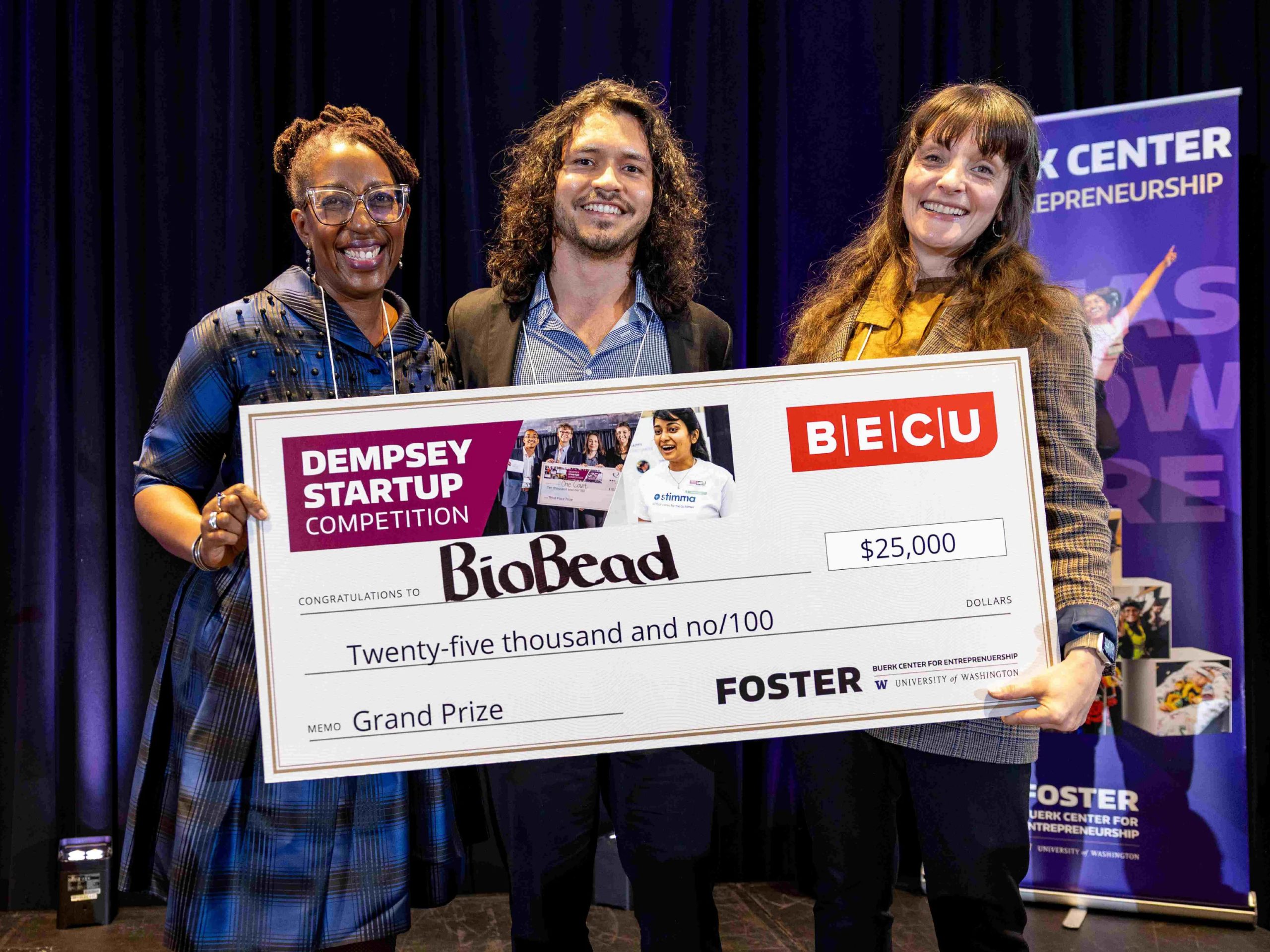
At the very top of this year’s competitor class stood BioBead, an agricultural technology startup that captured both the prestigious $25,000 Grand Prize, sponsored by the BECU Foundation, and the $2,500 Voyager Capital Best Business to Business Idea Prize. BioBead’s mission is centered on a resource that is as vital as it is routinely ignored: the soil beneath our feet. Modern conventional farming has long relied on synthetic chemical fertilizers to force high yields from tired ground, a practice that frequently leads to chemical runoff, degraded soil ecosystems, and skyrocketing operational costs for hard-working farmers. BioBead addresses this systemic crisis by manufacturing tiny, completely biodegradable pellets designed to harbor a powerful, natural partnership. These pellets encapsulate specific strains of beneficial bacteria and fungi that have naturally coexisted in forest and field soils for over four hundred million years. Once introduced to agricultural fields, the pellets slowly bio-degrade, releasing these microscopic allies directly into the rhizosphere where they help plants naturally absorb crucial, life-sustaining nutrients like nitrogen and phosphorus. By working with the earth’s natural biological machinery rather than against it, BioBead offers direct relief to farmers struggling with the compounding realities of climate change and shifting global markets.
The heart of BioBead lies in its highly collaborative, interdisciplinary founding team, illustrating how academic research can successfully transition from the isolation of laboratory benches to the mud of real-world crop fields. The startup’s scientific foundation was built by Dr. Korena Mafune, a dedicated UW research scientist who has spent years investigating the complex, unseen relationships within forest soils, alongside co-founders Renee Davis, a doctoral candidate at UW, and Dr. Mari Winkler, an associate professor in civil and environmental engineering. To bridge the gap between complex microbiology and commercial reality, they invited Jared Espinosa, a recent MBA graduate from the UW Foster School of Business, to join the team for the competition. Mafune notes that most people are profoundly disconnected from the subterranean ecosystems that keep our planet alive simply because they cannot see them. To prove their technology’s value to those who do work the land, the BioBead team has been actively collaborating with local farmers to test their pellets on staple crops including lettuce, tomatoes, corn, and wheat. The real-world trials have yielded highly encouraging outcomes, demonstrating noticeably higher crop yields while simultaneously reducing the farmers’ reliance on expensive synthetic fertilizers. This immediate real-world promise was further validated when Mafune secured a generous $275,000 grant from the Washington Research Foundation to aggressively fund the commercial scale-up of their biological soil treatments.
While BioBead focused on feeding the planet, the second-place winner looked to save human lives in the terrifyingly brief windows of medical emergencies. CPRight, a joint venture between students at the University of Washington and the Western University of Health Sciences in Oregon, took home the $15,000 WRF Capital Second Place Prize along with the $2,500 Chris and Barbara Petersen Best Health & Wellness Impact Idea Prize. During a sudden cardiac arrest, every passing second without proper blood flow dramatically decreases the chance of survival, yet bystanders and even trained medical professionals often struggle to deliver effective cardiopulmonary resuscitation (CPR) due to adrenaline and panic. CPRight has address this critical vulnerability by developing a low-cost, smart patch that can be applied during a cardiac crisis. The patch provides immediate, real-time auditory and visual feedback regarding the precise depth and pace of chest compressions, ensuring that the person administering CPR maintains the life-saving standards required to keep a patient alive until paramedics arrive. By stripping away the guesswork and anxiety from emergency medical care, CPRight democratizes high-quality emergency response, offering a simple, affordable tool that could easily be kept in schools, offices, homes, or public transit hubs to save countless lives.
Further highlighting the medical innovations of this year’s competition was the third-place winner, Kinnex Health, originating from the University of Idaho. The team walked away with the $10,000 iSpot.tv Third Place Prize as well as the $2,500 Amazon Best Consumer Product Idea Prize for their sophisticated wearable sensor system. For patients undergoing major orthopedic operations, such as knee or hip replacements, the road to recovery can be a long, painful, and deeply uncertain journey. Patients often worry about whether they are moving too much or too little, while physical therapists struggle to track a patient’s precise movements outside of scheduled clinical visits. Kinnex Health’s wearable device continuous tracks and collects joint-movement data throughout the recovery process, sending this vital information directly to healthcare providers. This constant feedback loop empowers patients to confidently manage their rehabilitation while allowing physical therapy plans to be tailored to actual recovery metrics. On the safety and personal security front, the University of Washington’s Alarmable captured the $7,500 Friends of the Dempsey Startup Fourth Place Prize. Alarmable has created an elegant, discreet bracelet charm that doubles as a high-decibel personal panic alarm. Intended to blend seamlessly into everyday jewelry, the charm can be instantaneously triggered in a dangerous situation, offering peace of mind to students, late-shift workers, or anyone navigating vulnerable public spaces alone.
Beyond the prominent top four podium spots, the Dempsey Startup Competition distributed a host of specialized category prizes, reflecting a generation of student innovators deeply committed to ethical progress and community-minded business models. The $5,000 Wilson Sonsini Social Impact Prize was awarded to Osanwe Link, while the $5,000 Kathryn Gardow & David Bradlee Climate Solutions Prize went to LEAF, highlighting the enduring student focus on environmental remediation. Adam Biotech took home the $5,000 Glympse Emerging Tech Prize, and the $2,500 Smukowski Family Best Sustainable Business Prize went to Clubless Collective. Other notable creative ventures included Kindred, which won the $2,500 eBay Best Marketplace Idea Prize; Emerald Dynamics, which claimed the $2,500 Perkins Coie Best Innovation/Technology Idea Prize; and UWEMS, which was awarded the $2,500 Saara Romu Community Impact Prize. Representing Canadian ingenuity, GridGuard from the University of British Columbia claimed the $2,500 DLA Piper Best Idea with Global Reach Prize. Taken together, the 2026 Dempsey Startup Competition proved to be far more than a simple academic exercise or business pitch contest. It served as a powerful showcase of human empathy, technical brilliance, and regional collaboration, proving that when young minds are given the resources, mentorship, and platform to solve the problems they care about, they can cultivate solutions that protect our soils, safeguard our bodies, and strengthen our global communities.