


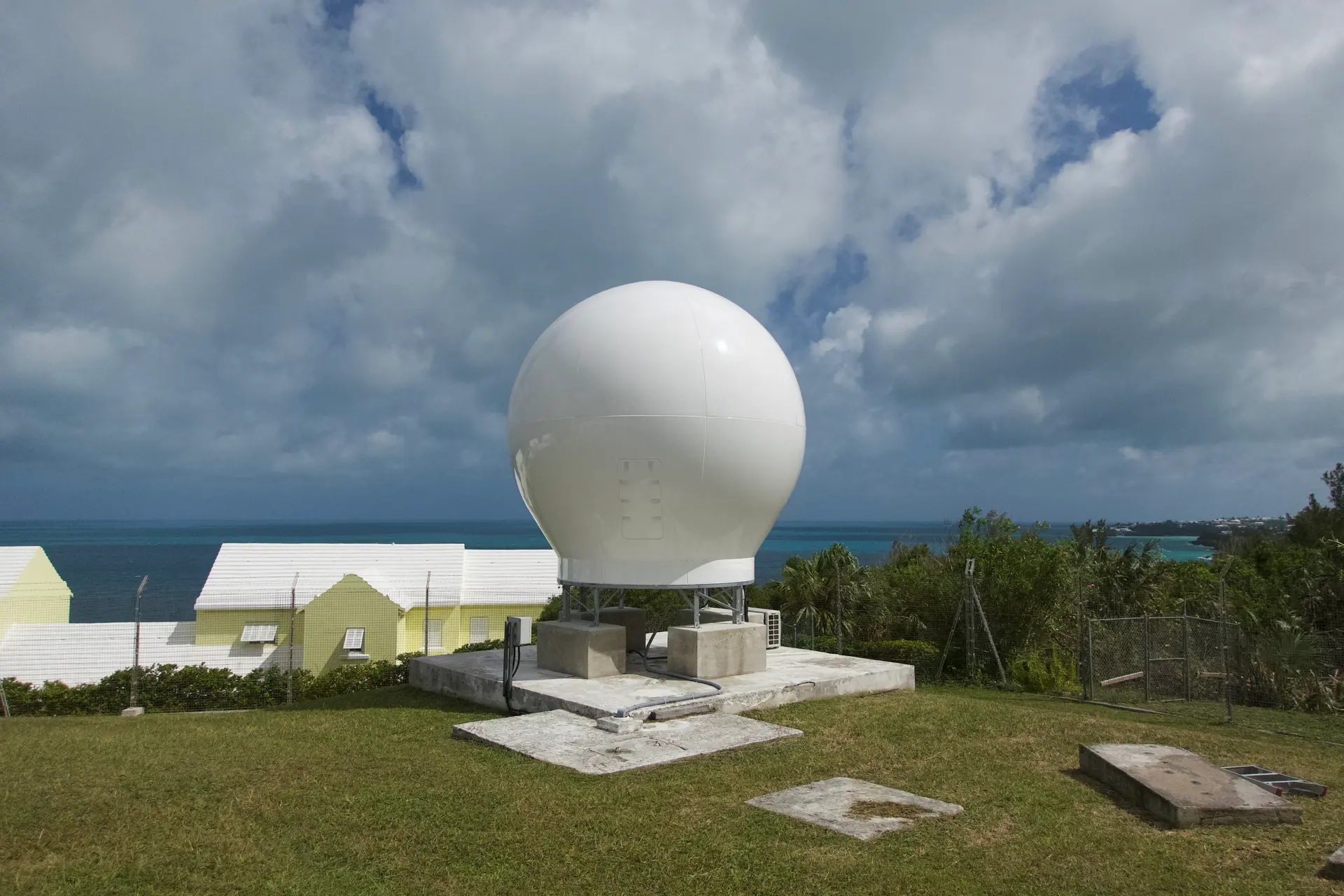
In the vast, silent expanse of space, every satellite is essentially a lonely whisperer. It transmits data, images, and telemetry down to Earth, but those signals are utterly useless unless someone is listening. For decades, that “someone” meant either building your own dedicated ground station or buying expensive, fragmented access to scattered antennas controlled by different entities. This logistical headache has always been one of the most underappreciated bottlenecks in space exploration. That is precisely why Jeff Bezos’ Blue Origin is making a strategic, quiet, yet monumental move to change the game entirely. Fresh off a series of successful tests, Blue Origin has just announced the operational status of the first three nodes of their ambitious global communications network, a project aptly named “Quartz.” These initial ground stations, situated in the idyllic island territory of Bermuda, the rugged landscapes of New Zealand, and the expansive outback of Australia, represent the foundational bricks of a planned global grid. According to the company, this is just the tip of the iceberg; they intend to have nine of these strategically placed sites fully operational and listening by the end of the year, laying the groundwork for their own sprawling commercial and national security missions in Earth’s orbit and far beyond it.
Why such an ambitious undertaking? To understand the gravity of this announcement, you have to step into the shoes of a mission planner. Previously, coordinating communications for a space mission meant dealing with a patchwork of incompatible systems, each with its own pricing model, its own operational quirks, and its own logistical constraints. It was, as Tory Bruno, Blue Origin’s President of National Security, aptly put it, “one of the most fragmented and costly elements of space operations.” Whether you are a commercial startup launching a constellation of small imaging satellites, a civil agency sending a probe to the Moon, or a national security asset tracking critical threats, the cabling and antenna infrastructure on the ground is often the weak link in the chain. The genius of the Quartz network is that it treats this problem holistically. Instead of forcing customers to build or buy access to incompatible facilities, Blue Origin is constructing a single, fully integrated, fully owned terrestrial backbone. In the opening phase, these sites are equipped with 3.7-meter aperture antennas that operate on the S-band and X-band frequencies—the workhorses of modern low-Earth-orbit satellite communication. These bands are perfect for primary telemetry, tracking, and command functions, ensuring that payloads and spacecraft are safely managed as they zip around the Earth at 17,500 miles per hour.
However, the initial phase is merely a teaser for the ambitious scale of the endgame. Blue Origin recognizes that failing to plan for the future is planning to fail, so the Quartz network has been architected with massive extensibility in mind. The next wave of installations, which are already in the design and procurement stages, will feature significantly larger 9-meter aperture antennas. These behemoth dishes will support a much broader spectrum of frequencies, including L-band, S-band, X-band, and the millimeter-wave Ka-band. These aren’t just for the satellite operators of today; they are built for the missions of tomorrow. These large antennas will provide the necessary bandwidth and power to support missions operating in geostationary orbit, those venturing into the cislunar space between the Earth and the Moon, and even ambitious deep-space probes destined for Mars, the asteroid belt, and beyond. With these high-powered dishes, Quartz will essentially act as the long-distance hotline for humanity’s footprints beyond the planet. The beauty of this infrastructure is that it provides economies of scale—one interface, one operations team, and transparent pricing models—that can streamline the entire industry, making it easier for smaller players to access high-end capabilities that were once exclusively within the grasp of superpowers or trillion-dollar corporations.
To accelerate this complex global buildout, Blue Origin didn’t have to reinvent the wheel when it comes to land acquisition and installation logistics; instead, they brought in a trusted partner with a proven track record. That partner is RBC Signals, an 11-year-old tech firm based in Redmond, Washington. This collaboration is a perfect example of how a massive, vertically integrated company like Blue Origin can leverage the agility and expertise of a specialized player. RBC Signals is handling the nitty-gritty, painstaking work of site surveys—a task that involves navigating local environmental regulations, ensuring radio-frequency interference is minimized, and physically installing massive antennas in remote and often unforgiving locations. As RBC’s antennas are deployed for Blue Origin, they will be plugged into RBC Signals’ pre-existing Global Ground Station Network, creating a combined global mesh. This setup is incredibly efficient; any unused capacity on these new antennas will be seamlessly marketed and made available to RBC’s other commercial customers. Ron Faith, the CEO of RBC Signals, framed the partnership beautifully in the official announcement, noting that Blue Origin’s ambitious vision aligns perfectly with his company’s core mission of delivering reliable, flexible, and innovative communications solutions. He specifically underscored the resilience of the combined network, which creates a robust, fail-safe system ensuring that no single geographic or weather event can knock out connectivity entirely.
There is a fascinating nuance to this deal that requires a bit of corporate clarity, particularly for those who remember that Blue Origin and Amazon Web Services (AWS) share the same founder, Jeff Bezos. In the past, RBC Signals collaborated closely with AWS Ground Station to provide satellite operators with low-latency access to the cloud. Some industry insiders might have assumed that the Quartz network was simply a rebranding or a sub-network of that older AWS partnership. That is definitely not the case. Ron Faith took great care to clarify that the Quartz ground network is entirely independent of the AWS Ground Station network, just as Blue Origin itself is an independent entity from AWS. Rather, RBC Signals is a marriage broker of sorts within the space industry, working simultaneously with multiple ground networks globally—including the new Quartz nodes and the AWS network—to offer clients the best coverage options. This independence is a strategic choice for Blue Origin, allowing them to maintain their unique security architecture and tailor the network specifically to the demanding requirements of national security missions, which require absolute data sovereignty and strict compliance protocols. It also sends a clear message to the market: Blue Origin is not just about rockets, but about building the entire infrastructure ecosystem needed for space, regardless of its sibling cloud monopoly.
While the new ground network represents Blue Origin’s “brains” for space operations, the company is simultaneously beefing up its physical “muscle” on the launch pads. The company has broken ground on a second launch pad at Cape Canaveral Space Force Station in Florida, known as Launch Complex 36B. This is a direct response to the ever-increasing demand for launch cadence. The construction of 36B is designed to work in perfect tandem with the existing Launch Complex 36A, which is currently being entirely rebuilt following substantial damage sustained during a catastrophic rocket explosion in May. The logic behind having two pads is pure engineering efficiency: Launch Complex 36A will be assigned to the company’s standard New Glenn 7×2 rockets, while the brand new B pad will be exclusively dedicated to hosting the heavier, beefed-up New Glenn 9×4 variants. Having multiple pads at one complex allows Blue Origin to perform quick turnarounds, essentially doubling their operational capability and ensuring that a setback on one pad doesn’t halt the entire launch manifest. It showcases a commitment to scale that rivals the tenacious scrappiness of their biggest competitor, SpaceX, albeit with a slightly different approach to vertical integration. The erection of massive launch towers and flame trenches is a spectacular sight, signaling to the industry that Blue Origin is no longer just a research and development project but a full-fledged, high-throughput launch provider.
Of course, no journey into the final frontier is without its fiery setbacks, and Blue Origin is currently navigating one of the most challenging periods in its flying history. The previously mentioned explosion in May, which caused the damage to Pad 36A, was a violent check on the company’s momentum. In a stark and candid admission, Blue Origin CEO Dave Limp took to social media to reveal the root cause of the anomaly: a failure in the main oxygen valve located on one of the booster’s powerful BE-4 engines. This kind of diagnostic transparency is vital in the aerospace industry, where failure is simply a data point on the way to success, but it doesn’t erase the sting of delay. All New Glenn launches remain suspended while the investigation and thorough corrective actions are being completed. The public exchange that followed Limp’s post was telling—Elon Musk, the CEO of SpaceX and a frequent rival of Bezos, replied with a simple, sincere, “Hope you get back to flight soon.” That moment of crossed wires between the two billionaires highlighted a simple truth: the physical difficulty of spaceflight unites everyone who works in it, regardless of their corporate colors. The pressure is immense to get the investigations right, because a returning-to-flight schedule is entirely dependent on the safety of that oxygen valve fix, but the infrastructure buildout—from the Quartz network to the new pads—shows a stubborn, long-term commitment to the mission.
Looking further ahead, Blue Origin’s ambition extends directly onto the mainland. According to a report by the Austin Business Journal, the company is scouting locations in both Texas and Florida for a colossal new facility, rumored to be a staggering $650 million investment encompassing a sprawling 1.3-million-square-foot manufacturing, logistics, and research-and-development complex. The sheer scale of this project speaks volumes about the company’s confidence in its future payload volume. It is not enough to just have the rockets and the communications network; they need the factories to produce the hardware, the warehouses to store the parts, and the labs to iterate on new designs at scale. City officials in Hutto, a charming Austin suburb, have reportedly already approved a robust set of economic development incentives to entice Blue Origin to build there, sparking a competitive bidding war between the two states. This expansion signals an industrial revolution in the space sector. For the people of Hutto or the communities in Florida, this means high-paying jobs in STEM fields, engineering, and advanced manufacturing. For Blue Origin, it means having the industrial horsepower to support a future where space travel is routine, not exceptional. As the ground antennas watch the skies in Bermuda and the new launch towers rise in Florida, the echo of hammers on factory floors in Texas represents the final puzzle piece in Bezos’ grand vision of humanity becoming a multiplanetary species—a vision that now requires not just rockets, but a fully operational, interconnected ecosystem of listening ears, manufacturing capacity, and unyielding perseverance.