





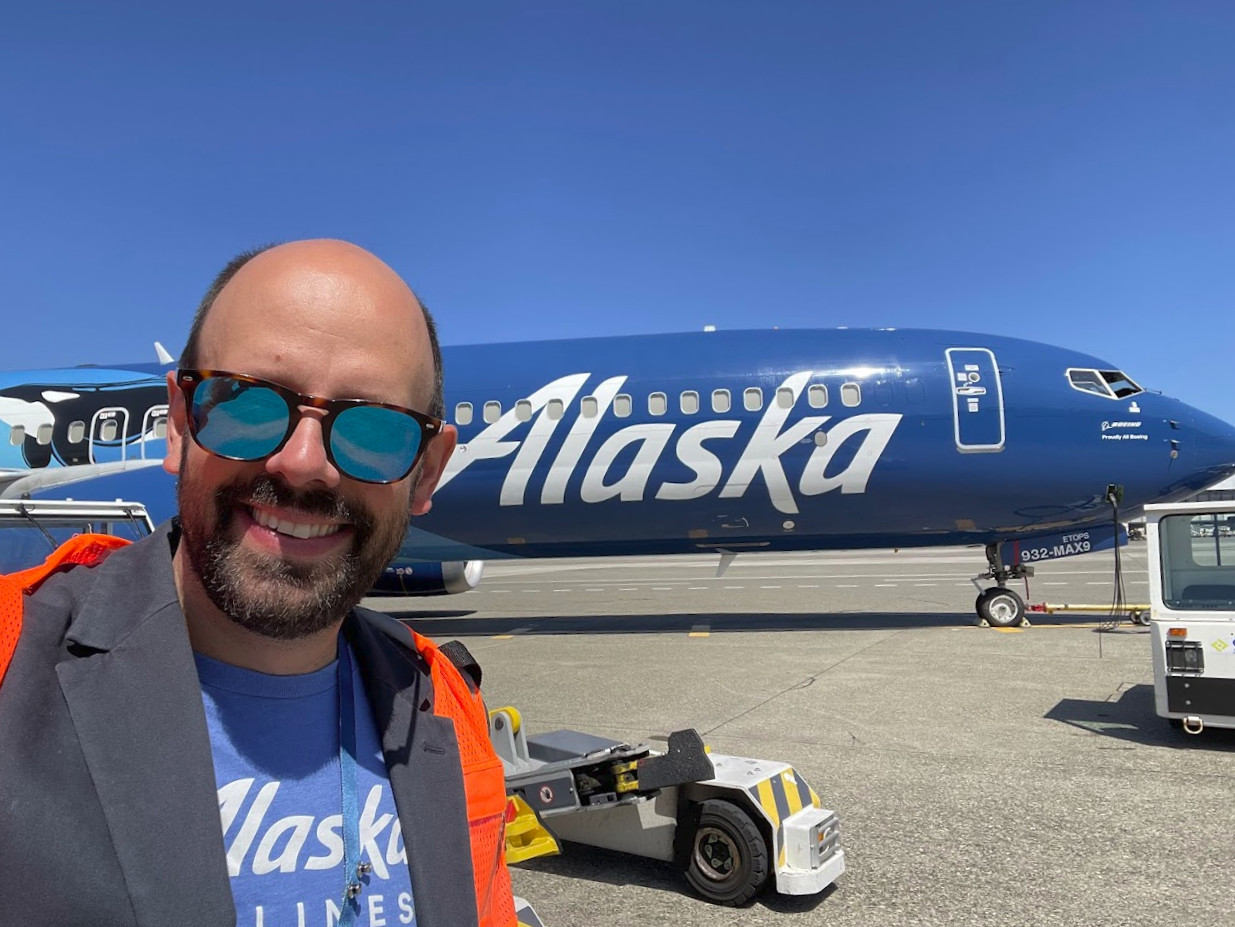
In a world where climate dialogues are too often dominated by uncompromising dogmatism and guilt-driven purism, Ryan Spies offers a refreshing, grounded alternative. As the managing director of sustainability for Alaska Airlines, Spies is responsible for steering the ecological footprint of a massive aviation network that operates nearly 1,500 daily flights across its mainline, Hawaiian Airlines, and various regional subsidiaries. Yet, despite his high-profile responsibility to decrystallize carbon from the skies, Spies openly admits he is far from a climate perfectionist. He drives an electric vehicle to offset his daily commute, but he will still happily indulge in a carbon-intensive cheeseburger from time to time. This intentional lack of rigid dogma is not a sign of hypocrisy, but rather a deliberate, pragmatic philosophy. Spies understands that demanding absolute lifestyle purity from individuals is a recipe for exhaustion and apathy. Instead, he believes the path to true planetary preservation lies in shifting our focus toward systemic, larger-scale changes. He advocates for collective action, intentional voting patterns, and using our consumer dollars to vote for the world we want to cultivate. For Spies, consumer power is not merely a passive exercise in choosing eco-friendly packaging; it is about active, direct engagement. He strongly encourages everyday citizens to write directly to corporations with their sustainability concerns, notes, and demands. Drawing from his years of executive experience across multiple industries, he affirms that a passionate, articulate customer letter voicing environmental concerns does not simply vanish into a digital void. Rather, these communications travel through corporate hierarchies, spark discussions among executives, and ultimately possess the quiet power to shift corporate policies and move industrial needles.
To truly understand how Spies arrived at this balanced, pragmatic worldview, one must look back two decades to an unexpected turning point in his early career. At the time, he was working as a civilian engineer for the United States Navy, a stable and highly technical profession that was, at the runtime, entirely detached from ecological advocacy or green energy development. His trajectory changed forever on the afternoon he sat in a dark movie theater and watched Al Gore’s seminal documentary, “An Inconvenient Truth.” While Spies had always identified as a casual environmentalist who cared about preserving nature, the film’s rigorous, stark presentation of the impending planetary crisis shattered his complacency. It became immediately clear to him that the coming decades would be defined by an existential battle against ecological instability, and he could no longer remain on the sidelines. Driven by a newfound sense of urgency, he took a calculated leap of faith: he walked away from his secure engineering position, returned to graduate school to earn his Master of Business Administration, and dedicated himself to learning how the mechanisms of corporate strategy and market economics could be harnessed to drive environmental good. Today, that professional transition is fueled by an even deeper personal motivator: his role as a father to three young children. Spies understands firsthand the exhausting reality of modern parenting, where the relentless day-to-day challenges of raising a family leave little mental bandwidth for worrying about global carbon parts per million. He worries deeply that the sheer scale of the climate crisis can leave ordinary people feeling paralyzed and disempowered, causing them to tune out entirely. Because of this, he views his job not as a mission to convert every citizen into an active activist, but to help build structural and governmental frameworks that handle the heavy lifting of decarbonization, making sustainable living the default and effortless choice for his busy neighbors.
Nowhere is the necessity for deep, structural systemic redesign more evident than in the core challenge of Spies’ day-to-day work: the stubborn physical realities of flight. Decarbonizing the aviation sector is widely regarded by climate scientists and engineers as one of the most difficult challenges on earth, primarily because it is bound by the uncompromising laws of physics. While the automotive industry has made rapid, inspiring strides toward electrification, a similar revolution remains a distant dream for commercial aviation. Spies is fond of keeping people grounded in the cold, hard mathematics of energy density that govern his industry. Modern commercial passenger jets require an immense amount of energy to lift heavy payloads into the stratosphere and carry them across oceans. The highest-performing lithium-ion batteries available in laboratory settings today possess an energy density of roughly 300 watt-hours per kilogram. By contrast, traditional petroleum-based jet fuel yields a staggering 14,000 watt-hours per kilogram. To attempt to power a standard Boeing passenger airliner across the Pacific using current battery technology would require a battery of such immense weight that the aircraft would be physically incapable of lifting off the tarmac. This is not a policy failure or a lack of corporate ambition; it is a fundamental thermodynamic constraint. Understanding this bottleneck prevents Spies from chasing unrealistic, overnight miracles. Instead, it forces his team at Alaska Airlines to focus on a multifaceted operational approach, refining route efficiencies, updating fleet compositions, minimizing ground-level waste, and seeking out transitional chemical fuels that can mimic the energy-rich profile of traditional hydrocarbons without relying on fossilized carbon extracted from the earth.
Because widespread electric flight remains a distant hope on the scientific horizon, Spies’ central, obsessive focus has become the rapid scaling and commercialization of Sustainable Aviation Fuel, commonly known as SAF. Formulated from renewable biological bases, municipal waste, or synthetic carbon capture technologies, SAF can be dropped directly into existing aircraft engines and airport fueling infrastructure without requiring trillions of dollars in systemic retrofits. However, the current global production of SAF is a mere drop in the bucket compared to the ocean of fuel consumed by the airline industry daily, and its cost remains prohibitively high. To help solve this complex supply chain puzzle, Spies has championed a model of extreme regional collaboration. Under his leadership, Alaska Airlines became a founding driver of the Cascadia Sustainable Aviation Fuel Accelerator, a groundbreaking regional initiative launched in January designed to establish the Pacific Northwest as a global hub for SAF technology. Spies points to the Cascadia Accelerator as the perfect real-world embodiment of his belief in the power of collective action. He readily acknowledges that Alaska Airlines, despite its major regional influence, cannot solve the aviation fuel challenge by working in isolation. Success in the SAF transition requires a highly synchronized dance between agricultural producers, state and federal legislators, advanced research universities, corporate buyers willing to subsidize initial high costs, and aerospace giants like Boeing. By constructing a localized ecosystem that supports the entire lifecycle of SAF—from crop cultivation and chemical refining to transport and corporate procurement—this collaborative framework aims to drive down costs, prove economic viability, and create a replicable model that can be scaled worldwide.
Operating at the intersection of heavy industry and environmental preservation requires Spies to navigate corporate spaces with a high degree of pragmatism and diplomatic skill. He is acutely aware that corporations are legally and structurally designed to generate financial profit, and that appeals to pure environmental morality will often stall when presented to hard-nosed financial officers or boardrooms. Therefore, his approach to internal advocacy relies on empathy, shared language, and aligning green goals directly with financial realities. Rather than expecting non-sustainability executives to instinctively understand global climate goals, Spies makes a conscious effort to meet them where they are, identifying how energy operational efficiency, waste reduction, and compliance risk mitigation can solve their existing business problems. This pragmatic lens is perfectly represented by the metric Spies monitors most obsessively in his daily work: the global price of crude oil. The price of petroleum is an incredibly complex variable for an sustainability executive; on one hand, high oil prices put immediate, intense pressure on an airline’s operational bottom line, squeezing profit margins and raising ticket prices for vacationers. On the other hand, Spies recognizes that the more expensive traditional fossil fuels become, the faster the market will naturally demand, fund, and adopt alternative solutions like SAF and solar energy. This constant tension forces him to live in the future, monitoring geopolitical shifts and trade routes while continually working to build business models that decouple Alaska Airlines’ long-term survival from the volatile, carbon-intensive commodity markets of the twentieth century.
Despite the daunting, multi-decade nature of the challenge, Spies remains profoundly optimistic about the trajectory of our relationship with the planet. He draws immense courage from looking back at how rapidly green technology has scaled over his sixteen years in the field. When he first entered the environmental space, clean renewable energy was regarded as an expensive, premium luxury that required decades of patient waiting to break even. Today, the exponential growth of solar power generation and battery storage has completely flipped that dynamic, making clean renewables the most affordable, efficient, and economically logical choice for new energy grid installations worldwide. This rapid industrial scaling fills him with hope that the aviation sector can undergo a similar, lightning-fast transformation once the initial economic and logistical hurdles of SAF are overcome. Spies’ personal journey came full circle during New York Climate Week, where he shared an unexpected breakfast coffee with Al Gore—the very man whose cinematic presentation had inspired him to change his life two decades prior. Looking forward to the next twenty years, Spies’ ultimate dream is for his daily labor to play a meaningful part in detaching human progress from carbon-heavy lifestyles. He hopes to build a legacy where sustainable aviation is no longer a complicated, expensive luxury, but an invisible, standard component of public transit. Ultimately, as he watches his three children grow up in a changing world, Spies is driven by the simple, profound desire to leave behind a planet that is cleaner, healthier, and robust enough to support the dreams of every generation still to come.