






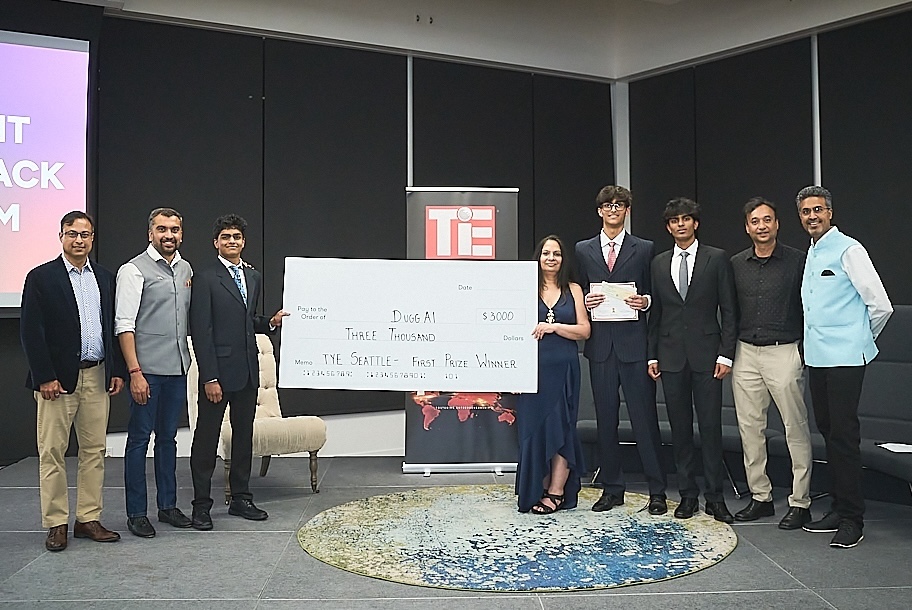
The hustle and bustle of innovation was palpable at the recent TYE Seattle Chapter Finals held at Bellevue College, where over 100 bright-eyed students from grades 9 through 12 turned the campus into a buzzing hive of young entrepreneurs. From left to right in the group photo, you could see the smiling faces of mentors and winners: Kishore Panpaliya, a dedicated TiE board member; Yash Wagh, the enthusiastic TYE program chair; Ashish Naik of the victorious DuggAI team; Vicky Mehta, the visionary founder of PathIvy; Shaurya Duggal, another DuggAI innovator; Kruthik Ankam, rounding out the DuggAI trio; Aravind Bala, the insightful TYE instructor; and Aalok Doshi, the supportive TYE program co-chair. It wasn’t just a competition—it was a celebration of grit, creativity, and the sheer joy of turning wild ideas into real-world pitches. Among the 20 teams vying for glory, one stood out: a team of high school whiz kids from Skyline High School in Sammamish who built an AI-powered email assistant, snagging first place and sealing their ticket to the global finals. Picture the energy—the auditorium echoing with applause as these teens, many probably still navigating their way through algebra and prom dramas, demonstrated software that could revolutionize everyday communication. It felt like witnessing the next generation of tech titans in their rawest form, not just coding lines but dreaming up solutions to problems we’d all face, like drowning in inbox chaos. The event didn’t stop at the pitches; it was a full-day affair where students mixed with mentors, sharing laughs and lessons over coffee breaks. One mentor recalled chatting with a young coder who admitted to staying up all night to perfect a demo, fueled by nothing but Red Bull and pure passion. That human spark—the blend of anxiety and exhilaration in their eyes—reminded everyone that entrepreneurship isn’t just about profits; it’s about that spark of possibility, the thrill of building something from nothing. As the judges deliberated, you could see the students’ nerves giving way to hope, each team clutching prototypes andPitch decks like treasures. The winner wasn’t just crowned; they were propelled into a larger story, representing Seattle on a world stage. Walking out of Bellevue College that day, attendees carried more than free swag—they carried inspiration, imagining how these kids might one day transform industries. It was a reminder that in a world obsessed with AI and algorithms, the human element of curiosity and collaboration remains the true engine of progress.
For over two decades, TiE Young Entrepreneurs has been the heartbeat of this movement, serving as a vibrant program under The Indus Entrepreneurs global network. It’s not your typical school club or after-school hobby; it’s a rigorous incubator where students dive headfirst into entrepreneurship, simulating the highs and lows of building a company from scratch. This year’s Seattle-area cohort was no exception, with teams tackling diverse challenges that mirrored real-world struggles—from the ethical dilemmas of AI ethics to the urgent call of environmental action. As I sat among the crowd, listening to these kids articulate business plans with the poise of seasoned CEOs, I couldn’t help but reflect on how far-reaching TiE has become. Now spanning more than 40 cities worldwide, the program has morphed from a local initiative into a global phenomenon, proving that passion knows no borders. Seattle’s chapter, in particular, has been on a tear, clinching the global first prize for the past two years—a streak that’s as inspiring as it is daunting for competitors. Imagine the pressure on these students, many of whom balance homework, extracurriculars, and personal lives, yet they emerge with ventures in artificial intelligence, children’s nutrition, ocean plastic recycling, mental health, and healthcare. One story that stuck with me was from a team captain who shared how the program forced her to push past her comfort zone, collaborating with classmates who became friends for life. TiE isn’t just teaching business acumen; it’s fostering resilience, empathy, and that unshakeable belief that young voices can drive change. Walking through the halls before the pitches, you could overhear snippets of conversations—kids debating scaling strategies with the same intensity as their favorite reality TV shows. It’s this human tapestry, woven from diverse backgrounds and shared ambitions, that makes TiE so powerful. No wonder alumni often return as mentors, eager to pay forward the advice that sparked their journeys. For these students, the program isn’t ephemeral; it’s a launchpad that could redefine their futures, showing them that entrepreneurship is less about luck and more about relentless hustle paired with heart.
Kicking off the event was a star-studded panel discussion titled “Future-Proofing Your Career in the Age of AI,” moderated by the ever-eloquent Aravind Bala, co-founder and CTO of SeekOut, who brought a grounded energy that put everyone at ease. Tech giants from Amazon, Microsoft, and OpenAI graced the stage, sharing insights that felt both profound and practical, like sage advice from friends who’ve weathered storms. Swami Sivasubramanian, vice president of agentic AI at Amazon Web Services, lit up the room with stories of experimentation in his teams, urging students to leverage AI not as a crutch but as a superpower for pursuing their passions. He painted a picture of a future where entrepreneurial skills eclipse mere technical know-how, encouraging kids to think big and iterate fearlessly. Vijaye Raji, chief technology officer of applications at OpenAI, added a layer of wisdom with her “no regret” mantra, reminding the audience that life’s most regretful paths are often the untaken ones. Most decisions, she argued, are reversible—why not dive in and learn from the waves? Picture a young student in the crowd, notebook in hand, scribbling furiously, inspired to tinker with ideas they’d once shelved. Then came Aseem Datar, chief product officer at Microsoft overseeing next-generation AI and quantum computing, who championed interdisciplinary knowledge as the secret sauce for high-impact innovations. He spoke of fusing fields like art, science, and ethics, creating opportunities that no single silo could yield. It wasn’t dry theory; these execs wove in personal anecdotes, like Bala sharing his own AI pivot story, making the discussion feel like a candid chat over dinner. Attendees left buzzing, exchanging thoughts on how these insights could shape their college applications or startup dreams. The panel wasn’t just informative—it humanized tech giants, showing them as approachable mentors rather than untouchable icons. One student later confided that hearing about real-world applications ignited a fire he’d never felt before. In an age of rapid change, this session served as a compass, guiding young minds through the fog of uncertainty with hope and actionable wisdom.
Diving into the heart of the competition, five remarkable teams battled it out in a grand finale that showcased the breadth of young innovation. Each one addressed pressing issues with freshness and flair, transforming classroom learnings into pitches that could sway investors. There was Hydrobin, tackling ocean plastic recycling with innovative solutions to curb marine pollution; Healix, diving into healthcare to improve patient experiences; NeuraKind, exploring mental health tools powered by empathy-driven tech; and Tiny Tummies, focusing on children’s nutrition to combat malnutrition in creative ways. It was captivating to witness these teens in action, not just reciting facts but embodying passion—sweat on their brows, voices steady despite the stakes. Behind each team was a story of collaboration: late-night Zoom calls, debates over design choices, and the kind of bonding that turns strangers into lifelong allies. One judge noted the emotional depth in their presentations, where personal motivations shone through, like a Healix member revealing how a family health scare fueled their drive. The atmosphere crackled with energy, friends and mentors cheering from the sidelines, phones flashing as proud parents captured the moments. It felt like a microcosm of the real world, where cutthroat competition meets camaraderie, reminding us that entrepreneurship thrives on collective effort. As teams rotated through the stage, you sensed the anticipation building, each pitch a testament to months of brainstorming and iteration. For spectators, it was a masterclass in vulnerability—watching these kids admit failures that led to breakthroughs. The diversity of ideas mirrored society’s complexities, from eco-warriors to health innovators, proving that young minds can address global challenges with ingenuity. Hearing the judges’ feedback, often laced with encouragement, was heartwarming, turning the event into more than a contest but a nurturing ground for growth.
Among them all, DuggAI emerged victorious, their AI-powered email assistant stealing the spotlight and hearts alike. Conceived by Skyline High School whiz kids Ashish Naik, Shaurya Duggal, and Kruthik Ankam, this tool reimagines inbox overload by intelligently pulling context from multiple apps to craft smarter, swipe-based replies—think TikTok for email management. It was fascinating to see their demo, a sleek interface that made mundane tasks feel revolutionary, earning not just first place but admiration from tech veterans in the audience. Aravind Bala, the TYE instructor, captured the sentiment perfectly, exclaiming how this cohort had raised the bar higher than ever before. “AI has changed what a team of high schoolers can build in a few months, and these students proved it on stage,” he shared, his pride palpable. Chatting with the team post-victory, you could feel their elation mixed with awe—they’d turned a school project into something futuristic, blending technical prowess with user-friendly design. Ashish reminisced about prototyping mishaps that taught resilience, Shaurya about iterating designs inspired by social media tweaks, and Kruthik about hashing out ethics behind AI decisions. Their journey wasn’t flawless; there were times of doubt, like late-night code debugs that tested friendships, but those hurdles forged a stronger bond. The win symbolized more than prize money—it was validation for their hard work, a nod that youthful curiosity can disrupt industries. Mentors like Yash Wagh beamed with pride, seeing echoes of their own entrepreneurial paths in these young achievers. DuggAI’s success underscored how accessible innovation has become, democratizing tech creation in an AI-driven era. As they accepted their trophy, surrounded by cheers, it was clear: these kids weren’t just participants; they were pioneers, ready to email the world smarter replies.
Looking ahead, the momentum from Seattle’s finals is propelling DuggAI toward the TYE Global competition, proudly hosted by TiE Seattle this June 12-13 back at Bellevue College. The finals, slated for the morning of June 13, are open to the public, inviting onlookers to witness international talent collide in a spectacle of ideas. It’s thrilling to imagine the global stage, where teams from around the world will converge, sharing pitches that transcend cultures and challenges. For DuggAI, this isn’t just a contest—it’s a platform to amplify their voice, potentially inspiring trickle-down effects in tech education. Reflecting on the event, one couldn’t help but feel optimistic about the future, where panels like this become blueprints for careers, and competitions like this spark movements. Alumni of TYE often talk of how these experiences shaped their worldviews, teaching them that failure is feedback and persistence is power. As TiE continues to grow, bridging continents with entrepreneurial spirit, these kids carry the torch forward, proving that age is no barrier to ambition. The human story here is one of connection—mentors guiding novices, students learning from icons, all united by a love for creation. In a time of rapid AI evolution, events like this remind us that technology’s true power lies in its builders: curious, compassionate humans. Attending felt like glimpsing tomorrow’s leaders, armed not just with code but with heart. And who knows? Perhaps the next big breakthrough will start from a high school hallway, much like DuggAI did. The legacy of TiE Seattle isn’t just in wins; it’s in the dreams it ignites, year after year. As the chapter prepares for global glory, the message is clear: entrepreneurship is alive, well, and wonderfully human.