





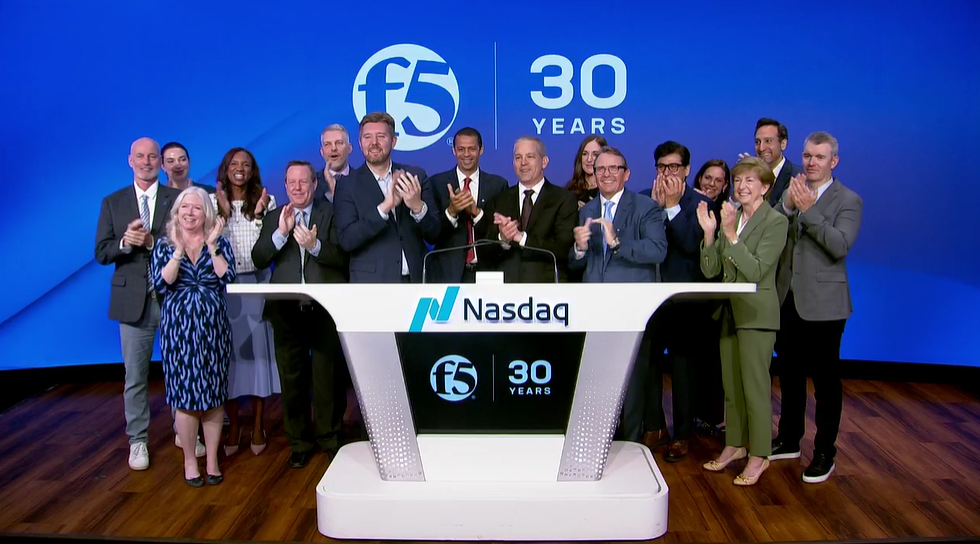
The atmosphere within the Nasdaq MarketSite in Times Square on the morning of May 29, 2026, was nothing short of electric, representing a triumphant convergence of history, human effort, and the constant evolution of digital technology. Standing at the center of the podium, surrounded by a radiant corporate family comprising members of the company’s leadership team and board of directors, was F5 Chief Executive Officer François Locoh-Donou. Beside him stood Nasdaq’s Jeff Thomas, both men grinning widely under the bright studio lights as they prepared to press the button to ring the opening bell—a ceremonial chime that officially marked F5’s remarkable thirtieth anniversary in business. To truly understand the weight of this milestone, one must travel back nearly twenty-seven years to the heat of the early internet boom in June 1999. In that era, a scrappy, three-year-old internet traffic-management company called F5 Networks Inc., born in Seattle, went public on the Nasdaq exchange. The young company’s initial public offering prospectus boasted a client roster filled with names that defined the frontier of the early web: PSINet, MCI WorldCom, StarMedia Network, Vanstar, Frontier GlobalCenter, and BellSouth.net. Today, these names are completely unrecognizable to the modern consumer, having long since vanished into the history books as structural casualties of the devastating dot-com crash, swallowed up by bankruptcy, acquired by rivals, or dissolved entirely. Ringing the bell in New York was not merely a celebration of corporate longevity; it stood as a powerful testament to a lone survivor that managed to outlive the very digital landscape of its birth, outlasting not only its original target market and customer list but also the three investment banks that initially guided it onto the public stock market.
Looking back at the final years of the twentieth century, the original initial public offering of F5 was far from a guaranteed success story, taking place in a speculative market landscape that valued theoretical potential over concrete financial performance. In its initial SEC paperwork, the tiny enterprise reported an annual net loss of $3.7 million on meager revenues of just $4.9 million, operating with a lean workforce of only 123 dedicated employees. This financial imbalance was a hallmark of the late-1990s tech environment, where unprofitable startups regularly went public based on projections of selling products to other equally unprofitable startups that had yet to validate their own long-term business models. To any objective financial analyst at the time, F5 looked like just another speculative play destined to collapse when the venture capital money dried up. Yet, while its prominent contemporaries crumbled under the weight of unfulfilled promises, F5 proved to possess an entirely different inner composition. Behind the numbers lay a resilient team in the Pacific Northwest who viewed their organizational mission not as a path to a quick payout, but as a critical engineering challenge. They were building the essential plumbing of the internet, ensuring that servers remained online and data flowed smoothly even when website traffic spiked unpredictably. When the financial storm hit and the investment firms that brought F5 to the public market dissolved, the Seattle team dug in, focusing on the technical realities of networking. This stubborn belief in real-world utility over temporary hype allowed them to weather the crash, steadily earning the trust of legacy enterprises that realized a stable internet required robust traffic management.
The secret to F5’s survival and growth over three decades has been its extraordinary capacity for technological metamorphosis, allowing it to adapt to every massive transformation in computing. What began as a simple load-balancing business has evolved into a global leader that secures and delivers applications and APIs across every conceivable environment. In its earliest days, F5 built physical load balancers—specialized hardware devices that acted as traffic cops to prevent websites from crashing under the weight of user requests. As the corporate world migrated from local web servers to massive enterprise data centers, and eventually to public and private cloud environments, F5 proactively transitioned its core architecture from physical boxes to highly sophisticated, cloud-native software solutions. This evolution required monumental cultural and technological shifts, forcing hardware engineers to think like software developers and vice versa. Remarkably, the cycle has come full circle in the era of artificial intelligence. Today, F5 is experiencing a massive resurgence in physical hardware sales, driven by the intense demands of modern AI data centers. Because AI training workloads involve processing massive data sets across thousands of interconnected chips, these systems require ultra-fast, physical load-balancing solutions to prevent bottlenecks. By masterfully shifting between hardware, software, and cloud-native solutions, F5 has proven that longevity in technology requires a willingness to constantly reinvent oneself and adapt to current market trends.
Now firmly established as a cornerstone of the global economy, F5 operates out of its iconic, glass-sheathed headquarters, the F5 Tower, which dominates the downtown Seattle skyline. The company’s current financial profile is a testament to its successful transformation, boasting an impressive market valuation of $21.9 billion, with annual revenues reaching $3.1 billion and profits climbing to $692 million in its most recent fiscal year. Supported by a dedicated global workforce of 6,578 employees, F5 has earned the unwavering trust of the world’s most powerful enterprises, counting more than 80 percent of the Fortune 500 among its active customer base. This massive scale means that the average consumer interacts with F5’s technology hundreds of times a day without even realizing it, whether banking online, streaming entertainment, or accessing healthcare portals. Under the steady guidance of CEO François Locoh-Donou, the company has fostered a culture of resilience that extends far beyond product development. Even when navigating the inevitable headwinds of the tech industry, including major cyber threats, economic downturns, and competitive pressures, the team has managed to maintain operations through transparency and a commitment to security. Locoh-Donou’s leadership emphasizes the human element of technology, reminding his team that behind every application and API they secure is a real person trying to navigate their digital life safely, securely, and reliably.
Looking toward the next horizon, F5 is positioning itself as a vital architect of the artificial intelligence revolution, expecting AI to be the primary engine of its business growth for the foreseeable future. In a detailed investor presentation held in New York just a day before the Nasdaq celebration, the executive team laid out an optimistic, strategic roadmap projecting upper-single-digit annual revenue growth through fiscal year 2029. More remarkably, the company estimates that its total addressable market will balloon from approximately $15 billion today to more than $40 billion by the year 2030, driven by the unique infrastructure challenges of the AI era. As organizations build and deploy their own conversational agents, machine learning pipelines, and predictive algorithms, they face massive bottlenecks in data delivery and unprecedented vulnerabilities in application security. F5 is solving these problems by offering high-speed load balancing tailored specifically for AI clusters, ensuring that data travels safely and instantaneously between storage networks and processors. Furthermore, because AI applications rely heavily on Application Programming Interfaces (APIs) to communicate with databases and users, securing these interfaces has become the front line of modern cybersecurity, requiring F5’s advanced protection capabilities. F5’s ability to protect and optimize these critical connections positions it as an essential partner for any enterprise attempting to deploy AI safely, effectively, and at a massive global scale.
As the opening bell’s echo faded across the busy streets of Manhattan and the ticker symbol FFIV flashed brightly on the massive Nasdaq screens, F5’s stock enjoyed a modest, steady half-percent rise in early trading. This calm market response felt strangely appropriate for a company that has spent thirty years prioritizing steady, sustainable growth over speculative market hype. In an industry where corporate life expectancies are notoriously short, particularly for companies that went public during the chaotic final years of the twentieth century, F5’s thirty-year run is a monument to human adaptability and strategic foresight. By maintaining the very same ticker symbol that represented its humble, 123-employee operations in 1999, F5 honors the long line of engineers, visionaries, and leaders who weathered the dot-com storm to construct the underlying structure of today’s internet. The journey from a small traffic-management startup to a $21.9 billion global leader in application security serves as an inspiring reminder of what can be accomplished when a team remains focused on solving real-world customer problems. As the celebratory crowd in Times Square began to disperse and return to their daily routines, the collective sense of pride among the F5 team was palpable, their eyes looking forward to the next thirty years of digital evolution in an increasingly interconnected and intelligent world.