






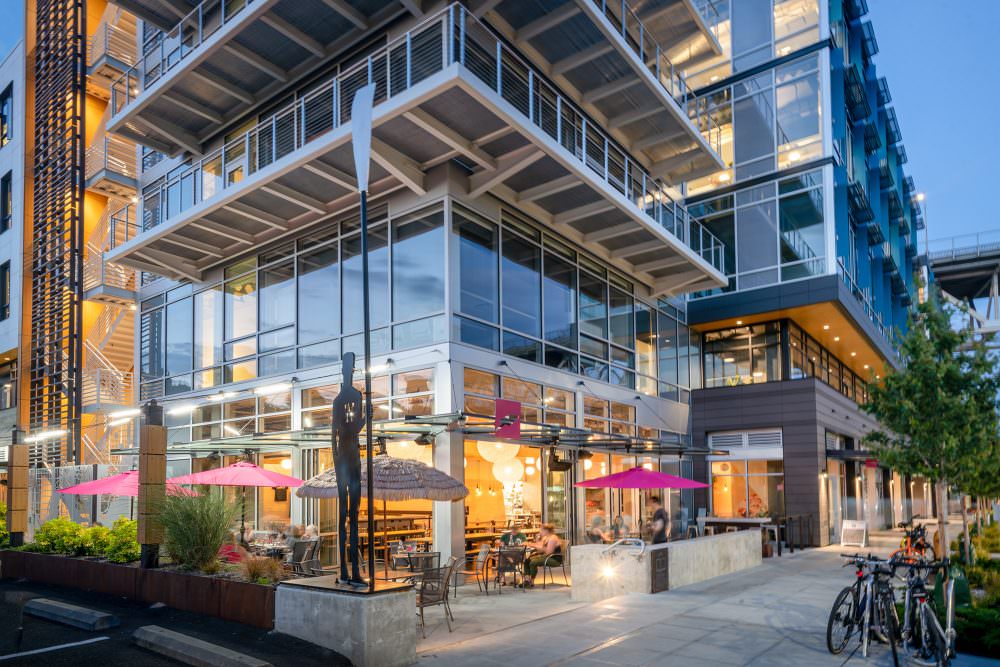
The Seattle tech landscape is witnessing a major milestone as Salesforce’s Tableau division officallly recommits to its roots. In a move that signals stability during a turbulent era for commercial real estate, the data visualization giant has renewed its lease for approximately 114,000 square feet at the iconic Data 1 office building in Seattle’s Fremont neighborhood. Set to take effect after the current agreement expires in 2029, this landmark deal represents the largest office lease renewal in Seattle so far this year. It stands as a powerful testament to Tableau’s enduring connection to the area, securing its long-term home in the Pacific Northwest and providing a much-needed boost of confidence to the local business community.
Tableau’s history is deeply woven into the fabric of Fremont. Years before Salesforce acquired the company in 2019 for a staggering $15.7 billion, Tableau grew rapidly by leasing various properties scattered throughout the neighborhood. At the time of the acquisition, Salesforce CEO Marc Benioff famously declared that the Seattle region would essentially become the company’s “HQ2.” While that promise initially energized the local tech scene, the years that followed brought a wave of restructuring. Post-acquisition, Salesforce navigated the industry-wide shift toward hybrid work by trimming its real estate holdings and executing several rounds of layoffs that impacted Tableau’s workforce, which had once reached about 4,200 employees worldwide.
The strategy surrounding the Data 1 building, located at 744 N. 34th St., has seen its fair share of corporate maneuvering. Tableau first opened the state-of-the-art facility in 2018 to serve as a modern crown jewel for its growing urban campus. Amid the shifts of the post-pandemic market, Salesforce initially put the Data 1 building up for sublease. However, executive leadership quickly reversed course in 2023, deciding instead to hold onto Data 1 and put its nearby Fremont headquarters building on the sublease market. This pivot highlights a calculated decision to consolidate their footprint in a premier, collaborative space that employees actually want to commute to.
This renewal comes at a transitional moment for Fremont, a quirky and vibrant neighborhood proudly self-dubbed the “Center of the Universe.” The local commercial market took a significant hit last year when search giant Google announced it would abandon its Fremont campus to consolidate its Seattle-area workers at its South Lake Union offices. Google’s departure left a noticeable void along the picturesque Lake Washington Ship Canal, sparking concerns about the neighborhood’s future as a tech hub. Tableau’s recommitment serves as a stabilizing counterweight, proving that Fremont has not lost its magnetic pull for major technology players.
While Google’s exit left a vacancy, Fremont is simultaneously welcoming fresh energy from other high-profile industries. Artificial intelligence pioneer Nvidia recently secured 28,000 square feet of office space at the nearby Fremont Lake Union Center to expand its local footprint. Additionally, the global public health nonprofit PATH took over offices formerly occupied by Tableau in Fremont’s West Dock building. These moves, combined with Salesforce’s renewed commitment, demonstrate that Fremont is successfully diversifying its ecosystem, transitioning from a neighborhood dominated by a couple of tech giants into a dynamic hub for AI, global health, and enterprise software.
Ultimately, the decision to stay at Data 1 is about people, collaboration, and community. Rob McCorkindale, Vice President of Global Real Estate Portfolio & Transactions at Salesforce, expressed excitement about the renewal, calling the building a “critical hub” for local employees and customers alike. Mark Grey, a partner at the building’s development firm, Hess Callahan Grey Group, echoed this sentiment, noting that Tableau remains an integral part of Fremont’s technology ecosystem. In an era where the future of the office is constantly questioned, Tableau’s renewed commitment to Fremont shows that physical workspaces, when placed in vibrant communities, still hold immense value for the world’s leading employers.