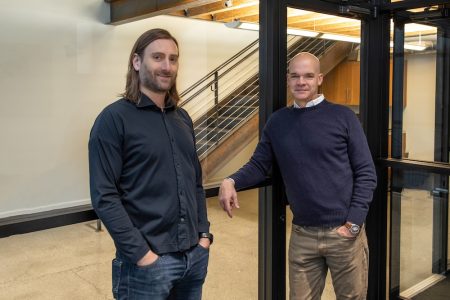



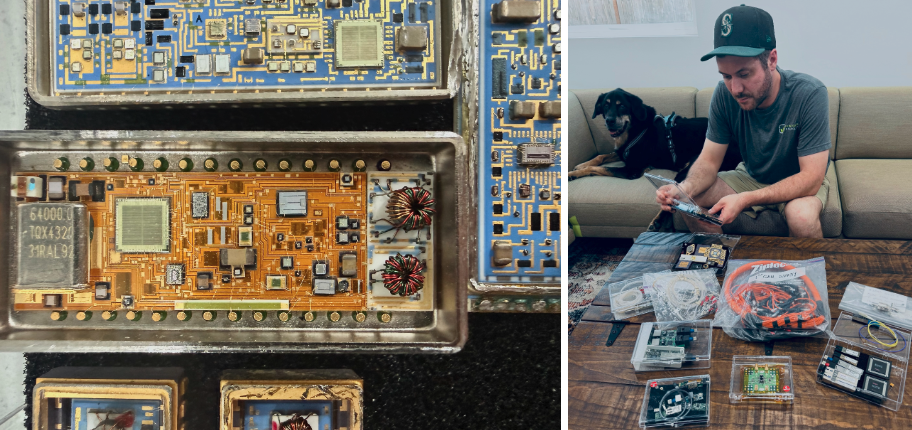
When a routine electronics recycling bin becomes a portal to the Cold War space race, you don’t just toss it in the shredder. That was the immediate realization of Tyler Rivers, the 34-year-old founder and CEO of Seattle-area recycler Living Green Technology. While inspecting weekly public drop-off donations at his Bellevue facility, Rivers stumbled upon an extraordinary collection of vintage computing and aerospace artifacts that looked less like e-waste and more like a pristine engineering archive from the dawn of modern aviation. Instead of the usual tangled cords and broken laptops, this anonymous donation contained gold-plated prototype microchips, raw silicon architectures exposed under glass, and experimental fiber-optic apparatuses from fifty years ago. Driven by a self-described “nerdy” curiosity, Rivers set the pieces aside, launching a fascinating high-tech detective hunt to uncover who owned them, where they originated, and what pioneering missions they once served.
The salvaged treasure trove offers a rare, physical look at the mid-to-late 20th-century transition when engineers were first figuring out how to make delicate computers survive the extreme, unforgiving environments of spaceflight and military aviation. Among the most remarkable discoveries is a Texas Instruments SBP9900X microprocessor from 1977, a rare, military-grade 16-bit chip prominently stamped “Experimental.” Built with specialized architecture to withstand extreme cosmic radiation and thermal shock, this family of microprocessors was famously utilized by NASA and defense contractors for deep-space missions and missile guidance. The collection also features un-lidded hybrid microcircuits, which resemble microscopic, hand-crafted gold cities housed inside tiny ceramic cavities. Rather than being mass-produced in plastic, these units integrated bare silicon dies and hand-wound inductors, connected by ultra-fine gold wires to pack maximum computing power into hermetically sealed, shock-resistant aerospace packages.
Beyond microchips, the collection traces the genesis of secure, high-speed aviation communications. Rivers recovered a beautifully preserved Canstar 8×8 optical star coupler from the late 1970s, which physically fused glass fiber-optic strands together to route light signals—a crucial stepping stone in prototyping early, interference-proof “Fly-by-Light” flight control systems. Alongside it sat an early “1st Gen Array” fiber-optic cable and a military-grade avionics module from Data Device Corporation (DDC). This mechanical sample was engineered for the MIL-STD-1553 data bus protocol, the very neural network that allowed cockpit computers and sensors to communicate on military aircraft and spacecraft. Together, these artifacts capture the exact historical moment when heavy, vulnerable copper wiring was being replaced by light-based data transmission, shielding military aircraft and spacecraft from electromagnetic interference and nuclear pulses.
To help decode the mystery, GeekWire consulted Andrew “bunnie” Huang, a renowned MIT-trained electrical engineer and hardware hacker. After reviewing the photos, Huang suggested the collection might not be an archive from a single project, but rather the ultimate lifetime “collage” of high-tech souvenirs kept by a passionate aerospace technician or test engineer. The eclectic mix of military-grade components, optical sensors, random LED displays, and an old 2K EEPROM memory chip suggests a career spent tinkering on the cutting edge of military aviation. In the Seattle region—a historical epicentre of aerospace innovation dominated by Boeing and its network of defense contractors—countless attics and garages likely hold similar forgotten boxes of history. Lāth Carlson, former director of Seattle’s now-closed Living Computers: Museum + Labs, noted that museums rely entirely on these quiet collectors who save things simply because they instinctively know “it seems like it’s worth keeping.”
For Rivers, rescuing history is a natural extension of his hands-on philosophy. He has no formal background in aerospace or computer science, having graduated from the University of Washington with an economics degree in 2012. He actually founded Living Green Technology as a student while working at a UPS Store, placing a cardboard drop-off bin on the counter to collect, repair, and resell old cell phones. Today, his company handles large-scale secure data destruction and asset recovery for major businesses and government agencies. Yet, Rivers’ personal, insatiable curiosity regularly follows him home to his garage, where he loves to dissect puzzling electronics. This isn’t his first historic save; he previously rescued a genuine NASA laptop, complete with government property tags and modifications proving it was customized for spaceflight, which now sits safely on a shelf in his home workshop alongside his other tech rescues.
Thanks to Rivers’ sharp eyes and appreciation for the past, these relics of human ingenuity have been saved from being melted down for their precious metals. They represent a tangible bridge to the quiet triumphs of the Cold War engineers who mapped out the digital blueprints for modern aviation. While Rivers waits for more clues—hoping that local tech history buffs or former aerospace employees might recognize the unique prototypes and reach out with answers—the collection remains safe and sound. For now, this fascinating time capsule sits protected on a shelf in Rivers’ workshop, serving as a quiet tribute to the brilliant minds of yesteryear and the recycler who refused to let their legacy be ground up into dust.