


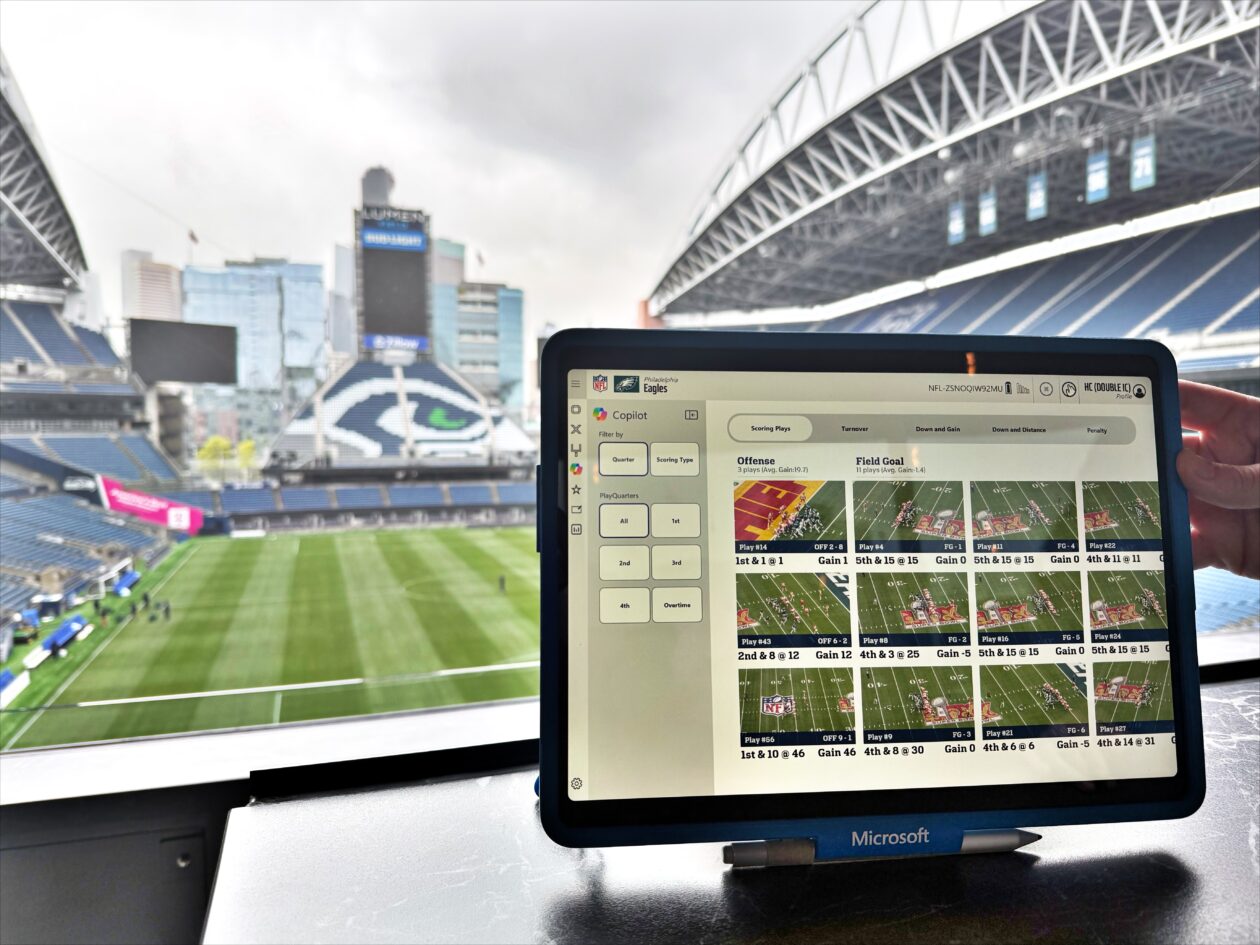
There is a moment in every NFL season opener that feels less like a football game and more like a glimpse of tomorrow. On Wednesday night, Sept. 9, 2026, that moment arrived in Seattle, where the Seahawks hosted the New England Patriots under the bright lights of Lumen Field. As the camera panned across the sideline and into the coaches’ box, NBC’s play-by-play announcer Mike Tirico pointed out something familiar yet newly charged: the Microsoft Surface tablets, dressed in vivid Action Green cases, sitting in the hands of Seattle’s football staff. These devices have been a fixture on NFL sidelines since 2014, but on this night, they were doing something different. Tirico explained that head coach Mike Macdonald’s staff, including Brian Eayrs, the director of football analysis and special situations, now had real-time access to Microsoft Copilot. The AI assistant was no longer a futuristic concept or a tech demo. It was embedded in the actual rhythm of an NFL game, delivering insights to coaches in a matter of seconds. Tirico put it simply: the staff could make sharper calls between series. In the span of a 40-second broadcast segment, football fans got a close look at the new era of artificial intelligence on the sideline.
The Surface tablets have always been a striking visual on NFL sidelines—rugged, recognizable, and constantly in the hands of players and coaches. But the story has evolved from hardware to intelligence. During the broadcast, NBC showed how Copilot is now layered onto those devices, transforming them from photo viewers and play-call displays into real-time analytical engines. In the coaches’ box, analysts like Brian Eayrs sit before a live Excel dashboard that ingests play-by-play data directly from the NFL as it happens. In the past, pulling meaningful insight from that data during a game required manual formulas, patience, and a cool head under pressure. Now, with Copilot, an analyst can simply ask a question in plain English—something like, “What formation have they favored on third-and-short in the second half?”—and get an answer in seconds. The system can track formation tendencies, snap counts, and player load as the game unfolds. It doesn’t replace the instinct of a coach or the eyes of a scout, but it removes the lag between a situation happening on the field and the data needed to respond to it. And because the output from the booth can be sent down to the sideline tablets, players and coaches can review stills and quick situational info between possessions without huddling around a laptop.
This isn’t just a story about a tech company and a football league; it’s a story about how a game hundreds of years old is being gently rewired for the speed of modern information. There’s a human texture to all of it. You can picture Eayrs and his colleagues in a dimly lit booth high above the field, headsets on, eyes on screens, translating a cascade of statistics into something a head coach can use in real time. You can imagine Macdonald, headset pressed to one ear, absorbing a piece of data that reframes a third-down decision. The beauty of the current system is that it doesn’t try to turn coaches into programmers. It meets them where they live. The AI handles the heavy lifting of data analysis, while the humans handle the pressure, the instinct, and the feel of the game. As GeekWire reported earlier this year, Microsoft’s pitch is raw speed — the ability to deliver insights in seconds rather than after the game. In a sport where one possession can decide a season, that speed matters.
But with all that power comes a thicket of rules, and the NFL has thought carefully about what the AI can and cannot do. The tablets run on a closed, league-controlled network slash no outside apps, no internet wandering, no custom-built software from enterprising third parties. The devices are locked away before kickoff patron saint of competitive integrity, handed over to league officials, and monitored throughout the game. They are collected immediately after the final whistle. This isn’t just bureaucratic caution. Under the NFL’s “Equity Rule,” if one team’s technology fails, the opposing team’s access is restricted or paused too, so a malfunction doesn’t become an unfair advantage. That may sound overly cautious in a league full of risk-taking on the field, but it reflects a deeper truth: as technology becomes more powerful, the league is trying to make sure it enhances the game without distorting it. Nobody wants a matchup decided by whose Wi-Fi is better. Nobody wants a timeout burned because a tablet froze at the wrong moment. The exact rules will keep evolving alongside the tech, but for now, the NFL and Microsoft are walking a careful line between innovation and fairness.
For Macdonald, this is not a gimmick. He has built his reputation as a smart, forward-thinking coach who isn’t afraid to talk about data. He has described himself as a “football nerd,” and in a league where that label is often worn with pride, he’s one of the most enthusiastic wearers of it. He told GeekWire that his approach is “old school principles, new school methods,” which is a perfect way to describe the marriage of a traditional sport and cutting-edge artificial intelligence. Macdonald isn’t interested in letting numbers make decisions for him; he wants them to inform the decisions he was going to make anyway. It’s a nuanced relationship. He calls himself a “psycho data guy” and a “football nerd,” but behind that self-deprecating humor is a genuine belief that information, delivered at the right moment, wins games. That philosophy is one of the reasons Microsoft’s expanding AI suite has found such a natural home in Seattle. Macdonald’s staff doesn’t see the technology as a replacement for the huddle or a substitute for instinct. They see it as a way to sharpen the instinct they already have, to move from “I think they’re going to blitz here” to “they have blitzed on 80 percent of third-and-medium situations in the second half.” That’s a meaningful shift, and it’s happening in real time.
The broader picture is even more interesting. Microsoft’s relationship with the NFL began long before Copilot was a household name cu. The Surface tablet has been the visible face of the partnership for more than a decade. But what GeekWire saw in April during a behind-the-scenes look at Lumen Field was a much deeper integration. It wasn’t just a tablet in a coach’s hand; it was an entire ecosystem designed to support decision-making at the speed of professional football. There are still images pulled from the broadcast, annotated in real time. There are dashboards that filter, sort, and visualize data without requiring a data scientist to interpret it. There are workflows that have been custom-built for the strange, chaotic rhythm of a football Sunday. And then there’s the broader AI wave sweeping through sports. The NFL already uses Amazon Web Services to power Next Gen Stats, the tracking system that measures speed, separation, and probability on every play. Now Microsoft is adding another layer, bringing large language models and natural-language interaction into a space where split-second decisions have always lived in the gut of coaches and quarterbacks.
For Microsoft, Wednesday night was a showcase, and a pretty good one. For those 40 seconds, millions of viewers saw a product being used in a way that felt native rather than forced. The Surface tablets in their Action Green cases were part of the visual culture of the NFL long before Copilot arrived, but now they’re becoming something more: a window into how artificial intelligence can work inside a high-stakes, deeply human environment. Earlier that day, Microsoft CEO Satya Nadella shared a video featuring Eayrs and the Seahawks’ setup, suggesting that the company sees this as a marquee example of AI in the real world. The timing was perfect for the Seattle season opener, and the fact that the broadcast mentioned Next Gen Stats, powered by Amazon Web Services, meant that two of the biggest tech companies on the planet were essentially parked side by side in front of a football audience. You could almost hear the marketing teams exhaling somewhere in Seattle and Redmond.
In the end, though, the story wasn’t about data or products. It was about a football game, and the Seahawks gave their new era a dramatic ending with a last-second interception to seal the win over New England. Macdonald walked off the field with a 1-0 recordcard, and somewhere in the coaches’ box, Eayrs probably closed a laptop full of statistics that had helped guide the evening. The Copilot integration didn’t throw a pass. It didn’t read the quarterback’s eyes or blow up a screen in the red zone. But it was there, quietly informing the decisions that led to those moments. And that’s how it will be for the rest of the season, and probably for the rest of the sport’s evolution. Technology in football is no longer a futuristic fantasy; it’s a headset crackling with information, a tablet protected by a rugged case, a quiet voice in a coaches’ ear suggesting that the numbers tilt one way or another. The game is still played by humans, but the people in charge of winning it are increasingly leaning on systems that see what they can’t, analyze what they can’t, and do it all in the space between one play and the next. It’s not just the future of football. It’s the present, unfolding one series at a time, under the lights in Seattle.