




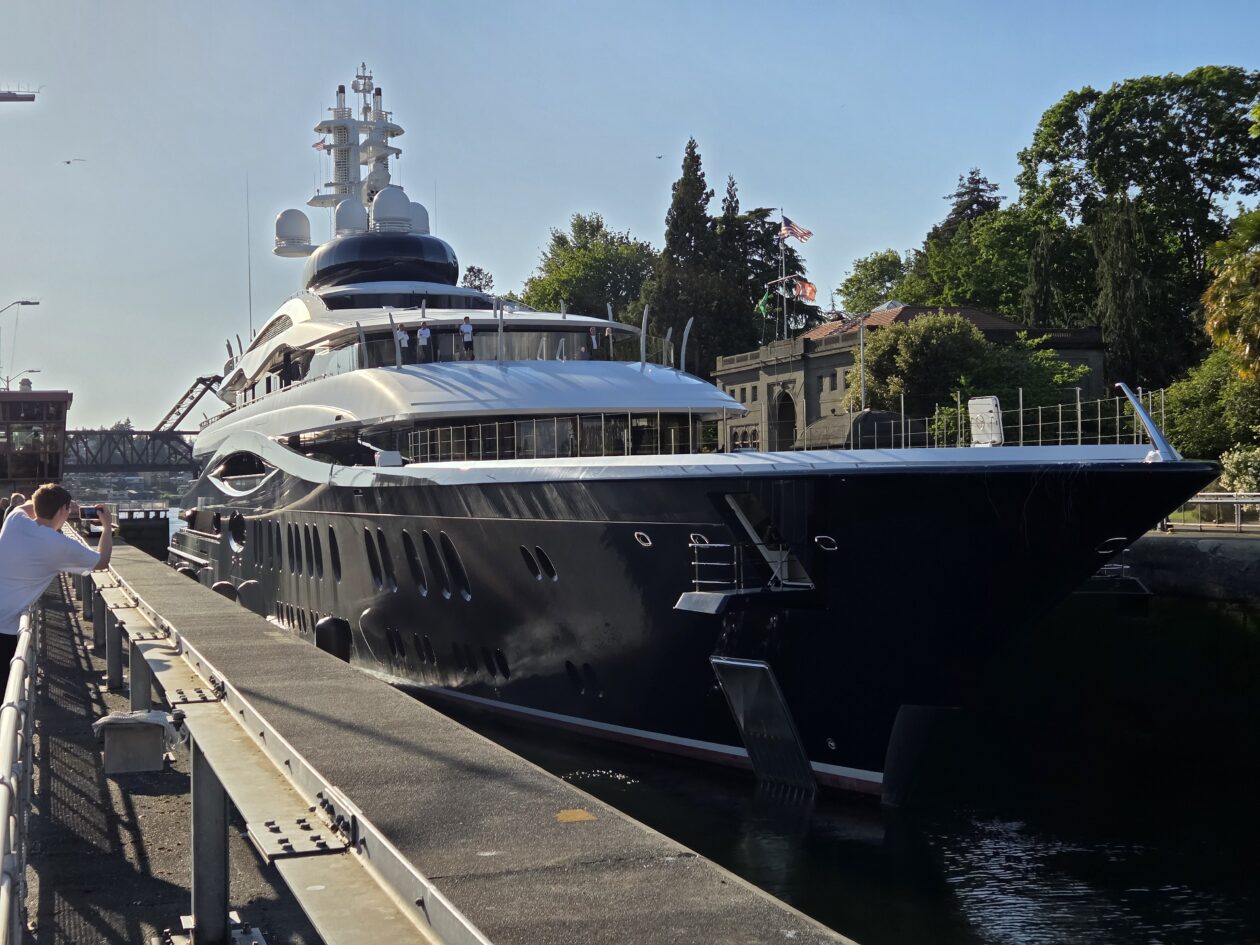
Underneath the introspective, slate-gray skies of a Pacific Northwest Tuesday, a deeply symbolic drama unfolded at the historic Hiram M. Chittenden Locks in Seattle’s Ballard neighborhood, capturing the stark economic divides of our modern tech-driven society. While a gentle dampness hung over the Ship Canal, a gargantuan testament to modern high-tech opulence was slowly, almost silently, squeezing through the historic concrete chambers. This was the Launchpad, a breathtakingly massive 387-foot superyacht owned by Meta Platforms Chief Executive Officer Mark Zuckerberg. Valued at an astronomical $300 million, this floating palace was transitioning from the saltwater of Elliott Bay toward the quiet, urban waters of Lake Union. But as the towering steel-and-aluminum monolith drew an impromptu crowd of onlookers along the locks’ public walkways, a far more sobering reality was breaking across the digital offices of Washington state. On that exact same morning, Meta officially disclosed plans to eliminate nearly 1,400 jobs in the region. The timing of these two events—the grand entrance of a billionaire’s ultimate luxury asset and the sudden, devastating dismantling of hundreds of local livelihoods—was nothing short of jarring. For the impacted employees, the day was defined by professional heartbreak, panic, and the terrifying anxiety of facing an increasingly volatile tech labor market. Meanwhile, the physical manifestation of their employer’s incomprehensible wealth glided effortlessly through the heart of their city, serving as a silent, towering monument to the deep systemic inequality of the digital gilded age. What should have been a routine maritime maneuver instead turned into a highly charged public theater, where the abstract realities of corporate downsizing and billionaire indulgence directly collided in a tangible, highly visible space that left onlookers grappling with a profound sense of irony and collective grief. In a city historically anchored by timber, fishing, and blue-collar labor—but now utterly transformed by the dazzling, often overwhelming influx of tech wealth—this physical juxtaposition felt like a raw, unedited snapshot of Seattle’s ongoing identity crisis.
The Launchpad is not merely a boat; it is a staggering engineering masterpiece, built by the renowned Dutch custom shipbuilder Feadship, a brand synonymous with the absolute pinnacle of luxury and bespoke naval architecture. Spanning an incredible 387 feet in length and featuring multiple cascading decks, a helicopter pad, a glass-walled swimming pool, and custom high-end interiors designed for the ultra-wealthy, the yacht is a self-contained island of extreme privilege. Moving a vessel of this immense scale through the historic Ballard Locks—a century-old engineering marvel designed to help boats negotiate the water level discrepancy between the Puget Sound and Lake Washington—is an exercise in supreme precision, requiring immense patience and mastery. The locks, which typically accommodate rugged commercial fishing vessels, tugboats, and modest weekend pleasure cruisers, were pushed to their aesthetic and operational limits as the mammoth yacht entered the large lock chamber. Bystanders leaned over the guardrails, watching in absolute silence as the dark, gleaming hull cleared the rough concrete lock walls by only a matter of inches on either side, requiring the utmost concentration from both the vessel’s professional crew and the local lock operators on the ground. One veteran lock operator, who has spent nearly a decade and a half guiding thousands of boats through this urban waterway, confessed that in his fourteen years on the job, this was the single largest superyacht he had ever had to guide through the facility. The sheer, overwhelming audacity of the boat’s physical presence in the middle of a historic public park created a surreal juxtaposition of public utility and private excess, highlighting an industrial-era public asset temporarily occupied by a private, high-tech fortress of leisure.
As word of the mega-yacht’s arrival rapidly spread across local social media channels, neighborhood forums, and professional networks, a diverse crowd of tech workers, maritime enthusiasts, and neighborhood residents quickly gathered along the locks’ concrete walkways to catch a glimpse of the spectacle. However, what might have otherwise been a peaceful gathering of curious boat enthusiasts quickly curdled into a modern demonstration of public frustration and class resentment. The devastating news of the Meta layoffs had already rippled through the local tech workforce, and the physical presence of Zuckerberg’s empty luxury vessel served as a lightning rod for the community’s pent-up anger and exhaustion. As the yacht slowly descended into the lock chamber to adjust to the lower water level, the quiet, low-frequency hum of the ship’s high-tech engines was repeatedly punctured by boos, jeers, and sharp heckling directed from delete shores toward the crew standing on the towering upper decks. The frustration of Seattle’s working class, who have long felt squeezed by the soaring housing costs, displacement, and intense economic gentrification driven by the tech boom, found a sudden, direct physical outlet. One particularly frustrated citizen, voicing a raw sentiment shared by many in the gathering crowd, pointedly yelled at the vessel to “pay some fucking taxes,” highlighting the deep-seated societal anger surrounding how global tax structures often shield the ultra-wealthy while average working people struggle to survive. The dockside heckling was not merely about a giant boat; it was a visceral reaction to the perceived callousness of a corporate culture that can seamlessly accommodate a $300 million personal playground while simultaneously severing the financial lifelines of thousands of dedicated employees. For those standing on the shore, the yacht was a physical translation of a tech ecosystem that has concentrated unfathomable fortunes in the hands of a select few executives while leaving the rank-and-file workers to bear the brunt of volatile corporate pivots.
The devastating layoffs in Washington state represent a significant and painful blow to the Pacific Northwest’s vibrant tech community, slicing away roughly 20% of Meta’s local workforce in a single, sweeping corporate maneuver. These deep cuts are not isolated incidents but rather part of a broader, highly aggressive company-wide downsizing initiative aimed at slashing Meta’s global headcount by approximately 8,000 positions. This massive restructuring comes as Meta rapidly pivots its corporate focus and capital reserves toward the highly competitive, capital-intensive artificial intelligence arms race. As the tech giant frantically accelerates its spending on advanced AI infrastructure, proprietary data centers, and massive GPU clusters, its projected capital expenditures for the year are expected to reach astronomical heights, potentially climbing up to an unbelievable $145 billion. To fund this massive, speculative gamble on the future of generative algorithms and machine learning, Meta is actively squeezing its human labor budgets, sacrificing the livelihoods of real people to pay for silicon chips and cold, unfeeling server hardware. The human cost of this strategic pivot is profound; behind the dry corporate terminology of a “headcount reduction” are real human beings—engineers, designers, project managers, recruiters, and support staff—who woke up to find themselves locked out of their internal networks, stripped of their professional security, and cast adrift in an uncertain economy. The painful irony is that the capital required to build, maintain, and fuel Zuckerberg’s private superyacht for just a fraction of its lifecycle could have easily secured the jobs, healthcare, and financial stability of all 1,400 laid-off Washington workers. This stark reality underscores a chilling modern corporate philosophy wherein human talent is treated as an easily disposable operational expense to be managed on a spreadsheet, while the physical vanity assets of tech billionaires and the speculative promise of artificial intelligence are funded with absolute impunity.
Adding a layer of psychological complexity to the event was the conspicuous absence of Mark Zuckerberg himself, who was not actually aboard the vessel to witness the public anger his physical presence had generated. Instead, the mega-yacht was populated by a highly professional, uniform-clad crew who found themselves acting as the human buffers between an angry public and a distant, shielded billionaire. When curious and disgruntled onlookers shouted up to the deck to ask if the Meta CEO was on board, one crew member quietly shook his head in a silent, apologetic “no,” while another crew member sought to downplay their presence by explaining that they were simply in transit, planned to “come and go,” and were not in town for any major events like the upcoming FIFA World Cup. Floating high above the water, the crew seemed like modern-day servants of a ghost ship, managing an extravagant, empty monument to a man who controls the digital interactions of billions of people but remains physically insulated from their lives. Adding to the geopolitical irony of the situation, the Launchpad proudly flew the flag of the Marshall Islands. This choice of registry is a ubiquitous practice among the world’s financial elite, serving as a tactical legal maneuver to minimize tax liabilities, bypass domestic labor regulations, and ensure maximum operational privacy. This flag of convenience stands as a stark reminder of the borderless nature of extreme wealth, allowed to glide smoothly through local laws and taxes, while the displaced workers remain firmly bound to the realities of local inflation, rising rents, and domestic tax codes. The crew, caught in the middle of this societal friction, were just working-class people themselves, dutifully maintaining a $300 million vessel for an absent master, highlighting how the super-rich successfully outsource both the physical upkeep of their lives and the immediate social consequences of their immense wealth.
Ultimately, the slow, silent transit of the Launchpad through the Ballard Locks serves as a hauntingly beautiful yet deeply disturbing metaphor for our current era of technological feudalism. We live in a world where jaw-dropping human ingenuity can construct steel giants that glide elegantly through historic waterways, and where artificial intelligence can process human thought at speeds previously deemed impossible. Yet, this incredible progress feels increasingly hollow when it is decoupled from basic human empathy, social responsibility, and economic stability for the very people who power these advancements. The image of hundreds of local Seattleites standing on the shoreline, watching a billionaire’s empty mega-yacht slide past while their neighbors process the loss of their careers, is an image that will linger in the collective memory of the city for years to come. It challenges us to look beyond the dazzling allure of high-tech innovation and ask ourselves what kind of society we are actively building. If our technological “launchpads” are designed to propel a tiny fraction of humanity into a stratosphere of unimaginable, untouchable luxury while casting the rest of the workforce into economic precarity, then we have profoundly lost our way. True progress should not be measured by the length of a CEO’s superyacht or the multi-billion-dollar scale of an AI infrastructure budget, but rather by the security, dignity, and flourishing of the human beings who dedicate their minds and lives to making these innovations possible. As the Launchpad finally cleared the locks and sailed off toward the glittering horizon of Lake Union, it left behind a quieted crowd on the shore—and a powerful reminder that while technology can build spectacular vessels to navigate the waters of our world, it is our shared humanity, compassion, and commitment to one another that must ultimately keep us afloat. Until we realign our corporate priorities to reflect this human-centric ethic, the grand vessels of the ultra-wealthy will continue to sail on as beautiful, empty monuments to a deeply fractured age.