






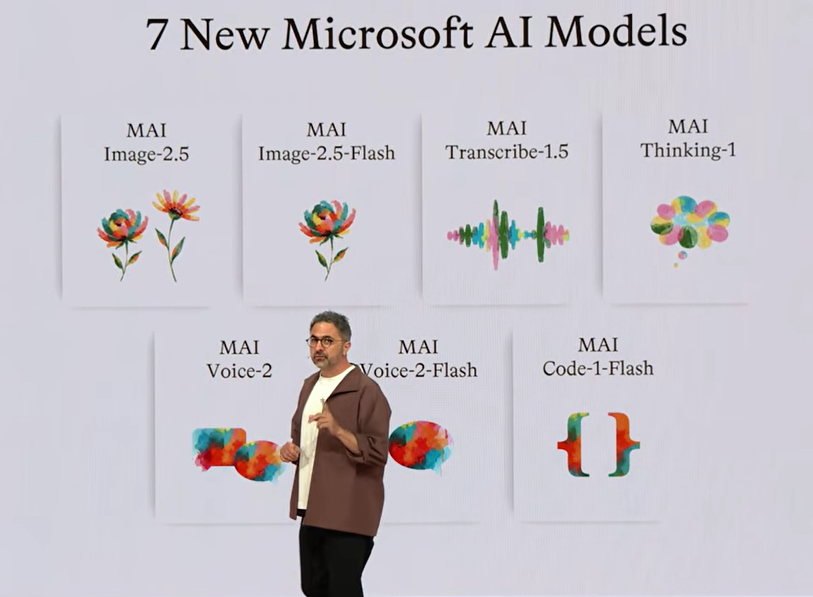
At the virtual stage of Microsoft’s annual Build developer conference in June 2026, the atmosphere carried a quiet but unmistakable charge of a revolution in the making. Mustafa Suleyman, the newly minted CEO of Microsoft AI, took to the screens to deliver an address that would fundamentally rewrite the geopolitics of the technology sector. For years, the conventional industry narrative cast Microsoft as a brilliant massive-scale distributor, a corporate giant that had masterfully hitched its wagon to the creative genius of independent startups like OpenAI and Anthropic. But Suleyman’s presentation of seven brand-new, internally engineered “MAI” models shattered that simplistic script. Built entirely from the ground up by the Microsoft AI Superintelligence Team, this new family of cognitive engines represents a monumental strategic pivot. It is a bold, public declaration of independence that signals Microsoft’s refusal to remain permanently dependent on external partners, no matter how close or lucrative those relationships might currently be. By stepping out from the shadow of its high-profile allies, Redmond is announcing that it intends to not only run the infrastructure of the intellectual era, but also to write the primary code of the minds that inhabit it.
To truly understand the human and corporate drama underlying this announcement, one must look at the incredibly complex, almost incestuous web of alliances that currently defines Silicon Valley. Over multiple funding rounds, Microsoft has poured a staggering, cumulative total of $13 billion into OpenAI, effectively keeping the ChatGPT creator fueled in its insatiable quest for computational power. Seeking further diversification, Microsoft subsequently directed up to $5 billion toward Anthropic, integrating its advanced Claude artificial intelligence into the Copilot Cowork ecosystem. Yet, loyalty is a highly volatile currency in the modern tech ecosystem; Anthropic is simultaneously backed by Microsoft’s fiercest rivals, Google and Amazon, while OpenAI has increasingly warmed its relations with Amazon as well. This delicate, polyamorous dance of multi-billion-dollar investments created a profound vulnerability for Microsoft, leaving its core product roadmap susceptible to the unpredictable boardroom squabbles, pricing whims, and shifting allegiances of independent startups. By systematically fabricating the MAI suite internally, Microsoft is constructing a massive corporate fortress, taking direct control of its technological destiny to ensure that its flagship software offerings remain immune to the turbulent winds of external corporate politics.
At the heart of Microsoft’s new philosophy is a concept that Suleyman passionately highlighted during his address: the preservation of absolute trust and long-term self-sufficiency through clean, uncompromised data lineage. In an era where AI development is frequently plagued by copyright lawsuits, ethical scandals, and the lazy practice of “model distillation”—where smaller models are cheaply trained on the distilled outputs of rival systems—Microsoft chose the arduous, expensive path of starting completely from absolute scratch. For corporate enterprises, who are naturally risk-averse and deeply concerned about the legal compliance of their digital infrastructure, this clean-slate approach is an incredibly powerful selling point. Suleyman designed these models specifically to address the anxieties of chief technology officers who worry about the legal integrity of their data pipelines, reassuring them that their AI tools are built on legally sound, original intellectual foundations. This is the digital equivalent of transitioning from highly processed, mystery-ingredient fast food to a wholly traceable, farm-to-table culinary experience, offering international enterprises a profound level of operational security and intellectual property protection that startup competitors simply cannot match.
The undeniable crown jewel of this new product suite is MAI-Thinking-1, a cutting-edge reasoning model that aims to revolutionize how machines engage in complex, multi-step problem solving. Rather than generating rapid, shallow conversational responses, reasoning models mimic human “System 2” thinking—slowing down to actively deliberate, analyze paths of logic, and self-correct errors before producing a final output. In rigorous, double-blind human evaluations against the finest models currently on the market, MAI-Thinking-1 drew completely even with Anthropic’s highly celebrated Claude Sonnet 4.6 and matched the formidable Claude Opus 4.6 on demanding programming benchmarks. What makes this feat particularly impressive is that it was achieved entirely through proprietary Microsoft engineering, proving that the company’s internal research divisions can match or exceed the outputs of the world’s most elite dedicated AI labs. In a characteristically pragmatic move, Microsoft is hosting this new flagship alongside rival models in its premium Foundry platform, letting corporate clients test them head-to-head, confident that their homegrown champion can win on its own objective merits.
While MAI-Thinking-1 serves as the heavy-duty intellectual engine of the family, the other six models in the suite are meticulously optimized to bring swift, practical utility directly to everyday human workflows. Among these is MAI-Code-1-Flash, a highly refined, 5-billion-parameter coding model specifically engineered to act as an instantaneous, seamless co-pilot for developers working within Visual Studio Code and GitHub Copilot. In the fast-paced realm of software engineering, high latency is the ultimate productivity killer; by optimizing a smaller parameter model for blistering speed, Microsoft ensures that helpful, highly accurate code completions appear on the screen in a fraction of a second, matching the natural rhythm of human thought. Simultaneously, the company unveiled MAI-Image-2.5, a powerful visual editing and generation system that has already secured second place on a prominent, independent industry leaderboard, comfortably outpacing Google’s Nano Banana Pro. This comprehensive coverage across reasoning, coding, linguistics, transcription, and computer vision demonstrates that Microsoft is not merely launching a single experimental tool, but is instead deploying a fully synchronized armada of specialized intelligent systems designed to master every aspect of modern digital life.
Ultimately, this pivotal showcase at Build 2026 offers us a fascinating glimpse into a future where the traditional paradigms of how we interact with personal computers are being completely dismantled. The rollout of these clean, locally controlled MAI models dovetails perfectly with Microsoft’s broader strategic initiatives, such as Project Solara—an innovative platform designed to run autonomous, proactive AI agents rather than traditional static software applications. By synthesizing its massive global cloud infrastructure, customized silicon chips, and now its own state-of-the-art native software models, Microsoft is rapidly evolving into a vertically integrated superpower capable of delivering an entirely frictionless user experience. For the everyday professional, developer, and casual consumer, this transition promises a world where artificial intelligence is no longer experienced as a clunky, foreign third-party add-on, but rather as a natural, highly secure, and deeply intuitive extension of the operating system itself. By pursuing true cognitive self-sufficiency, Microsoft is positioning itself to be more than just a landlord of the digital age; it is successfully building the very brainpower that will run the global modern economy for decades to come.