





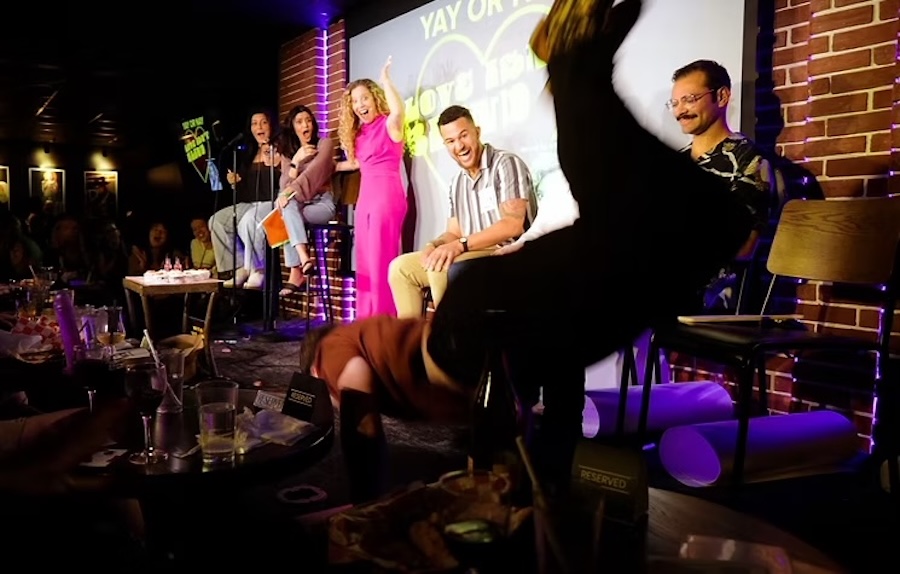
Imagine stepping onto a brightly lit stage, heart racing with the hope of finding a genuine human connection in an era dominated by superficial digital interactions, only to be greeted by a chorus of collective boos the moment your profession is announced. This is the bizarre, hilarious, and deeply telling reality for software engineers participating in “Love Isn’t Blind,” a touring live dating show hosted by the vibrant comedian Allison Goldberg. Clad in her eye-catching, signature pink attire, Goldberg serves as both a master of ceremonies and a bewildered cultural observer, standing at the epicenter of a unique regional phenomenon. During her stops in Seattle, Goldberg has witnessed firsthand a curious pattern: whenever she introduces a contestant who works in the tech industry, the local audience reflexively erupts in good-natured but pointed jeering. For Goldberg, a resident of Los Angeles—a city notorious for its highly competitive, unstable gig economy where finding a partner with a steady income can feel like searching for a needle in a haystack—this hostile reaction to gainful employment is utterly mind-boggling. “I’m sorry, are we booing a man with a job?” Goldberg famously questioned, highlighting the sheer irony of rejecting someone with a secure career, comprehensive health benefits, and a predictable schedule. This comedic friction on stage offers a fascinating, albeit unscientific, window into how tech workers are perceived in their own backyard, providing undeniable anecdotal evidence of a much larger, deeply rooted cultural conflict. It reveals a community grappling with its own success, where the very qualities that make a person an ideal partner on paper—stability, intelligence, and financial security—have somehow been transformed into a social liability. This paradox invites us to look beyond the laughter and explore the complex emotional and social landscape of a city that is constantly struggling to reconcile its wealthy present with its humble, artistic past.
To truly appreciate the bravery of the contestants who volunteer for this experience, one must understand the radically unconventional and deeply vulnerable mechanics of “Love Isn’t Blind.” Operating under the rebellious, refreshing battle cry of “F*** the apps,” the show serves as a direct, theatrical antidote to the clinical, exhausting world of modern digital matchmakers. On Goldberg’s stage, the traditional rules of courtship are completely dismantled: the male contestants competing for the affection of a single, hopeful bachelorette are stripped of their most basic tool of persuasion—they are forbidden from speaking a single word. Instead of relying on rehearsed pickup lines, practiced charisma, or polished, deceptive dating profiles, these men must allow their digital souls to be laid entirely bare before a live, highly opinionated audience. Goldberg takes on the role of an affectionate yet ruthless digital archaeologist, diving headfirst into the contents of the contestants’ smartphones. She scrolls through their text message histories, reads aloud from their deeply personal Notes apps, inspects their recent AI search queries, and even calls their unsuspecting mothers live on speakerphone to get the real, unfiltered truth about their character. Meanwhile, the audience holds physical green and red flags, waving them high in the air to collectively signal their approval or disapproval of each revelation. It is an intensely exposing, terrifyingly public, and yet incredibly humanizing process that strips away the manicured facades of modern social media. By forcing these singles to bypass the exhausting pretense of modern dating and expose the messy, mundane, and often hilarious realities of their daily lives, the show creates a space where true authenticity can shine through the digital clutter. This format forces both the participants and the audience to confront the reality that our digital footprints hold the true, unvarnished stories of who we are, far more than any carefully curated profile ever could.
This public roasting of tech workers is not just an isolated comedic gag; it is a direct reflection of Seattle’s long-running, deeply unresolved identity crisis. Decades after the initial tech boom transformed the Pacific Northwest, the city remains caught in a painful tug-of-war between its blue-collar, artistic, and countercultural heritage and the massive, high-earning influx of tech professionals who have redefined its skyline. For generations, Seattle prided itself on being a gritty, creative sanctuary—the proud birthplace of grunge music, a haven for independent artists, and a place where a modest living could still buy a vibrant, community-oriented life. The rapid rise of tech giants like Amazon and Microsoft, alongside a sprawling ecosystem of startups, brought unprecedented wealth and global influence, but it also brought skyrocketing rents, aggressive gentrification, and a creeping sense of cultural erasure. To many longtime residents, the ubiquitous “tech bro” became the convenient, walking symbol of these unwanted changes, leading to a pervasive, reflexive resentment that manifests in everything from hostile street art and anti-tech stickers to the playful booing heard in comedy clubs. Shows like “Socially Inept,” which previously specialized in roasting tech culture in the region, have long tapped into this same vein of local frustration. By laughing at the software engineers and project managers who now dominate the local economy, Seattleites are able to reclaim a small sense of ownership over their city’s narrative, using humor as a coping mechanism and a defense shield against the overwhelming tide of corporate monoculture that threatens to wash away their beloved local history.
However, when we look past the easy stereotypes and the satirical jeering, we find a much more complex and deeply human reality waiting beneath the surface of the “tech bro” caricature. The software engineers, data analysts, and Ph.D. candidates who fill Goldberg’s stages are not merely faceless agents of gentrification; they are real human beings searching for connection, community, and intimacy in a city that can often feel notoriously cold and insular. The phenomenon known as the “Seattle Freeze”—a widely recognized social barrier where locals are polite but distant, making it notoriously difficult for newcomers to forge deep friendships—only compounds the loneliness that many of these highly educated transplants experience. Many of these tech workers moved to the Pacific Northwest from all corners of the globe, drawn by career opportunities but leaving behind their established social safety nets. They spend their days solving complex, abstract logical problems in front of glowing screens, only to return home to a dating landscape that feels equally sterile, transactional, and exhausting. By volunteering to stand silently on a stage and have their personal lives picked apart by a comedian, these brave singles are demonstrating a profound willingness to step out of their comfort zones, embrace vulnerability, and laugh at themselves. They are actively trying to break through the digital wall that separates them from the community they wish to belong to. To dismiss them as mere corporate cogs is to ignore their shared humanity and their very basic, universal desire to be seen, understood, and loved for who they are, quirks and all.
Interestingly, Goldberg’s nationwide tour has revealed that Seattle’s audience and contestant pool possess a very distinct, intellectual flavor that sets them apart from other cities. While a show in Los Angeles or New York might be populated by aspiring influencers, actors, and media professionals, Seattle boasts an exceptionally high concentration of brilliant minds, featuring far more advanced degrees, scientific researchers, and software engineers than almost anywhere else. This high density of intellect creates a fascinating dynamic where the comedy is sharper, the self-deprecation is deeper, and the crowd’s expectations are uniquely challenging. The local audience’s tendency to boo their own tech-driven demographic is a complex, self-referential ritual; often, the very people booing the software engineers are software engineers themselves, engaging in a form of collective, lighthearted self-flagellation. It is an ironic acknowledgment of their own stereotype, a way of saying, “We know who we are, and we know how we are perceived.” This intellectual sophistication means that while the roasting is frequent, it is also highly nuanced, celebrating the dry wit and analytical minds of the participants even as it pokes fun at their perceived social awkwardness. The cultural friction in Seattle is therefore not a simple story of outsiders versus insiders, but a complex, evolving conversation among a highly educated population trying to negotiate their place in a rapidly changing world, proving that intelligence and a capacity for self-irony are among the city’s greatest, if most complicated, assets.
As “Love Isn’t Blind” prepares to make its highly anticipated return to the stage at the historic Fremont Abbey Arts Center, there is a powerful opportunity for the community to write a new chapter in this ongoing cultural dialogue. Rather than reinforcing the rigid divides that keep people siloed in their respective social enclaves, the event offers a joyful, communal space where creatives, blue-collar workers, and tech professionals can laugh at themselves and each other in equal measure. In an era defined by division and screen-mediated isolation, a live dating show that demands vulnerability and physical presence is a radical and necessary antidote. It serves as a reminder that regardless of our job titles, our income brackets, or how we feel about the changing cityscape, we are all ultimately searching for the same fundamental human connections. When the curtains rise this Friday, perhaps the audience can offer a bit of grace to the brave souls stepping onto the stage, choosing to celebrate their courage rather than dismiss them based on their professions. After all, in a dating world that often feels incredibly bleak, anyone willing to put their heart, their phone, and their mother on the line for a chance at love deserves more than just a punchline. It is time to bridge the gap between the artists and the engineers, to look past the stereotypes, and to go cheer for a geek who is brave enough to stand up, stay quiet, and let their humanity shine through.