


Amid the quiet, rain-drenched campus of Microsoft’s headquarters in Redmond, Washington, a small and visionary team has spent quarters working on a physical manifestation of our technological future. Led by Stevie Bathiche, a distinguished Technical Fellow and Corporate Vice President of the Applied Sciences Group, this team is quietly orchestrating a profound paradigm shift in how human beings interact with digital systems. Dubbed “Project Solara,” this ambitious initiative marks a radical departure from the screens, menus, and application grids that have dominated personal computing for nearly half a century. At its core, Solara is an ecosystem designed entirely around artificial intelligence agents rather than software apps, running on specialized, lightweight physical hardware. Instead of forcing human beings to adapt to the arbitrary silos of software applications—constantly switching between programs to complete a single real-world task—Project Solara is built upon a philosophy where technology molds itself directly around our physical lives. By utilizing off-the-shelf components, cloud computing, and advanced AI agents, Microsoft is aiming to create a highly flexible, low-cost platform that liberates users from the psychological friction of modern device screens, encouraging an era where technology returns to being a supportive background presence rather than an attention-grabbing tyrant.
The underlying architecture of Project Solara reflects a deliberate, highly pragmatic choice that prioritizes scalability, security, and rapid development over legacy corporate pride. Surprisingly, Microsoft has bypassed its flagship Windows operating system for this venture, opting instead to build the platform on the Microsoft Device Ecosystem Platform (MDEP)—an enterprise-grade, highly secure version of Android. For a company whose historical identity is deeply intertwined with Windows, this decision represents a bold step forward. Windows is an incredibly powerful OS, but it is also heavy, resource-intensive, and fundamentally built around the traditional desktop interface of mouse clicks, keyboards, and multiple windows. To power tiny, energy-efficient, and highly specialized devices, the team needed a streamlined foundation that could easily run on low-power mobile processors while retaining key enterprise guarantees. By choosing MDEP, Microsoft can keep the system incredibly lightweight while seamlessly integrating the security features corporate IT departments require, including Microsoft Defender, Intune, Entra ID, and regular over-the-air security patches. The physical hardware acts as a sensory portal, collecting local input, while the dynamic execution of AI agents is offloaded to the expansive Azure cloud ecosystem. This division of labor allows simple, inexpensive silicon to behave like a supercomputer, bridging the gap between local physical interaction and unlimited remote computing power.
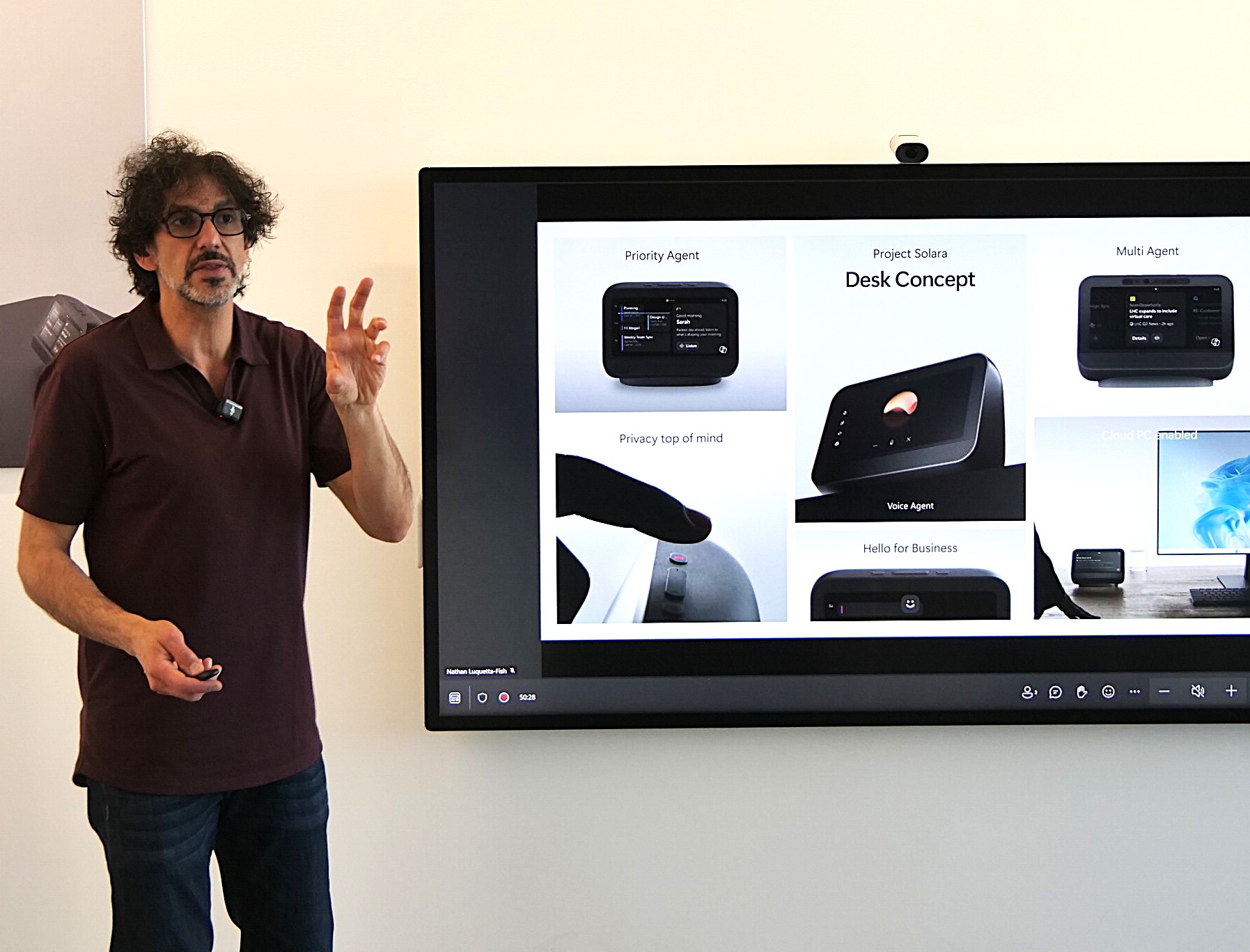
During the private briefing in Redmond, Microsoft demonstrated this philosophical shift through two physical prototypes, illustrating how different these agent-centric form factors are from contemporary consumer electronics. The first is a sleek, minimalist desktop hub designed to sit quietly beside a primary computer monitor. This companion unit leverages facial recognition to effortlessly sign a user in, monitors their schedule, and uses audio-spatial awareness to coordinate schedules, tasks, and communications through voice commands. In a clever design twist, if a user connects a monitor directly to this desktop hub, it immediately establishes a connection to the cloud, rendering a full Windows desktop operating in virtual space—conceptually proving that the device in front of you does not need physical heft to deliver heavy computational firepower. The second device is even more intimate: a smart, wearable employee badge designed to replace the standard identification cards worn by corporate workers. This badge features a fingerprint reader for instant verification, a specialized microphone that can record and transcribe natural conversations with a single tap, and an integrated camera. Rather than requiring a user to peer down at a screen, this non-intrusive wearable badge allows the AI agent to share the user’s physical field of view, helping them process and interpret real-world surroundings without interrupting human eye contact.
These initial hardware models raise an inevitable question that the Solara team has spent a great deal of time addressing: if we all carry incredibly capable smartphones in our pockets, why do we need dedicated physical badges or desktop hubs? Bathiche points out that the general-purpose smartphone, while revolutionary, has introduced significant psychological and physical friction into professional environments. In a clinical trial or hospital setting, for example, when a healthcare provider pulls out a personal smartphone to document patient vitals or search a medical database, the physical gesture creates a psychological barrier; the patient feels ignored, and serious questions about data privacy and hardware sanitation immediately arise. A dedicated, single-purpose enterprise device like the Solara wearable badge presents an entirely different human dynamic. It has a significantly smaller attack surface for security breaches, features a battery life optimized to last for days rather than hours, and is designed to sit quietly on a lapel so that the worker can maintain face-to-face eye contact with patients or clients. It is this practical approach to workplace environments that has attracted major brand partners—including retail and healthcare giants CVS Health, Best Buy, Target, Levi’s, and AccuWeather—to prepare pilots for Solara-based reference designs, aiming to make their workforces more present and effective.
The unveiling of Project Solara at the annual Build conference highlights the intense, high-stakes competition currently shaping the landscape of artificial intelligence. Microsoft is engaged in a relentless race against heavily funded competitors like Apple, Google, Amazon, and OpenAI to build the next iteration of consumer and enterprise hardware. Microsoft’s CEO, Satya Nadella, was so impressed by the early prototypes that he pushed the team to debut Solara publicly far earlier than is typical for a experimental lab project. This aggressive timeline illustrates just how rapidly AI-driven development is accelerating the hardware production cycle. Using off-the-shelf chipsets from MediaTek and Qualcomm rather than waiting years to design custom proprietary silicon, the Applied Sciences Group managed to get the wearable badge prototype fully functional on the Solara platform in a mere three days. This agility means that hardware is no longer the bottleneck block it once was; any company can quickly and affordably design a custom device tailored to their specific industry—whether it takes the form of smart glasses for warehouse logistics, connected rings for corporate biometrics, or specialized retail scanners—without incurring multi-million-dollar experimental costs.
Ultimately, Project Solara is a window into a more human-centric technological era, championing a philosophy known as “ambient computing.” For the past two decades, personal technology has clawed voraciously at our attention, pulling our eyes away from our physical surroundings and burying our minds in endless feeds, notification alerts, and digital clutter. Solara represents a quiet rebellion against this paradigm, attempting to return technology to the background of our everyday lives where it can support us without demanding our constant gaze. By shifting the user interface from bright touchscreens to natural voice commands, spatial awareness, and intuitive contextual prompts, Bathiche and his team are designing tools that respect human focus rather than exploit it. As computing devices naturally specialize and become smaller, they inevitably move closer to our bodies, integrating into the physical fabric of our work, our clothes, and our homes. If Microsoft’s vision for Project Solara succeeds, it will not only redefine the physical tools we use to get things done; it will fundamentally restore our relationship with our immediate physical environment, enabling us to engage with the digital world with greater presence, focus, and humanity.