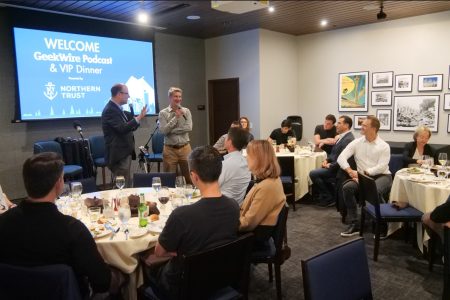



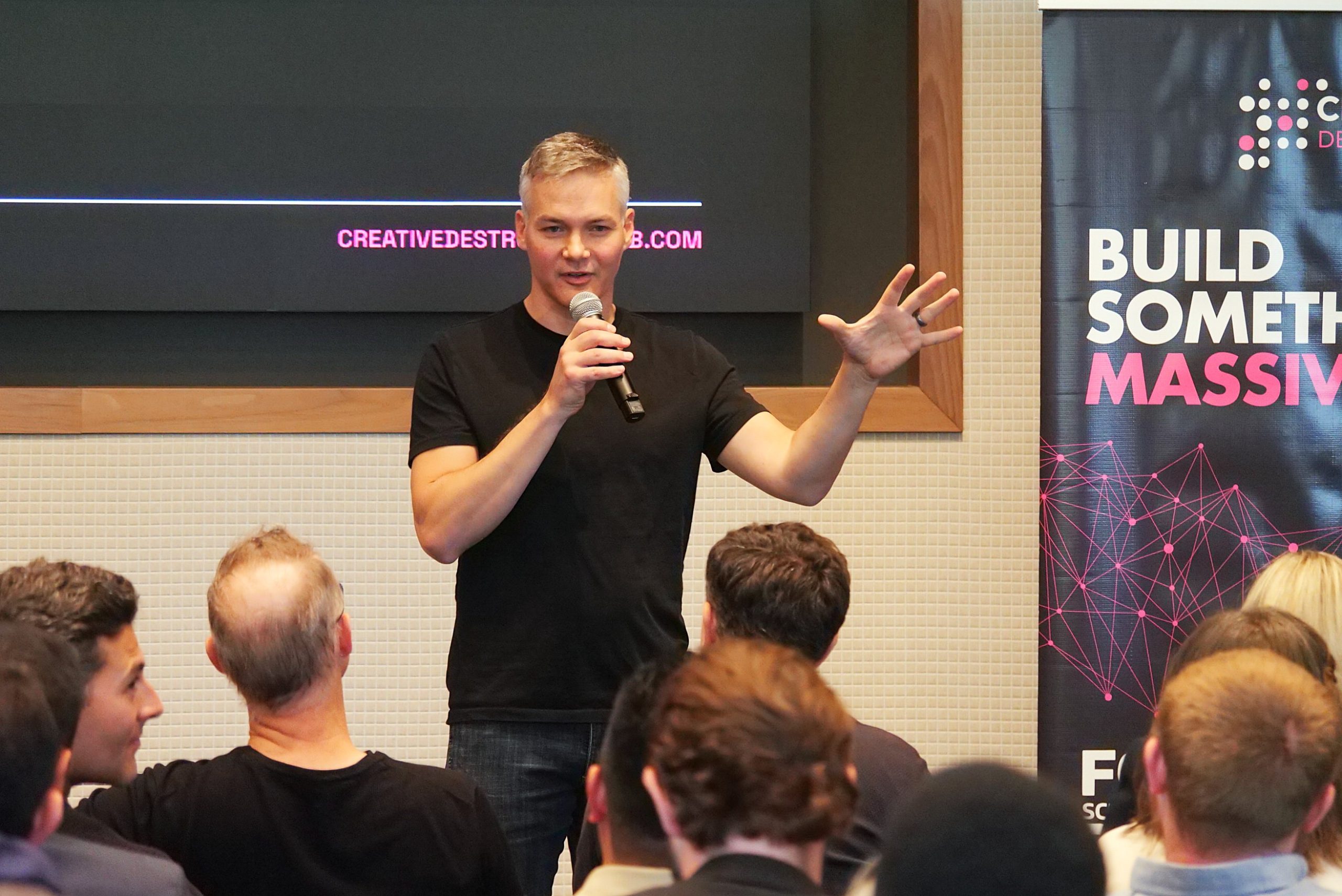
Andy Lapsa stood at the podium in a Seattle event space, reading from several sheets of printed paper, his voice catching at times as he told the story of why he started Stoke Space and what it cost him. He gave up a well-paying job, spent his family’s nest egg, and went fifteen months without paying himself anything close to his old salary. For anyone who has ever dreamed of building something from nothing, the picture he painted was achingly familiar: the sleepless nights, the gnawing doubt, the quiet fear that the bet won’t pay off. And yet Lapsa, the CEO of the Kent, Washington-based rocket company, wasn’t there to ask for sympathy or applause. He was there to ask a harder question. If he and co-founder Tom Feldman were starting Stoke today, would they choose Washington again? His honest answer, delivered to a hushed room at the Creative Destruction Lab-Seattle event “Manufacturing the Future in the PNW: Space, Defense & Robotics,” was: “I’m not sure we’d make the same decision.” The audience gave him a standing ovation. The moment felt less like a victory lap than a wake-up call, the kind of frank, uncomfortable truth that lingers long after the room empties.
Lapsa’s speech was rooted in a deep affection for Washington, not a dismissal of it. He acknowledged that Stoke chose the state for world-class talent spanning software, aerospace, and manufacturing, and for a virtuous cycle that has made the region a launchpad for ambition. Iconic global companies bring skilled people and suppliers to the area, and the alumni of those companies eventually leave to start companies of their own. That ecosystem is real, and Lapsa is grateful for it. But he also ticked through reasons why he isn’t sure a fresh founder would bet on Washington today. He pointed to a political climate that, in his view, vilifies successful companies and the people who build them. He noted that the state does less than others to actively court promising startups, that Seattle’s public schools feel like a failed institution to many families, and that the push for a wealth tax on unrealized gains would make the founder’s journey nearly impossible for anyone who isn’t already wealthy. The consequence, he warned, is that the next generation of Stoke Spaces might not happen here. He said it without bitterness, more with the weary concern of someone who wants his home state to wake up before it loses what makes it special. “What will it take to ensure the next Stoke builds here, too?” he asked. It was a question aimed squarely at the politicians, business leaders, and citizens in the room, and it carried a sense of urgency that no amount of polished talking points could match.
Lapsa’s message echoed a broader conversation that has been building in Washington for some time. In July, former Starbucks CEO Howard Schultz wrote a Wall Street Journal op-ed singling out Stoke Space as a test for the state, urging everyone to watch whether Stoke and other companies decide that Washington is the best place for them to grow. Schultz, who himself moved to Miami earlier this year, became part of Lapsa’s narrative. Lapsa invoked Jeff Bezos and Schultz as examples of founders the region has welcomed in spirit but sometimes vilified in practice, and he pointed to Boeing’s decision to move its headquarters and Amazon’s HQ2 search as warning signs that Washington can no longer take its homegrown giants for granted. The frustration is not abstract. Lapsa revealed that South Carolina, Texas, Florida, Ohio, Idaho, and Illinois had all emailed him in the past week or two, trying to lure Stoke to open operations in their states. “I’ve never received the same in Washington state,” he said. That line landed like a thud. Lapsa made clear that Stoke isn’t planning to leave and that his comments were hypothetical, aimed at founders starting new companies, not at threatening a relocation. But the fact that other states are actively recruiting one of the most exciting aerospace companies in America while Washington stays silent is a powerful illustration of the gap between state pride and state policy.
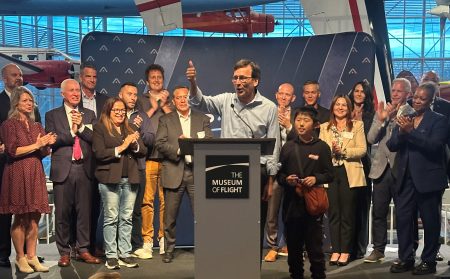
Hours later, Lapsa was introduced as one of twenty-three members of Governor Bob Ferguson’s new Washington Space Council at the Space Week kickoff at the Museum of Flight. In those remarks, he struck a similar tone but with an added sense of urgency. He described the competition as real and unrelenting. “States like Florida and Texas and Colorado want this industry, and they want it bad,” he said. “They compete for it every day. Washington has every advantage it needs to lead them all, and the window to use those advantages is open right now.” It is hard to overstate the weight that Stoke’s progress gives to Lapsa’s words. The company is developing Nova, a rocket designed so that both of its stages can return and fly again, with the goal of making access to space cheaper and more frequent. Only SpaceX has pursued full reusability before, and even SpaceX still doesn’t reuse its Starship upper stage. Stoke is also only the second company to go down this demanding path. The company announced a roughly $1 billion Series E round this month, bringing its total funding to about $2.3 billion. It employs more than 350 people in Washington, operates a 168,000-square-foot factory in Kent, and is expanding its test site in Moses Lake from 75 to 550 acres. The first Nova launch is scheduled for early 2027 from Cape Canaveral. Those are not the numbers of a pipe dream; they are the markers of a serious enterprise that could anchor Washington’s aerospace future for decades. And yet Lapsa’s worry is not about Stoke’s survival. It’s about the next founder, the one working out of a garage or a spare bedroom, who might decide it’s not worth the fight here.
The most personal part of Lapsa’s speech came when he explained why the proposed wealth tax on unrealized gains frightens him so deeply. He told a story he said he had never told before, one that grounded his policy objections in lived experience. His father grew up in a post-war refugee camp and waited twelve years to immigrate to the United States, arriving without speaking English. He eventually became a university researcher, but Lapsa’s mother still worked a minimum-wage job to help put Lapsa and his two siblings through college. Lapsa and his wife graduated from college about $200,000 in debt and spent roughly a decade paying it off. When he left Blue Origin to start Stoke in 2019, he gave himself nine months to get on track to earning a living wage. Small-business grants and a few angel investors kept the company alive. That is the context in which he views a tax on unrealized gains. When a startup raises money, its founders become wealthy on paper overnight, but they don’t have a dime of cash to pay a tax bill based on that paper valuation. Lapsa’s warning was blunt: “It makes it so that the only people who can afford to start a company are the people who are already rich.” For him, this is not an abstract debate about tax policy. It is a matter of whether the American dream remains accessible to people who don’t start with a safety net. His father’s journey, his family’s sacrifices, and his own years of struggle all stand behind that sentence. The room grew quieter as he spoke, and for a moment his voice almost broke.
But Lapsa closed on a note of optimism, and it was not the hollow optimism of a man pretending everything is fine. He urged the audience to look past the headlines in their feeds and think critically about the consequences of the policies being proposed. He warned that political extremism harms the country and benefits its adversaries, and that both sides of the aisle are feeding a dangerous cycle of rhetoric that makes it harder to solve real problems. He reminded everyone that Americans have more in common than their differences, and that the freedoms they share, including the ability to change public policy when it isn’t working, are what made the United States the greatest country in history. “These are the reasons I stubbornly cling to the hope that Washington state will come around,” he concluded, “and the next Stoke Space decides here is their place.” The stubbornness in his voice was unmistakable. He wasn’t promising that the state will change course or that the political wind will shift. He was saying that hope itself is a choice, and that the future depends on people showing up and demanding better. The standing ovation that followed was not just for his speech. It was for the courage to tell the truth, the vulnerability to share his family’s story, and the belief that Washington can still be the place where the next great dream takes root. Whether that belief becomes reality depends on whether the rest of us listen, not just to his words, but to the warning beneath them.