



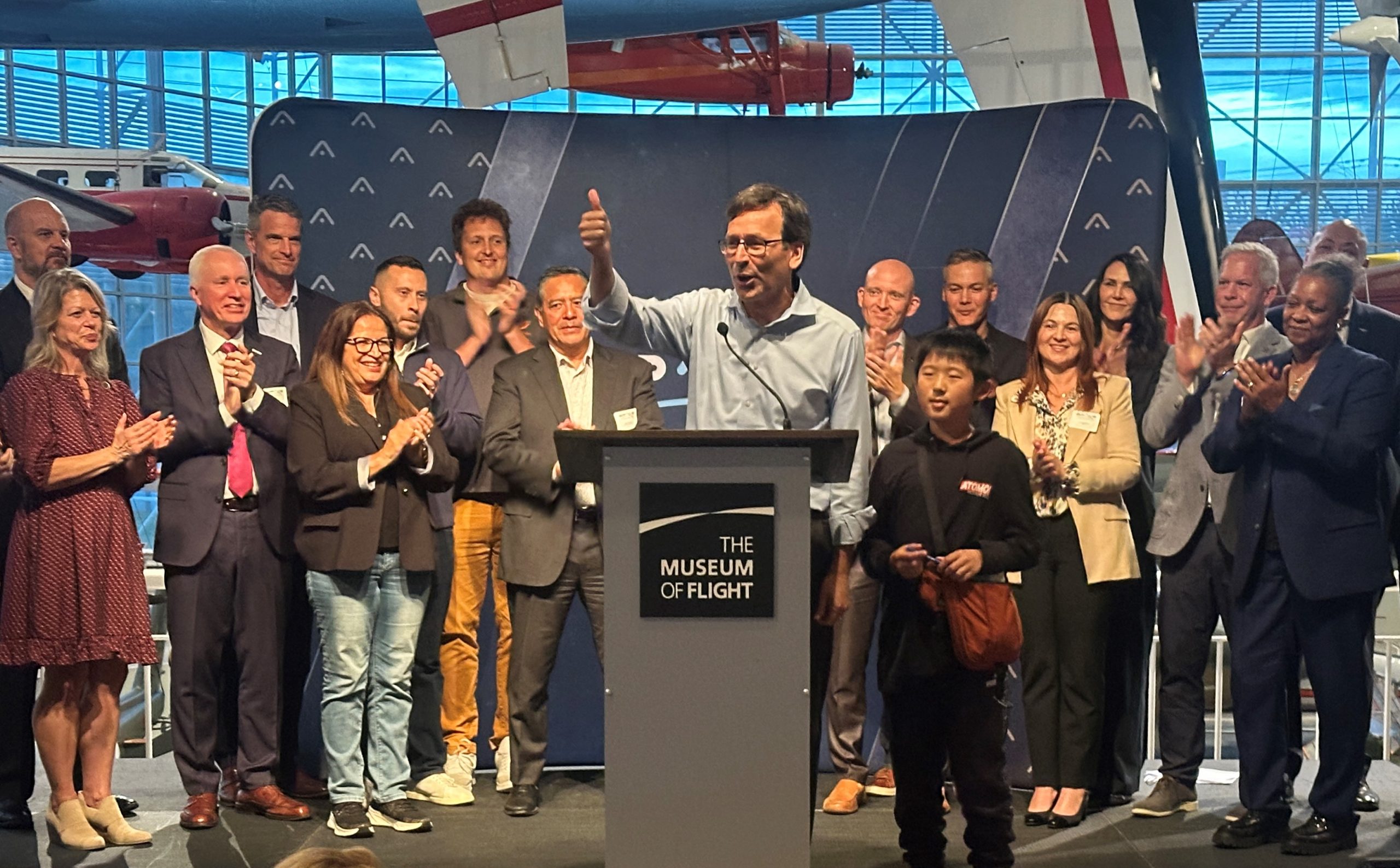
On a late September evening in 2026, the Museum of Flight became the staging ground for Washington state’s next chapter in the space age. Gov. Bob Ferguson arrived not with a ribbon to cut but with an executive order to sign, one that would formally create the Washington Space Council, a 23-member public-private partnership intended to elevate the Evergreen State’s profile in an increasingly competitive national space industry. The event doubled as the kickoff for Seattle Space Week, organized by the nonprofit Space Northwest, and the room was filled with an eclectic mix of people: engineers in fleece vests, executives in tailored suits, university students with backpacks, union representatives, and government staffers. The atmosphere was optimistic but focused. Ferguson, who has made clear that Washington intends to fight for its aerospace heritage, laid out the council’s mission in simple terms: keep the state competitive by comparing it with other leading space states and finding ways to improve. The museum itself was a fitting venue, with historic aircraft suspended from the ceiling and the legacy of Boeing, Apollo, and commercial aviation all around. Yet the evening was less about looking backward than about positioning for the future. The most memorable part of the evening came when Ferguson invited 10-year-old Sebastian Yu onto the stage. The governor signed the order, then handed the pen to the boy. “Your assignment, Sebastian, is that when we do that first launch, you have to save this pen and bring it with you to the first launch,” Ferguson said. “Take care of this pen, OK? I’m going to expect to see it again someday.” The gesture turned a bureaucratic milestone into a promise across generations.
Ferguson offered figures to make the case that Washington is already a space powerhouse. He said the state is home to more than 90 space companies, employs more than 13,000 workers, generates over $4 billion in annual economic activity, and produces $1.6 billion in annual payroll. Those are impressive numbers, but the governor used them as a baseline rather than a victory lap. The industry is being courted intensely by other states, and the crowd heard a blunt warning from Andy Lapsa, co-founder and CEO of Kent-based Stoke Space, which is developing reusable rockets. “States like Florida and Texas and Colorado want this industry, and they want it bad,” Lapsa said. “They compete for it every day. Washington has every advantage it needs to lead them all, and the window to use those advantages is open right now.” Lapsa’s words carried particular weight because he has chosen to build his company in Washington, even though he could have located it almost anywhere. His message was that the state’s natural advantages — a deep talent pool, a legacy of aerospace engineering, a culture of innovation, and proximity to some of the world’s most influential technology companies — are not enough unless public policy keeps pace. The competition is not theoretical. Florida has Cape Canaveral and a long history of launches; Texas has SpaceX’s Boca Chica operations and a growing commercial spaceport ecosystem; Colorado has a dense cluster of aerospace contractors and research institutions. Washington has its own strengths, but strength alone does not guarantee survival in a market where incentives, infrastructure, and regulatory environments can shift investment from one state to another in a matter of years, or even months.
Then there is the existing ecosystem, which is broader and deeper than many outsiders realize. Boeing has historically anchored the state’s aerospace industry, and while commercial aviation remains a massive employer, the space sector has begun to develop its own identity. Blue Origin, Jeff Bezos’s rocket company, is one of the most prominent space ventures in Washington, but the state’s real specialty may be satellites. According to officials at the event, more than half of the world’s satellites are built in the Seattle area. That statistic becomes more tangible when you look at the map: SpaceX operates large Starlink satellite facilities in Redmond and Woodinville; Amazon Leo, the company’s low-Earth-orbit satellite project, has a factory in Kirkland; BlackSky builds spacecraft in Tukwila; and Xplore has operations in Bellevue. This concentration has made the Puget Sound region a critical node in the global communications infrastructure that much of the world now relies on for internet access, navigation, and earth observation. The new Washington Space Council reflects that breadth. Its 23 members include not just company executives but elected officials, union leaders, educators, investors, representatives from space-related technology companies, and researchers from Pacific Northwest National Laboratory. The list includes names like Gravitics, which is working on space station modules; Interlune, a company exploring lunar resources; Portal Space Systems, which is developing advanced spacecraft propulsion; Starcloud, which aims to provide space-based cloud computing; and Starfish Space, which is working on orbital servicing and debris removal. The mix is a reminder that space is no longer a single vertical industry but a sprawling ecosystem that touches software, materials science, propulsion, manufacturing, telecommunications, and defense. It also means the council’s work will require balancing the needs of startups and established giants, public-sector priorities and private-sector incentives.
Ferguson described the council not as a ceremonial body but as a working group with a clear agenda. “It will identify barriers for the industry and find opportunities for growth,” he said. That includes workforce development, infrastructure, and much more. One particularly ambitious item on the agenda caught the room’s attention: exploring Washington-based commercial launch capabilities. Washington has not historically been an orbital launch state; most American rockets lift off from Florida, Texas, or California. But the idea of launching rockets from the Pacific Northwest has been discussed for years, and Ferguson’s mention of it drew audible excitement. “That would be a very exciting addition to what we’re doing right here in Washington,” he said. The governor also framed the council’s work in comparative terms: it will benchmark Washington against other leading space states and develop strategies to remain attractive to companies that are constantly weighing where to expand or relocate. This is not an abstract exercise. Workforce development means ensuring that the next generation of engineers, technicians, and manufacturing workers are trained in Washington and want to stay there. Infrastructure means making sure that industrial land, energy, water, and transportation are available and affordable. The council’s job is to connect the dots between public investment and private innovation. And by creating a formal public-private structure, Ferguson is attempting to ensure that the industry’s priorities remain visible to state government long after the current news cycle fades. The signing ceremony, with its handoff of the pen to Sebastian Yu, underscored that point in a way no policy document could: the decisions made in the coming years will shape not just the state’s economy but the opportunities available to people who are still children today.
The evening also honored the people and organizations already doing the work. Space Northwest presented three awards during the kickoff. The Shooting Star award for municipal support went to the city of Kent, where Boeing once built lunar rovers for NASA’s Apollo missions in the 1970s. Kent Mayor Dana Ralph accepted the award with a mixture of pride and humility, noting that the city’s space heritage runs deep but that past success is no guarantee of future relevance. “Our job is to make it possible for companies to build and grow and hire,” Ralph said. “That means reinvesting in the basics: roads, great mobility, water, sewer, plentiful and easily accessible energy and industrial land.” Her emphasis on basic infrastructure was a grounding reminder that the space industry, for all its high-tech glamour, depends on the unglamorous work of municipal government. Portal Space Systems won the Rising Star award for emerging companies, a recognition of its momentum in spacecraft propulsion and in-space transportation. SpaceX, which operates one of the largest and most consequential space companies in the world, received the North Star award for large space companies, a nod to its satellite manufacturing presence in the Seattle area even though its headquarters and launch operations are elsewhere. On the education front, Mehran Mesbahi, professor and chair of the University of Washington’s Department of Aeronautics and Astronautics, highlighted the university’s efforts to expand pathways into the industry. “We have Husky Satellite Lab, a group of energized students at UW, and we’re going to create a certificate program around space systems going forward,” he said. The lineup of recognized organizations and educational initiatives made clear that Washington’s space ecosystem is not just a collection of companies; it’s a community of institutions, governments, schools, and individuals all invested in keeping the region relevant.
By the time the ceremony ended, the outlines of Washington’s ambitions were clear. The creation of the Washington Space Council is a statement, but it is also a starting point. The space industry is at a pivotal moment: launch costs are falling, satellites are multiplying, and nations and companies are racing to establish presence in orbit and beyond. Washington finds itself in an enviable position, with a dense cluster of space ventures, a workforce steeped in aerospace and software, and a governor willing to put public weight behind the industry. But the window Lapsa spoke of will not stay open forever. Other states are courting the same companies with tax breaks, dedicated spaceports, and streamlined regulations. The council’s success will depend on whether it can translate good intentions into concrete action — whether it can help build new launch capabilities, support workforce training, remove regulatory obstacles, and create the conditions for companies to stay and grow. There is also something more intangible at stake: identity. Washington has long been known as the birthplace of Boeing and the home of Amazon and Microsoft, but its identity as a space state is still being written. Events like this one, and the people who attended it, are part of that story. Seattle Space Week continues with the Space Northwest Symposium on Tuesday, but the broader conversation about the region’s future in space is just beginning. The scene onstage — a governor, a room full of leaders, and a 10-year-old holding a pen — captured the essential optimism of the industry: that the future is not already determined, and that the people who show up to shape it will decide where the next frontier begins. If all goes according to plan, Sebastian Yu will be an adult when Washington’s first launch finally happens, and he will carry with him a pen that once represented a promise made in a museum. That’s a lovely image. But it is also a challenge to everyone who entered that room: make sure the promise is kept.