





For as long as humans have looked up at the night sky, we have been captivated by the silent, mesmerizing brilliance of the stars. Those celestial bodies, burning bright across billions of years, perform a cosmic dance of nuclear fusion—compressing hydrogen atoms under extreme gravity and heat to unleash a nearly limitless wellspring of clean, radiant energy. For decades, the dream of capturing this stellar engine and housing it within a man-made machine has been the holy grail of modern science, a poetic promise of an earthbound future completely free of fossil fuels, carbon emissions, and energy scarcity. Today, that dream is transitioning from the pages of science fiction into the high-stakes arenas of venture capital and commercial engineering. Helion Energy, an ambitious startup nestled in Everett, Wash., recently sent shockwaves through both the energy and technology sectors by announcing a massive new $465 million funding round. This latest injection of capital brings the company’s total raised funding to more than $1.5 billion, propelling its market valuation to an astronomical $15.5 billion. In a world increasingly desperate for reliable, sustainable energy to combat the escalating climate crisis, Helion’s co-founder and Chief Executive Officer, David Kirtley, stands firm in his conviction that his team is uniquely positioned to achieve the unthinkable: generating commercially viable electricity from nuclear fusion within the current decade.
This bold pursuit is not mere academic posturing; it is backed by concrete, high-value corporate commitments that are forcing the rest of the energy industry to take notice. While traditional nuclear projects often span decades and run billions of dollars over budget, Helion is moving at a breakneck, startup-style pace to meet an incredibly tight deadline. The company has entered into a landmark, first-of-its-kind agreement with tech giant Microsoft to deliver fusion-generated power to one of its massive data centers in Central Washington by 2028. To fulfill this contract, Helion broke ground last July on a 50-megawatt commercial fusion plant, which they have aptly named Orion, situated in Malaga, Wash. The choice of Malaga is highly symbolic, representing a bridge between the rustic, agricultural heart of the Pacific Northwest and the hyper-advanced, energy-hungry digital landscape of the future. The urgency of this project is further highlighted by the explosion of artificial intelligence, which requires vast amounts of electricity to power the data centers that train and run neural networks. Pointedly, OpenAI’s Chief Executive Officer, Sam Altman, is one of Helion’s most prominent champions and investors; court documents recently revealed that he owns roughly a third of the startup. Though Altman recently stepped off Helion’s board and was not directly involved in negotiations, OpenAI itself has actively explored power purchase agreements with Helion. This deeply underscores a profound realization among tech leaders: to power the next generation of artificial minds, we must first master the energy of the stars.
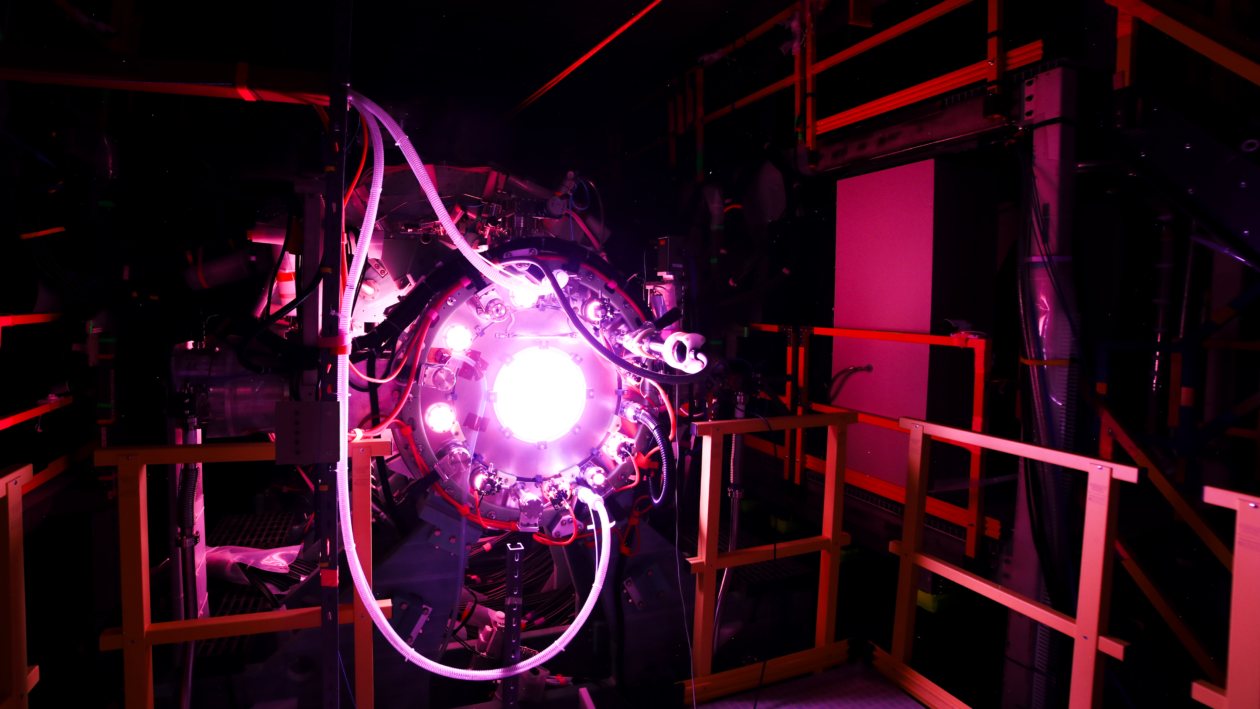
Yet, translating astrophysics into an earthly utility grid requires conquering complex physical realities that have baffled the world’s greatest minds for nearly a century. At Helion’s research facility in Everett, engineers are working tirelessly to tame plasma—super-heated gas that mimics the intense conditions found inside the core of a star. The primary testbed for this research is Polaris, a massive, sixty-foot-long, seventh-generation fusion prototype that pulses with a brilliantly hot, ethereal glow when active. However, because working with a machine of Polaris’s scale is incredibly time-consuming and expensive, the company’s brilliant scientific minds have conceived a clever detour to accelerate their learning curve. Helion recently unveiled a secondary project known as “Tiny Merge,” an agile, scaled-down machine that is roughly one-eighth the size of Polaris. As Michael Hua, Helion’s senior director of radiation safety and nuclear science, pointed out, this miniature testing ground allows engineers to try out radical new ideas with a fraction of the energy and resources. This philosophy of rapid, agile iteration—failing fast, learning quickly, and constantly adjusting parameters on a smaller scale—is a hallmark of software engineering, but applying it to the stubborn, highly hazardous field of plasma physics represents a fascinating and potentially revolutionary paradigm shift.
Despite the infectious optimism and the influx of cash flowing into Everett, the broader scientific community remains deeply divided, viewing Helion’s rapid timeline with a healthy dose of skepticism. Many veteran physicists and independent researchers argue that immense technical hurdles stand between today’s laboratory prototypes and a fully operational, grid-connected power plant. A major source of frustration for critics is Helion’s culture of corporate secrecy; unlike traditional research institutions, the company has published relatively few peer-reviewed scientific papers. This makes it challenging for outside experts to thoroughly evaluate their design, leaving some to worry that Helion’s lofty promises may be running ahead of the verifiable science. Adding fuel to this competitive fire is Commonwealth Fusion Systems, a formidable rival emerging from the Massachusetts Institute of Technology ecosystem. Taking a more traditional, academically open route, the Massachusetts-based startup has raised nearly $3 billion and is aiming to commercialize its own fusion technology by the early 2030s. Commonwealth recently announced that five peer-reviewed scientific papers have officially validated the fundamental physics underlying their approach. This setting creates a thrilling, high-stakes ideological race: on one side stands a highly open, peer-reviewed academic model, and on the other, a secretive, Silicon Valley-style sprint to market.
Nevertheless, the financial world seems more than willing to bet heavily on Helion’s secretive and aggressive strategy, as evidenced by the star-studded roster of investors backing their latest Series G funding round. The massive investment was led by the prominent venture firm Thrive Capital, alongside a diverse array of new backers that includes Alta Park Capital, Anti Fund, BoxGroup, Lux Capital, Peak XV Partners, and even Ford Motor Company’s Executive Chairman, Bill Ford, who brings a legacy of industrial manufacturing expertise to the table. Existing heavy hitters such as Capricorn Technology Impact Funds, Lightspeed Venture Partners, Mithril Capital, SoftBank Vision Fund 2, and Dustin Moskovitz’s Good Ventures Foundation also stepped up to double down on their support. This historic funding round represents the largest venture capital infusion into a Pacific Northwest startup so far this year, securing Helion’s coveted number-one spot on the GeekWire 200 ranking of regional startups. This monumental financial support demonstrates that the global investment community is no longer viewing fusion as an elusive, far-off dream, but rather as one of the most bankable and critically transformational investment opportunities of the modern era.
Ultimately, the story of Helion Energy is not just a tale of corporate finance, high-powered lasers, or competitive tech rivalries; it is a profoundly human endeavor, driven by the audacity of engineers and scientists who refuse to accept the status quo. If Helion successfully delivers on its historic promise to Microsoft in 2028, it will mark a definitive turning point in human history, fundamentally rewriting our relationship with the natural world and decoupling human progress from environmental destruction. Even if they hit unforeseen roadblocks along the way, the sheer scale of intellect, capital, and relentless passion being poured into these experimental hangars in Washington State is pushing the boundaries of what humanity can achieve. By daring to capture the very fire of the heavens to warm our homes, illuminate our cities, and power our digital future, these dreamers are proving that we are no longer just passive observers of the universe’s grandest forces. Instead, we are active participants, slowly but surely learning how to build our own stars right here on Earth.