


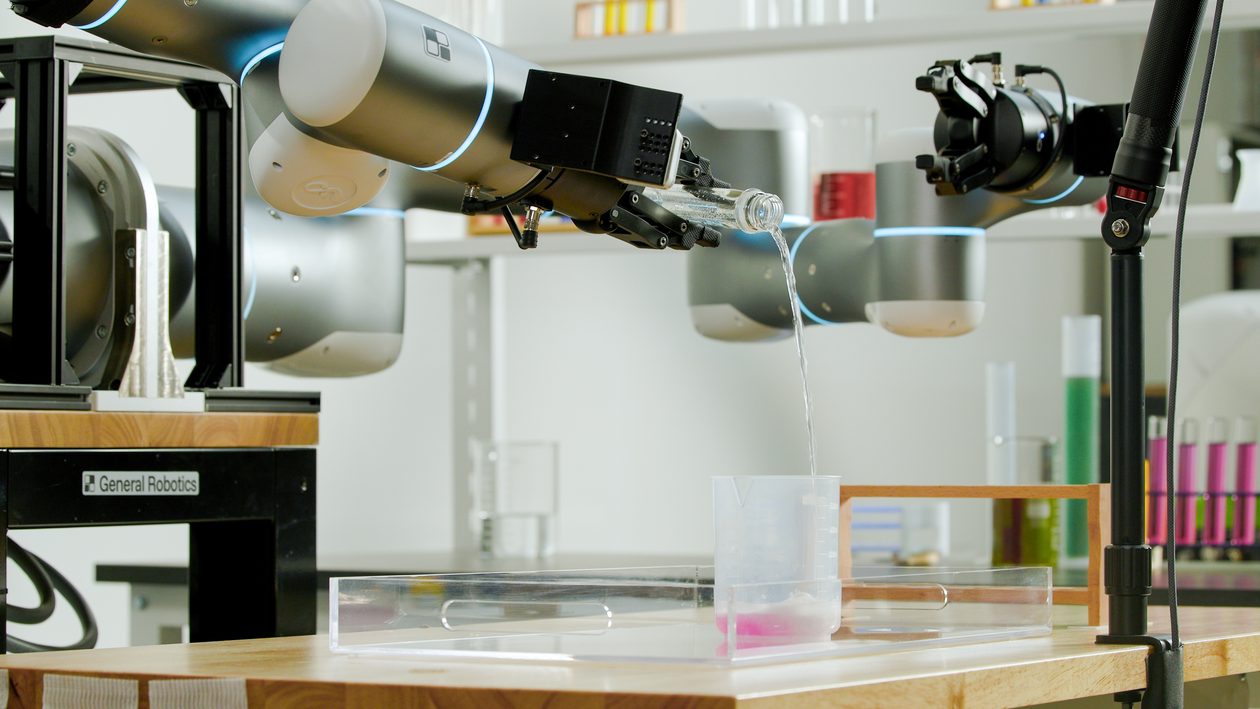
Behind the unassuming doors of a Redmond, Washington, laboratory, a robotic arm carefully tilts a test tube over a beaker. It seems like a simple, almost mundane gesture, but it represents a seismic shift in how industrial automation is coming to life. For decades, the chasm between a robot’s raw mechanical capability and its real-world usefulness has been bridged by highly specialized engineers who spend weeks, sometimes months, coding, tweaking, and troubleshooting every single deployment. This intricate ballet of cables, software patches, and manual calibration has been the industry’s dirty secret: the hardware was ready, but the integration was a bottleneck. Today, a startup born from the minds of former Microsoft researchers is rewriting that calculus. General Robotics, with its newly unveiled “Auto Engineering” capabilities, is demonstrating that the arduous, multi-week process of onboarding a robot into a factory or warehouse can now be compressed into a startling two hours, effectively handing the keys to the machine over to the machine itself.
The core of this transformation lies within GRID, the company’s robot intelligence platform, which has undergone a significant evolution. The previous paradigm demanded that a dedicated team of experts travel to a site, map the environment, manually program the robot’s path, and iterate endlessly to ensure the machine could handle edge cases—like a stray pallet or a slightly misaligned component. General Robotics’ new approach treats deployment not as a one-off engineering project, but as a continuous learning loop. When a robot is first placed in situ, the system observes, simulates, and auto-generates the necessary control policies. It diagnoses its own failures, learns from them, and pushes that knowledge back into the central GRID database. Consequently, every single robot deployed acts as a sensor for the next. If a robot manages a tricky pick-and-place task in a Singapore port, the lessons learned are instantly available to a robot prepping for a similar task in a German automotive plant. This self-generating cycle of intelligence is what allows the timeline to shrink so dramatically, shifting the human role from micromanaging code to high-level supervision and strategy.
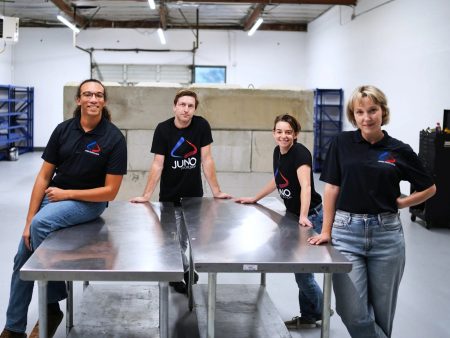
At the helm of this quiet revolution is Ashish Kapoor, the CEO and co-founder, whose career arc has been defined by bridging the virtual and physical worlds. Kapoor spent seventeen years at Microsoft, ultimately serving as the general manager of its autonomous systems and robotics research group in Redmond, where he created AirSim, the open-source drone simulator that became a cornerstone for aerial robotics research. He left that stability with two colleagues from the same team—CTO Sai Vemprala and Shuhang Chen—to start the company. They initially launched in 2023 as Scaled Foundations, pitching a bold vision of creating a “ChatGPT for robots,” with a core focus on aerial drones and a lean team of just five people. The name change to General Robotics signified a broadening of ambition; they were no longer just about flying machines, but about creating the foundational intelligence for any autonomous machine. Looking back, Kapoor notes the frustration that sparked the venture: the realization that even the best robot hardware is essentially inert without the complex “last layer” of situational awareness and task execution that makes it valuable in a specific setting.
The practical implications of this “Auto Engineering” approach are staggering for the industrial sector, where labor shortages and the need for efficiency collide with astronomical integration costs. Imagine a sprawling shipping terminal that wants to introduce a fleet of autonomous wheeled robots to transport cargo. Traditionally, this requires a team of roboticists to spend a month writing custom navigation software, testing it against the facility’s unique layout, and programming fallback routines for human interaction. With GRID, Kapoor explains, the system handles the heavy lifting. The platform supports a dizzying array of hardware—industrial arms, humanoids, quadrupeds that can clamber over rough terrain, wheeled platforms, and even drones—and it connects them to the specific task at hand. The company currently boasts roughly a dozen large enterprise customers across manufacturing, logistics, energy, and defense, generating millions in revenue. One notable partner is HTX, the science and technology agency of Singapore’s Ministry of Home Affairs, which has been working with the startup for a year and a half, assessing how autonomous systems can assist in public safety and security scenarios.
Checking the balance sheet, General Robotics finds itself in a lucrative, crowded, and highly competitive market. The company has secured nearly $34 million in funding, with its most recent injection—a round led by Construct Capital, with participation from Khosla Ventures, Accenture Ventures, Nvidia, and Valo Ventures—arriving in April. This financial backing places them in the ring with behemoths like Physical Intelligence, which has raised over $2 billion to build general-purpose foundation models for robots. Even Nvidia, which is both an investor in General Robotics and the creator of the Isaac Sim simulation software that is deeply integrated into GRID, is actively developing its own robot deployment tools. However, Kapoor remains unfazed by this crowded space. He argues that robot makers—whether they construct heavy-duty arms or sleek humanoids—are excellent at engineering mechanics, actuators, and batteries, but they often lack the specialized software expertise required to deploy their creations in a specific operational environment. General Robotics considers this “last layer” of integration its battleground. By leveraging Nvidia’s simulation tools rather than fighting them, the startup focuses its proprietary algorithms on the high-level understanding of mission objectives, creating a more adaptable, hardware-agnostic brain.
Looking ahead, the philosophy behind General Robotics is perhaps more profound than the technology itself. Kapoor frequently emphasizes that the goal is not to replace engineers, but to “magnify and accelerate each engineer’s capability.” In a world where human expertise is scarce and expensive, this democratization of robotic deployment is crucial. Instead of a scarce resource like a robotics Ph.D. spending weeks on a single factory floor, their knowledge is encoded into the GRID platform, allowing a junior technician to supervise a complex deployment with the assistance of the AI. The company has grown to roughly 50 employees, mostly engineers, but the ambition is scalable far beyond that count. The robotic arm pouring liquid in the Redmond lab is more than a demonstration; it is a symbol of a turning point where the physical world becomes as programmable as the digital one. As the feedback loop continues to spin—each deployment making the next one easier—the timeline from delivery to full productivity may eventually shrink from hours to minutes. For the industries that have long dreamed of flexible, intelligent automation, General Robotics is proving that the future of robotics isn’t just about better hardware, but about the invisible software that finally makes it think, learn, and adapt on its own.