


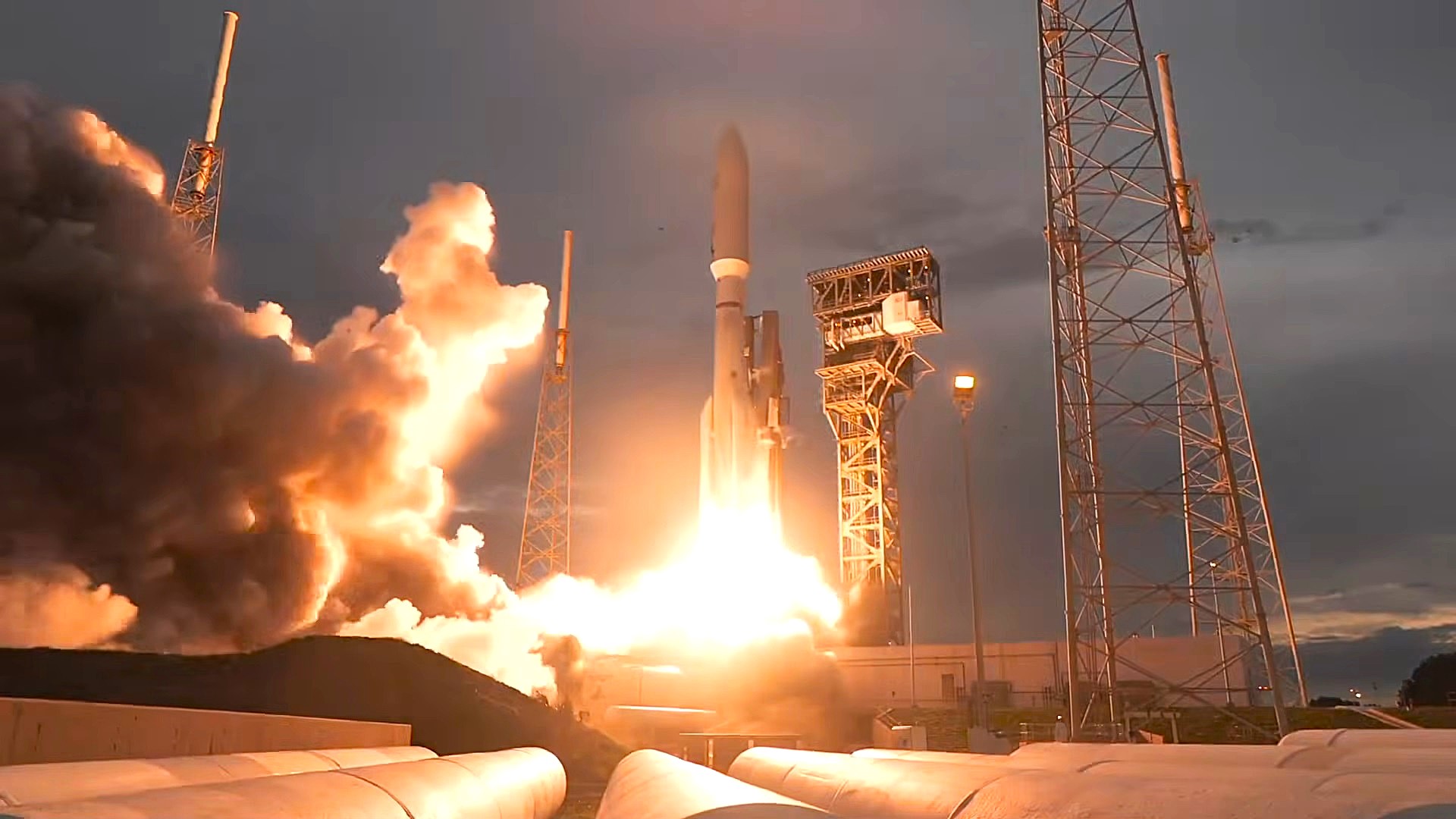
The aerospace sector is an unforgiving arena defined by sharp physical realities and dramatic turnarounds, where the line between a triumphant step forward and a catastrophic setback is razor-thin. This reality was underscored at Cape Canaveral, Florida, where a routine technical milestone transformed in an instant into a spectacular public crisis. During a critical static-fire test of Blue Origin’s highly anticipated, heavy-lift New Glenn rocket—ironically nicknamed “No, It’s Necessary”—the vehicle suffered a devastating on-pad explosion that sent shockwaves through the local launch complex and the broader aerospace industry. Yet, in a twist of corporate and technical irony, the very next day saw United Launch Alliance’s reliable Atlas 5 rocket thunder into the skies from a nearby pad, successfully delivering twenty-nine Amazon Leo satellites into low Earth orbit. The contrast was as stark as it was symbolic: while Jeff Bezos’ space tourism and orbital delivery company was left to assess the charred, smoldering ruins of its premier launch platform at Launch Complex 36, his retail empire’s satellite division was marching steadily forward with its high-speed orbital internet constellation, courtesy of a competitor’s booster. The immediate fallout from the explosion was swift, forcing the immediate postponement of what was supposed to be a milestone commercial mission intended to place forty-eight additional Amazon Leo units into orbit. The blast did more than just scrub a single launch; it shattered the timeline for Blue Origin’s long-delayed entry into the heavy-lift market, leaving industry analysts and nervous customers scrambling to understand the broader implications. As engineers began the grim task of combing through telemetry and physical debris, the collective mood across the Space Coast shifted from eager anticipation to a sobering realization of the monumental challenges that lie ahead.
To understand why this disaster is so paralyzing for Blue Origin, one must look closely at the sheer physical devastation wrought not just upon the rocket itself, but upon the complex, custom-engineered infrastructure of Launch Complex 36. Rocket launches require a dizzying array of plumbing, fuel storage, cooling systems, umbilical towers, and computerized monitoring equipment, all of which must withstand the near-nuclear heat and pressure of a successful engine ignition; when a massive booster explodes directly on the pad, these systems are essentially subjected to a direct bomb blast. Industry experts, such as Caleb Henry, the director of research at Quilty Space, point out that while a standard rocket failure in mid-flight can typically be investigated and resolved in three to six months, a major launchpad destruction is an entirely different beast requiring extensive civil engineering, steel fabrication, and environmental remediation. The closest modern parallel to this scenario is the 2016 AMOS-6 disaster, in which a SpaceX Falcon 9 exploded during a pre-launch test at Cape Canaveral’s Launch Complex 40, a catastrophe that sidelined that specific pad for a staggering fifteen months while SpaceX worked to completely rebuild the facility. Unlike SpaceX, which had alternative, functional launch pads active at the time to sustain its high-consequence launch manifest, Blue Origin finds itself in an incredibly vulnerable strategic position because Launch Complex 36 is currently the company’s only operational pad capable of accommodating the massive New Glenn system. While there are architectural designs on the drawing boards for additional launch sites in both Florida and California, these facilities exist purely as early-stage development projects, meaning Blue Origin has no backup option and must wait for a complete, ground-up rebuild of its sole gateway to space before its flagship rocket can fly again.
Despite the severity of this setback, the strategic positioning of its primary customer, Amazon Leo (formerly recognized in development circles as Project Kuiper), highlights the profound wisdom of supply-chain diversification in the modern space race. Amazon is currently in a high-stakes, clock-defying sprint to deploy thousands of low-Earth-orbit satellites to build out its global satellite broadband network and satisfy strict regulatory deployment deadlines imposed by the Federal Communications Commission. Knowing the immense risks inherent to rocket development, Amazon’s procurement strategists wisely chose not to put all of their technical eggs in the basket of Bezos’ own Blue Origin; instead, they secured an extensive, multi-billion-dollar portfolio of launch contracts distributed across a global fleet of providers. This safety-in-diversity strategy includes dedicated flights on United Launch Alliance’s Atlas 5 and next-generation Vulcan rockets, Arianespace’s European Ariane 6, and even their chief rival’s workhorse, the SpaceX Falcon 9. Yet, while Caleb Henry notes that Amazon is arguably in the best position among all of New Glenn’s contracted customers to absorb this blow without suffering total strategic paralysis, there are hard thermodynamic and temporal limits to their resilience. If Amazon’s near-term operational business model relied heavily on New Glenn’s massive payload fairing to loft the critical mass of satellites needed to activate commercial internet services by this summer, then the complete loss of this launch capability will inevitably push their commercial service timeline deeper into the future. The diversity of their rocket arsenal will keep the constellation growing, but they must now navigate a crowded, incredibly tight global launch market to see if competitors can accommodate extra payloads on short notice.
While Amazon possesses the corporate scale and diverse provider base to buffer this blow, the same cannot be said for NASA, which is watching its dreams of a swift, triumphant return to the moon drift further into the realm of scheduling fantasy. The space agency has integrated Blue Origin heavily into its multi-decade Artemis lunar exploration framework, relying on the massive lifting potential of New Glenn to carry out crucial stages of its robotic and human lander programs. New Glenn was scheduled to launch Blue Origin’s uncrewed Blue Moon Mark 1 lander to the lunar surface as early as this autumn, serving as a vital dress rehearsal and technology demonstrator for the human-rated Mark 2 lander, which NASA hoped to test in Earth orbit next year in tandem with the historic Artemis 3 mission. With New Glenn sidelined indefinitely due to the destruction of its launch site, this entire development pipeline has been thrown into disarray, placing enormous pressure on SpaceX’s Starship architecture to shoulder the burden of the lunar landing timeline—even though Starship is currently navigating its own highly complex, iterative flight-testing program. The strategic bottleneck has only worsened in light of NASA’s recent, high-visibility announcement selecting Blue Origin’s Blue Moon architecture and the New Glenn booster to deploy two massive lunar terrain vehicles ahead of the Artemis 4 mission, which is tentatively slated to land astronauts on the moon in 2028. John Logsdon, the venerable founder of the Space Policy Institute at George Washington University, did not mince words when analyzing the situation, observing that the explosion throws a massive “monkey wrench” into an Artemis schedule that was already on remarkably shaky ground even before the disaster. The psychological weight of this setback was palpable in a memo sent by NASA Administrator Jared Isaacman to agency staff, where he acknowledged the severe headwinds facing their lunar ambitions but urged his workforce to view this moment as a challenging, yet ultimately surmountable, test of human ingenuity and resilience.
Beyond the geopolitical theater of NASA and the corporate warfare of global telecom giants, the collateral damage of the New Glenn explosion is being felt with devastating, immediate intensity by smaller, highly specialized commercial entities like AST SpaceMobile. AST SpaceMobile represents a highly ambitious wave of satellite manufacturers attempting to deliver direct-to-cell phone connectivity worldwide, a technological feat that requires incredibly massive, delicate phase-array antennas known as BlueBirds. Because these next-generation satellites are physically gigantic and carry a footprint that stretches far beyond traditional satellite dimensions, they cannot be easily or efficiently packaged inside the standard payload fairings of smaller, highly available rockets like SpaceX’s Falcon 9 without incurring massive packing and deployment penalties. AST SpaceMobile was in many ways the textbook client for New Glenn, relying on the rocket’s cavernous volume and heavy-lift capacity to deploy its constellation in cost-effective, multi-satellite batches. This launch pad disaster represents a compounding tragedy for the company, which is already reeling from a recent, highly frustrating orbital testing anomaly where one of their pioneering satellites was inserted into an incorrect, sub-optimal orbit. With New Glenn out of commission for the foreseeable future and the global launch sector locked in the fourth year of an acute, systemic shortage of commercial heavy-lift capacity, AST SpaceMobile is left with virtually no easy alternatives to get their critical hardware off the ground. The reality of these compounding crises hit the company’s valuation like a tidal wave, causing their stock price to plunge by fifteen percent in a single trading session and sending a chilling warning throughout the public markets about the massive systemic dependencies that exist within the commercial space ecosystem.
The fallout from the New Glenn explosion serves as a profound, sobering reminder of the ancient engineering adage that “rockets are hard,” a warning that cuts through the speculative hype of the commercial space industry to reveal the harsh physics of spaceflight. Even the United States military and the intelligence community, which have increasingly sought to leverage low-cost, privately developed launch vehicles for national security purposes, find themselves forced to balance immediate tactical disruptions against the long-term necessity of nurturing dual-use aerospace capabilities. Showing the long-term strategic resolve typical of military planners, the U.S. Space Force sought to project confidence in the aftermath of the crash by announcing a task order through the National Reconnaissance Office for a New Glenn launch slated for the 2027 to 2028 operational window. This decision, as Space Force Lieutenant Colonel Doug Downs noted, is a solemn acknowledgment that rocket science is an inherently risky, borderline chaotic discipline, and that the Space Force remains fully committed to collaborating with Blue Origin to isolate the root cause, rebuild the platform, and execute necessary corrective designs. However, as investor confidence temporarily wavers and stock prices drop across publicly traded aerospace firms, the broader lesson is clear: the modern space economy cannot simply run on venture capital, software-style scaling, and ambitious public relations campaigns. It requires massive, highly vulnerable, and slow-to-build physical launch infrastructure that remains susceptible to catastrophic failures from a single bad valve, a weld fracture, or a software glitch. Until Blue Origin can clear the debris, redesign the critical points of failure on its rocket, and meticulously reconstruct the complex network of steel and concrete at Launch Complex 36, the entire global space community will continue to feel the constricting pressure of a market with too many satellites, too few pads, and an unforgiving sky.