





In the sprawling, data-drenched world of modern medicine, important observations often hide in plain sight for years, buried beneath layers of information so vast that no human mind can hold them all at once. That is why the latest news from Seattle’s Allen Institute for AI feels like both a scientific milestone and a glimpse of a very different future. An artificial intelligence system called AutoDiscovery, built by Ai2, has uncovered something that cancer researchers had long overlooked or actively discounted: a common form of breast cancer, invasive lobular carcinoma, may actually be more responsive to immunotherapy than anyone had reason to believe. For years, this subtype—representing roughly 15 percent of breast cancer diagnoses in the United States—has been largely left out of immunotherapy clinical trials, in part because its biological features did not fit the standard expectations for a tumor that would respond to these drugs. But when AutoDiscovery was set loose on a vast federal repository of cancer genomics, it began to see signals in the noise. It flagged the possibility that the immune system could be harnessed to fight these tumors after all. The finding did not come from a scientist’s carefully posed question; it came from a machine designed to generate its own hypotheses and to rank them according to how sharply they contradicted the assumptions embedded in existing research. For the thousands of people diagnosed with invasive lobular carcinoma each year, the news carries a note of cautious hope, because immunotherapy has been one of the most powerful arrows in the modern cancer arsenal, yet it has rarely been pointed at their disease. The result is a striking example of what happens when artificial intelligence moves beyond answering questions and begins deciding which questions are worth asking in the first place—and, more broadly, a reminder that the next major advance in medicine may arrive not from a lab bench, but from a database.
To understand why the discovery matters, it helps to appreciate how far immunotherapy has come—and how much remains uncertain. Immunotherapy works by taking the brakes off the immune system, allowing T-cells to recognize and attack cancer cells. It has revolutionized the treatment of melanoma, lung cancer, and other malignancies, but it has always been a harder sell in breast cancer, particularly in the subtypes driven by hormones. Invasive lobular carcinoma, or ILC, is something of a shape-shifter: its cells do not clump together into the kind of lump that usually announces breast cancer; instead, they infiltrate surrounding tissue in thin lines and strands, making detection and treatment decisions more complicated. Many ILC tumors are hormone-receptor positive and HER2 negative, and they tend to grow more slowly than the aggressive, mutation-heavy tumors that often respond dramatically to immunotherapy. Because ILC lacks the high mutation burdens and the dense immune infiltration commonly associated with strong responses to checkpoint inhibitors, researchers assumed that it was simply not a candidate for those drugs. That assumption shaped the landscape of clinical research: ILC was left out of trials, left out of investigations, and left out of the conversation about how immune-based treatments might be applied to breast cancer. But AutoDiscovery saw something in the data that challenged that assumption—a pattern of immune activity in the tumor microenvironment that might make ILC vulnerable to treatments aimed at turning the immune system against cancer. The AI’s suggestion was not proof, of course, but it was enough to turn the attention of cancer researchers at Providence Swedish Cancer Institute, who decided to put all of their expertise into finding out whether the machine had stumbled onto a real biological truth or had simply found a statistical coincidence.
How did a machine make a discovery that humans had missed? The answer lies in the unusual design of AutoDiscovery itself. Most AI research tools are trained to answer questions: read this scan, predict this outcome, find a drug for this target. AutoDiscovery, by contrast, was built to operate like a curious scientist—but an extraordinarily fast one. Instead of waiting for a human to tell it what to investigate, it takes a dataset and starts asking its own questions. Those questions, and the hypotheses they generate, are then sorted according to how much they would disrupt the existing consensus. The idea is not simply to find patterns; it is to find the patterns that matter, especially the ones that run against everything researchers think they know. In this case, the data source was The Cancer Genome Atlas, a monumental federal database containing genomic and clinical information across more than thirty types of cancer. Working through this treasure trove, AutoDiscovery surfaced the possibility that invasive lobular carcinoma might be unexpectedly responsive to immune checkpoint inhibitors, a class of drugs that has transformed cancer care in recent years. The system reportedly flagged the finding with high confidence, not because it had any special intuition, but because it was willing to question, systematically and without bias, a set of assumptions that many researchers had simply accepted. As the authors note in a research paper posted to the preprint server MedRxiv, the result illustrates how AI can help bridge the gap between data collection and true understanding—a gap that has become one of the central bottlenecks in modern biomedical research. It is one thing to gather genomic information from tens of thousands of patients; it is another thing entirely to know what that information is telling us, especially when the message is one that nobody expected to hear.
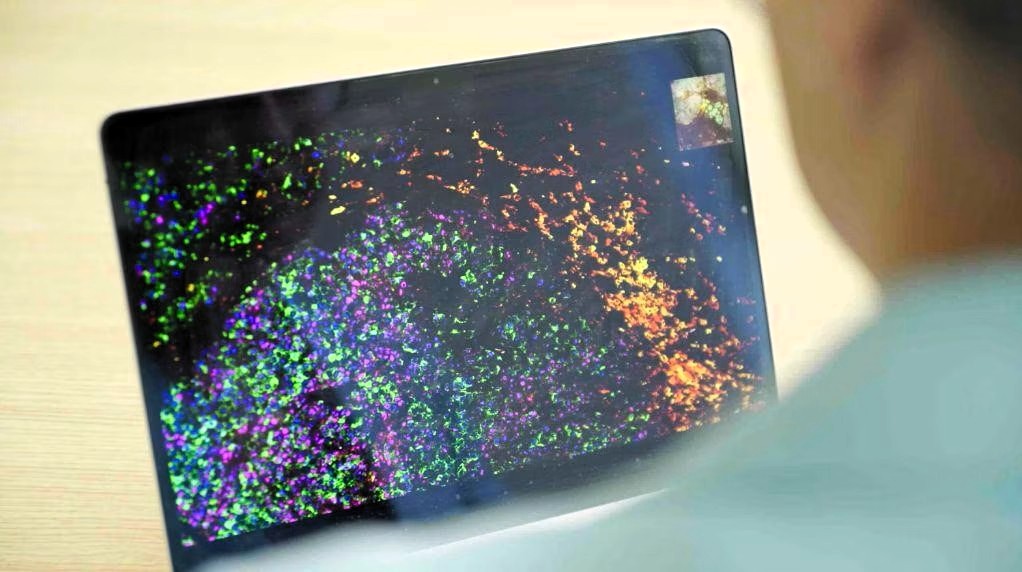
But a computer-generated hunch, no matter how intriguing, means little in medicine until it survives contact with the real world. That is why the validation work done by the team at Providence Swedish is so important. Under the direction of Dr. Kelly Paulson, who leads the Center for Immuno-Oncology at the Paul G. Allen Research Center, the researchers took AutoDiscovery’s hypothesis and tested it against a second, independent set of patient data. The pattern held. They then went further, examining tumor tissue in the laboratory. In an image released by Ai2, Dr. Paulson is shown examining an immunofluorescent stain that reveals T-cells surrounding a lobular breast cancer tumor sample—a striking visual confirmation of the immune presence that AutoDiscovery had inferred from the data. It is a moment that neatly captures the promise of AI-guided discovery: the machine spots a trend in numbers, and then a human expert looks at a glowing image and sees the physical reality behind it. Still, Paulson and her colleagues are careful to manage expectations. These findings do not prove that immunotherapy will work for patients with invasive lobular carcinoma. They do not change treatment recommendations today. What they do is something almost as valuable: they identify a promising question that deserves a serious clinical investigation. As Paulson put it, cancer researchers already have extraordinary datasets at their disposal; the challenge is no longer collecting data, but understanding everything those datasets have to tell us. AutoDiscovery, by this way of thinking, is not a replacement for human expertise but an extension of it—a tireless pair of eyes scanning the infinite landscape of data and returning with gemstones that, until now, have been hidden in plain sight. The next step, researchers say, will be to move from laboratory validation toward clinical studies that can determine whether these immune signals translate into real benefits for patients.
The discovery has also opened a new chapter in an unlikely partnership that now bears the name of the late Microsoft co-founder Paul Allen. On Thursday, Ai2 and the Paul G. Allen Research Center at Providence Swedish announced that they are expanding their collaboration, taking AutoDiscovery beyond a one-off research project and deploying it directly on the cancer center’s own patient data. The goal, according to the announcement, is to look for similar opportunities across other types of disease—cases where conventional wisdom may be obscuring a more nuanced, and perhaps more hopeful, picture. The collaboration is a natural marriage of two worlds: one built around developing cutting-edge artificial intelligence, the other devoted to translating that intelligence into tools that can help people facing cancer. It also underscores how profoundly the process of medical discovery is changing. For centuries, the scientific method depended on human intuition, human curiosity, and human persistence. Those qualities remain essential. But the scale of the data now generated by genomic sequencing, pathology imaging, and electronic health records has grown far beyond what any research team can absorb in a lifetime. AI systems that can generate hypotheses from that data offer a way out of the logjam—not by substituting for human reasoning, but by amplifying it. The new partnership suggests a practical model for how hospitals, universities, and research institutes might integrate AI into their everyday work: not as a futuristic add-on, but as a core part of the discovery process. And because the system will be applied to Providence Swedish’s own patients, with all of the nuance, diversity, and complexity that real clinical data contains, it has the potential to generate insights that are even more directly relevant to the people the institution serves.
Perhaps the most fitting aspect of the story is the institutional lineage that made it possible. Ai2 was founded in 2014 by Paul Allen, and the Paul G. Allen Research Center at Providence Swedish Cancer Institute was established in part through a $20 million gift from the Allen family and estate in 2024. Two institutions, connected by the vision of the same man, have now come together in a collaboration that is equal parts machine learning and human hope. Allen had long believed that technology could be a force for profound good, and he was particularly interested in the idea that scientific discovery could be accelerated. This week’s news offers a small but compelling vindication of that belief. It is too early to say whether invasive lobular carcinoma will become a new frontier in immunotherapy, and the researchers themselves would be the first to warn against jumping to conclusions. But the fact that this question is even on the table is itself a sign that the way we find new treatments is changing in front of our eyes. The path from data to diagnosis, from hypothesis to healing, will always begin with a curious mind—but that mind no longer has to be human. As AutoDiscovery begins its work on patient data at Providence Swedish, and as other institutions watch closely, the message is clear: in the fight against cancer, the next great discovery might come from a system that learns from the past, questions the present, and leads us somewhere we did not know we needed to go.