


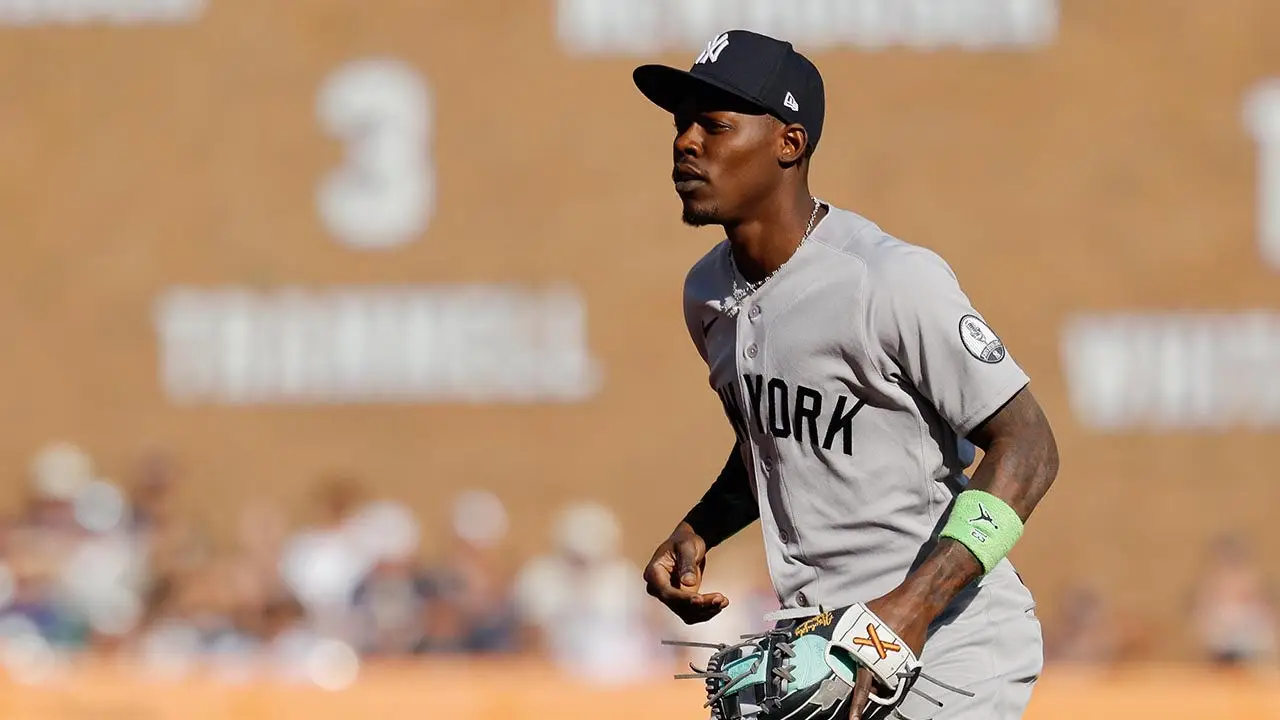
The visual landscape of a modern Major League Baseball game is a tapestry of highly specialized equipment, obsessive-compulsive player rituals, and deeply ingrained cultural habits. For over a century, the sport’s relationship with oral fixation has been well-documented, transitioning from the dark, dangerous era of smokeless tobacco mud-packs to the modern, harmless cascades of salted sunflower seeds and massive wads of pink bubble gum. However, even in an era defined by individual expression and a loosening of rigid traditionalism, a line was crossed on a cloudy Tuesday afternoon in Detroit that left the baseball world bewildered, amused, and in the case of one manager, deeply irritated. As the New York Yankees found themselves trailing 4-1 against the Tigers, stuck in the mud of a frustrating mid-season slump, television cameras zoomed in on second baseman Jazz Chisholm Jr. standing in the infield. There, bobbing between his lips with casual nonchalance as he prepared for the next pitch, was not a wad of gum or a pinch of seeds, but a brightly colored lollipop. To the casual viewer, it was a humorous, childlike anomaly; to the brass in the dugout, it was a symbol of playfulness bordering on a lack of situational awareness. The image of a Yankee, wearing the most historic and demanding uniform in professional sports, sucking on a Blow Pop while trailing in a game they desperately needed to win, instantly sparked a debate about focus, optics, and the shifting boundaries of professional athleticism.
This unconventional choice of field-snack did not sit well with Yankees manager Aaron Boone, a man who has built a reputation as the ultimate player’s manager—often defending his roster to a fault, drawing ejections to protect them, and maintaining a stoic, unified front in the face of relentless New York media scrutiny. Yet, for all of Boone’s patience and modern-minded tolerance for player flair, the sugary sweet confection dangling from Chisholm’s mouth represented a step too far. When questioned about the incident later on the “Talkin’ Yanks” show, Boone did not mince words, admitting with refreshing, unfiltered honesty that the sight of the lollipop on defense “pissed him off.” The manager revealed that he was entirely unaware of the sweet treat until after the final out was recorded, prompting an immediate, closed-door conversation between him and his colorful second baseman to establish boundaries. Boone made it explicitly clear to the public that such candy-fueled high jinks would no longer be tolerated under his watch, drawing a firm, albeit unexpected, line in the dirt of the infield. This immediate pushback highlight the delicate balancing act managers must perform in today’s game: giving young, charismatic superstars the runway to express their unique personalities while fiercely protecting the dignity, focus, and prestige expected of a franchise fighting for a championship.
To understand why the lollipop incident created such a stir, one must understand the unique, unapologetic force of nature that is Jazz Chisholm Jr., a player who has never met a spotlight he did not want to stand under. Since arriving in the big leagues, the Bahamas native has played the game with a vibrant, high-energy swagger that polarizes fans and delights purists who crave more personality in a historically buttoned-up sport. Chisholm is a walking headline, a man who actively embraces the role of both hero and villain with an infectious smile, as evidenced by his reaction to the chorus of boos he happily invited in Kansas City after boldly claiming the Royals “got lucky” in a postseason matchup. His confidence has always bordered on the mythic; before the season even began, he boldly forecasted a historic 50-home run, 50-stolen base campaign for himself, and just weeks ago, he confidently predicted that the Yankees would easily march their way to a twenty-eighth World Series championship. This level of self-assuredness would be endearing if backed by historic production, but when a player behaves as though they are invincible while the team is struggling on the field, even minor deviations from traditional etiquette—like candy on the diamond—are viewed through a highly critical lens.
The outrage and subsequent management intervention spark a larger, fascinating conversation about the generational divide and the historical evolution of baseball’s on-field aesthetic. Decades ago, players like Babe Ruth, Mickey Mantle, and Al Kaline defined grit through dirt-stained uniforms, calloused hands, and a stoic, almost blue-collar approach to their daily work. Over time, that rigid mold began to fracture, giving way to gold chains, colorful batting gloves, customized cleats, and personalized home-run celebrations that have successfully injected new life and a younger demographic into the grand old game of baseball. However, the introduction of a lollipop in the middle of active play challenges the psychological boundary between professional focus and childlike recreational leisure, forcing fans and analysts to ask where the line between “having fun” and “unprofessional conduct” actually lies. For traditionalists, the lollipop is an affront to the seriousness of the sport, suggesting that a player views a high-stakes Major League game with the same casual air as a weekend slow-pitch softball tournament in a public park. For supporters of Chisholm’s untamed joy, it is simply another harmless manifestation of a player who refuses to let the suffocating pressure of New York strip away the childlike enthusiasm that made him fall in love with the game in the first place.
Yet, no matter how much charisma a player possesses, the cold, hard reality of professional sports is that performance will always dictate how much leeway an athlete is granted by their team and their fan base. If Chisholm were currently putting up MVP-caliber numbers and carrying the Yankees offense through their mid-season doldrums, the lollipop incident would likely be laughed off as a quirky, marketable trademark, perhaps even inspiring candy giveaways at Yankee Stadium. Instead, Chisholm is quietly enduring the most frustrating and statistically disappointing season of his professional career, dragging down his overall value at the worst possible time. With his batting average hovering at a meager .226, his slugging percentage dipping to .406, and his on-base plus slugging (OPS) sitting at a career-low .716, the data paints a picture of a player who is currently struggling to find his identity and consistency at the plate. This stark decline in offensive production adds a layer of tension to his off-field antics, particularly because Chisholm is scheduled to hit the highly lucrative waters of free agency at the end of the year—a milestone for which he previously claimed he was aiming to secure a contract in the astronomical tax bracket of $350 million.
Ultimately, this sweet and sour saga of the infield lollipop serves as a poignant microcosm of the modern athlete’s struggle to balance brand, performance, and institutional discipline in the glare of the New York media spotlight. For Jazz Chisholm Jr., the lesson from Aaron Boone’s angry intervention is clear: swagger is a powerful tool when backed by results, but it can quickly look like a distraction when the numbers on the scoreboard and the stat sheet begin to decline. The Yankees are structured on a foundation of intense focus, historical reverence, and an relentless pursuit of championships, leaving very little room for errors—or hard candy—during moments of athletic vulnerability. As the team pushes forward through the grueling summer months and gears up for a highly competitive postseason run, Chisholm will need to channel his immense energy, confidence, and undeniable talent back into his offensive game. If he can swap the sweets for base hits and help lead the Bronx Bombers back to the promised land of the World Series, fans will gladly forgive his past eccentricities; if not, the image of the second baseman casually sucking on a Blow Pop while his team faded in Detroit will remain a frustrating symbol of a season that promised greatness but settled for sweetness.