


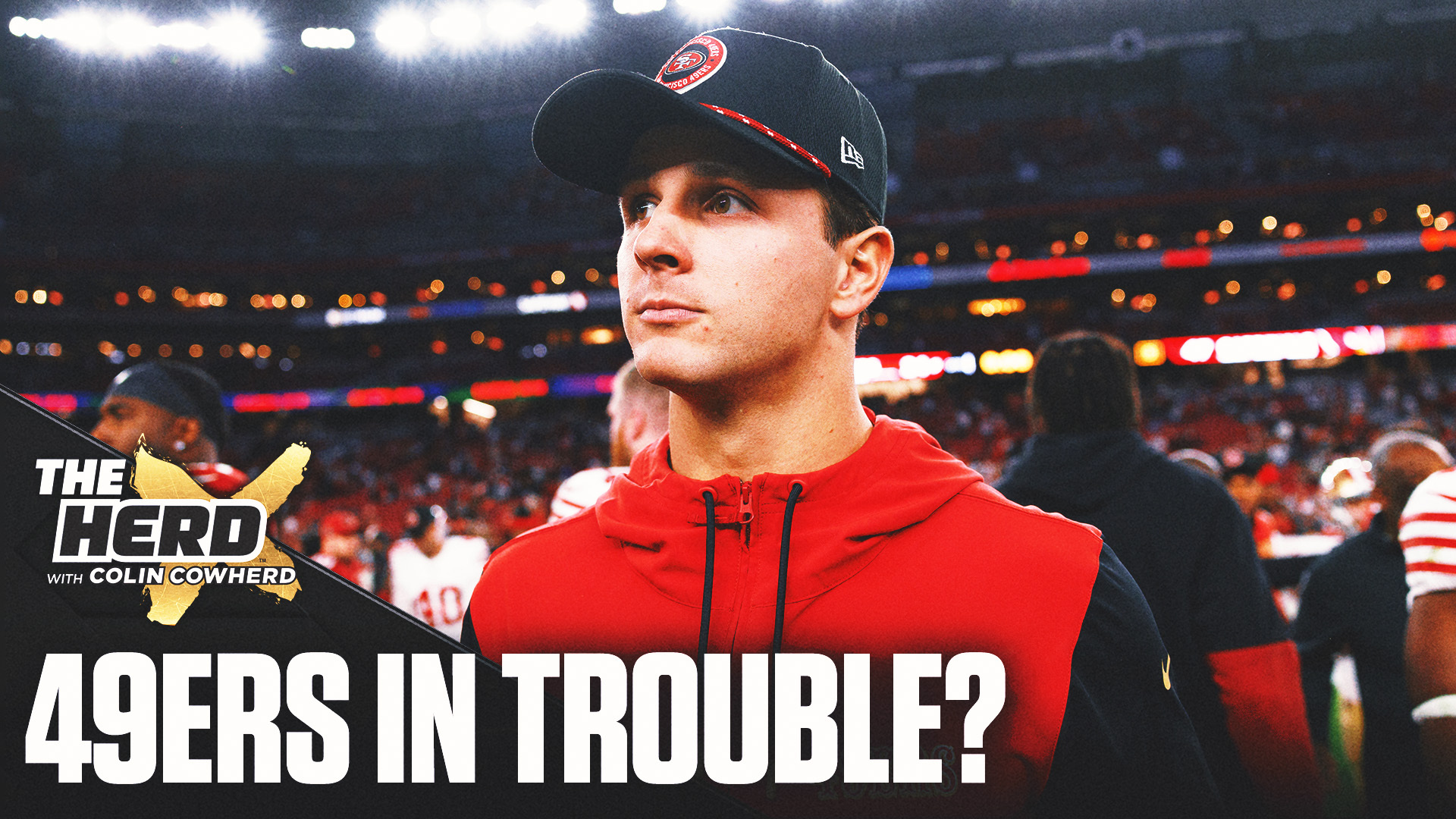
Here is a humanized and deeply expanded summary of the provided content, structured into six comprehensive paragraphs that capture the essence, context, and emotional weight of Colin Cowherd’s critical take on the San Francisco 49ers.
Paragraph 1: The Looming Cliff and a Season of Fragile Hope
As the San Francisco 49ers prepare to open their regular season, there’s an undeniable tension hanging over the franchise. The roster sheet looks formidable, boasting the kind of star power that should make any Super Bowl contender blush. However, sportscaster Colin Cowherd isn’t buying the hype. In fact, during a recent episode of The Herd, he painted a picture of a team teetering on the edge of a catastrophic fall, describing them as being “very close to pulling a Thelma and Louise and driving off a cliff.” This dramatic metaphor wasn’t born out of hatred for the organization, but rather out of a deep concern for the physical and structural fragility of a team expected to dominate the NFC West—a division Cowherd itself admits is arguably the best in football. The 49ers enter this season battling not only external rivals like the Rams and Seahawks, but also internal demons: an aging core, a stunning collection of injuries to key players, and an unsettling off-field distraction involving team ownership. While the margin for error in the NFL is already razor-thin, Cowherd suggests that San Francisco has backed itself into a corner where even the slightest misstep—a slow start, a nagging hamstring, a locker room leak—could send the entire season spiraling into chaos, turning a promised championship run into a historic collapse.
Paragraph 2: The Paper Championship Versus the Physical Reality
On paper, the 49ers’ front office deserves credit for trying to reload rather than rebuild. They made aggressive moves in the offseason, addressing glaring weaknesses with high-profile acquisitions. They bolted their wide receiver corps with a dynamic, star-caliber pass catcher to complement the existing weapons, and they successfully brought back the hard-hitting linebacker Dre Greenlaw to solidify the defensive midfield. These additions look great on a depth chart, and they certainly injected a dose of optimism into a fanbase starving for a sixth Lombardi Trophy. Yet, Cowherd is quick to point out the stark contrast between the gleaming roster on paper and the aching, bandaged bodies on the practice field. The 49ers are the oldest roster in the NFL, and their foundational pillars are all in various stages of recovery or chronic management. It’s one thing to sign a veteran to play a rotational role; it’s quite another to rely on an aging, injury-prone core to carry the weight of the entire season. The phrase “on paper” has never felt less reassuring, because the physical reality is that this team is running on borrowed time. The margin between their impressive roster and the rest of the league is shrinking rapidly due to Father Time, and Cowherd’s skepticism stems from the fact that the front office has chosen to double down on a high-risk strategy that leaves them vulnerable to the slightest physical breakdown.
Paragraph 3: A MASH Unit of Superstars and the Toll of War
The most alarming aspect of the 49ers’ situation isn’t their age itself, but the specific nature of the injuries plaguing their most vital players. Cowherd meticulously laid out a medical chart that would worry any trainer. Tight end George Kittle, a future Hall of Famer who relies on explosive cuts and punishing contact, is still working his way back from Achilles surgery, hoping to be ready for Week 1—a risky proposition for a position that demands such physicality. Similarly, the reigning league MVP running back, Christian McCaffrey, is already being managed with “load management” during practice reps. While this is a precautionary measure, it highlights the fact that his body is accumulating serious miles after leading the NFL in touches—a historical death sentence for running backs. Even the defense is a shambles of surgical scars. Nick Bosa, the defensive cornerstone and highest-paid defensive player in football, is coming off his second major surgery, which raises legitimate questions about his burst and power. Linebacker Fred Warner, the heart of the defense, is also fresh off an operation. When your best players are all starting from a physical deficit, the margin for error disappears. Cowherd’s point is simple: these aren’t just minor tweaks; these are complex, major injuries to players who have already endured years of brutal punishment. You can’t simply flip a switch and expect them to perform at an elite level when they haven’t had a healthy, uninterrupted offseason to build their bodies for the war to come.
Paragraph 4: Drafting Failures and the Rise of Division Rivals
While the veterans are struggling to stay healthy, the future looks equally precarious. San Francisco’s depth, which once seemed so deep, has been exposed by a string of recent draft misses and unfortunate circumstances. Cowherd pointed out that their first-round picks—the lifeblood of any modern NFL roster—are either absent or already broken down. Ricky Pearsall, the highly-touted receiver they invested in, is sidelined and out for the year, representing a significant void in the passing game and a missed opportunity to inject youth. Meanwhile, another highly regarded young defender is “banged up” and won’t be available for Week 1, leaving the defense void of fresh, cheap talent to replace the expensive veterans. This lack of young contributors is even more damning when you compare it to the recent success of their rivals within the NFC West. The Seattle Seahawks and the Los Angeles Rams have been drafting brilliantly over the last three years, hitting on late-round steals and rookie contributors who are playing beyond their pay scale. These young players provide depth, energy, and cap relief, allowing those teams to build more balanced rosters. In stark contrast, the 49ers are forced to rely on a shrinking window of expensive, aging veterans because their recent draft classes have failed to replenish the pipeline. This creates a competitive imbalance where the division rivals are getting younger and cheaper while San Francisco gets older and more expensive.
Paragraph 5: The Deceptive Schedule and the Weight of Expectations
Even the schedule, which initially appears favorable, might actually be a trap. San Francisco will open their season with a highly disruptive trip to Australia, which brings with it jet lag, altered routines, and the loss of a true “home” feeling. Upon their return, they have consecutive home games against the Miami Dolphins and the Arizona Cardinals—games that should technically be wins. However, Cowherd cautions that those favorable matchups might be exactly what sets them up for failure. If the veteran stars need early-season rest or if they fail to find a rhythm immediately due to their lack of practice reps, they could easily drop winnable games. After that cushy start, the schedule toughens up substantially with a gauntlet featuring the Seattle Seahawks and the Denver Broncos. By that point in the season, the wear-and-tear of the long games will have truly begun to take its toll on the older bodies. The early-season grace period is a myth for this team; they don’t have the luxury of easing into the year because their franchise players are already rehabbing. When you pair that with the internal pressure and the off-field drama from the ownership level, the distraction becomes a ticking time bomb. A 2-2 start in this division could effectively be a nail in the coffin, and given the physical state of the roster, predicting a smooth start feels like wishful thinking.
Paragraph 6: The Final Verdict—A Heartbreak Waiting to Happen
Ultimately, Colin Cowherd’s verdict is a sobering one. He flat-out stated, “I don’t think they’re a playoff team,” a shocking prediction for a team that harbors Super Bowl aspirations. But his reasoning is grounded in a profound sense of fatigue and structural decay. He loves the coach, Kyle Shanahan, praising his offensive genius. He loves Christian McCaffrey’s work ethic and the organization’s competitive spirit. But love doesn’t win football games; health does. “I think they’re heading right for a cliff,” he concluded, capturing the deep-seated fear that this season will be a heartbreaking whimper rather than a triumphant roar. It’s a human story of trying to keep a championship window open just a little bit longer, of betting on the heart of veterans who have given everything they have, only to see their bodies betray them. The off-field noise from the ownership only serves to distract a locker room that needs absolute focus. This isn’t a bad football team; it’s a tired one. It’s a team that is one more hamstring pull away from being forced to rely on unproven rookies who weren’t ready to play. The NFL is a mercenary league where the past means nothing. As the season unfolds, the 49ers are walking a tightrope without a safety net. Either they defy the odds, find a miraculous fountain of youth, and silence their critics with a deep playoff run, or they suffer the devastating crash that Cowherd, and many casual observers, see looming just ahead. The stage is set for a defining moment, but the script seems to be headed toward a tragic ending filled with what-ifs and broken dreams.