





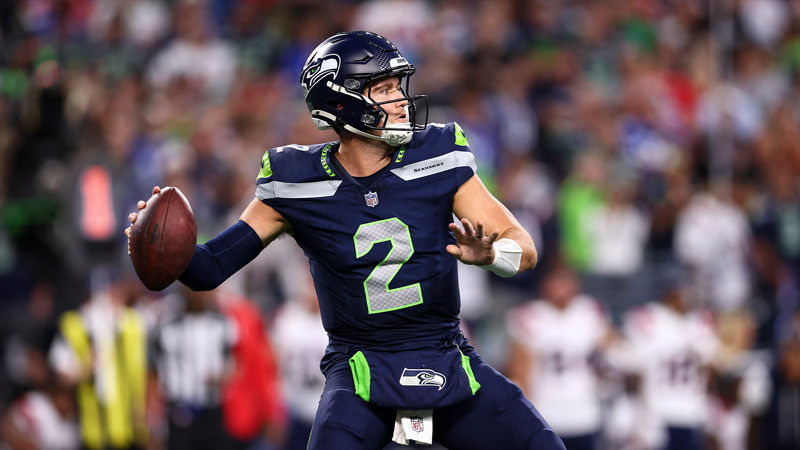
There is something deeply human about a backup quarterback. He prepares like a starter every week, studies like a starter, and stays ready for a moment that may never come — until suddenly it does. For Drew Lock, that moment has arrived again, and the Seattle Seahawks are asking the 29-year-old to step into the spotlight for their Week 2 road game against the NFC West-rival Arizona Cardinals, a Sunday afternoon showdown set for 4:25 p.m. ET on FOX. Lock isn’t replacing an injured superstar or stepping in after a franchise-altering trade; he’s simply being asked to keep the ship afloat while starter Sam Darnold nurses a glute injury sustained in Seattle’s Week 1 victory over the New England Patriots. It’s a familiar role for Lock, a quarterback whose entire NFL career has been defined by opportunity, unpredictability, and the relentless need to prove himself all over again. “Lock it in!” has become something of a rallying cry in the Pacific Northwest, and Sunday will mark Lock’s 29th NFL start — a number that feels both substantial and modest for a player who has been in the league since 2019. For fans, this is a chance to watch a familiar face who has somehow become a journeyman by age 29, a former second-round pick who carries the kind of arm talent and confidence that makes you believe he could be great, but whose career has never quite settled into a permanent home. Sunday is another chapter in a story that has already had plenty of twists, from Missouri stardom to Denver’s quarterback carousel, from being part of a blockbuster trade to stealing a win in a season when his own team supposedly had nothing to play for. This is Drew Lock, and the only thing certain about him is that uncertainty always seems to be lurking just around the corner.
Before Lock became an NFL curiosity, he was a genuine star at the University of Missouri, a program that has always had a soft spot for strong-armed, fearless passers who are willing to try almost anything on the football field. Lock served as the Tigers’ starting quarterback from 2016 through 2018, and while those years were not always defined by team championships, they were defined by prolific, often breathtaking production. Over that span, Lock averaged 3,620.3 passing yards, 31.7 touchdowns and 10.3 interceptions per season, completing 58.4 percent of his passes and posting a 148.7 passer rating. Those are the kind of numbers that make scouts drool and defensive coordinators lose sleep. His best season came in 2017, when he led the SEC with 3,964 passing yards, 44 passing touchdowns and a 165.7 passer rating — eye-popping totals that put him in the conversation with some of college football’s most dynamic quarterbacks. The 44 touchdown passes, in particular, felt like something out of a video game, especially considering he accomplished it in one of the strongest defensive conferences in the country. But there was also a catch: Lock led the league with 13 interceptions that same year. That combination of incredible highs and maddening risk-taking would become a recurring theme throughout his career. The Tigers appeared in bowl games in both 2017 and 2018, and Lock finished his college tenure as second in Missouri history with 12,193 passing yards and 99 passing touchdowns. Those records place him in rarefied air alongside the university’s greatest quarterbacks, and they remind us that Lock was never just a passenger on someone else’s ride. He was the engine. He still looks the part — tall, confident, with a howitzer for a right arm and a swagger that says he belongs. But for all the college glory, the transition to the NFL would be far less forgiving.
When the Denver Broncos selected Lock with the 42nd overall pick in the 2019 NFL Draft, the hope was that he would become the long-term answer at quarterback, a franchise savior in the mold of John Elway, the Hall of Fame legend who was running the team’s football operations. Instead, Lock became just another name in one of the most chaotic quarterback carousels in NFL history. Between Peyton Manning’s final season in 2015 and Russell Wilson’s first season with the team in 2022 — a period that we’ll revisit shortly — an astonishing 11 different quarterbacks started games for the Broncos. Lock was one of those eleven, and he experienced the full range of emotions that come with being a young signal-caller in an unstable organization. He started a combined 21 games over three seasons from 2019 to 2021, and in 2020, when he was nominally the team’s primary quarterback, he threw for 2,933 yards, 16 touchdowns and 15 interceptions across 13 starts, finishing with a 75.4 passer rating and a 57.3 completion percentage. Those numbers were respectable enough to keep hope alive, but not good enough to secure the job. He also added 160 rushing yards and three touchdowns on the ground, showing that he could move when needed, even if he was never going to be mistaken for a designed-runner. The interceptions, the inconsistency, the occasional flashes of brilliance followed by the inevitable mistake — it all became exhausting for a fan base desperate for stability. Lock wasn’t the only problem in Denver, but he was the quarterback, and quarterbacks get the blame. By the time the 2021 season ended, the Broncos had seen enough. They needed a change, and they were willing to make a massive gamble to get it. That gamble would eventually be the biggest trade of Lock’s life, and it would send him over the Rocky Mountains to the Pacific Northwest, in a deal that reshaped two franchises and completely altered the trajectory of his career.
The Russell Wilson trade will go down as one of the defining blockbuster deals of the modern NFL era, and Drew Lock had the strange privilege of being a throw-in with a significant résumé. In March 2022, the Denver Broncos traded Lock, tight end Noah Fant, defensive lineman Shelby Harris, two first-round picks, two second-round picks and a fifth-round select to the Seattle Seahawks in exchange for star quarterback Russell Wilson and a fourth-round pick. At the time, Wilson was a nine-time Pro Bowler with a Super Bowl ring, and the narrative was simple: Denver had finally found its franchise quarterback again, while Seattle had chosen to rebuild and reset its future. Lock, by contrast, was just another asset in the deal, a young quarterback who had shown flashes but never enough consistency to be trusted. For Lock, being traded in the same deal as Russell Wilson had to be a surreal, humbling experience. One day he was competing in Denver, the next he was being sent to a team that was clearing the deck for someone else’s departure. But it also gave him a new beginning. In Seattle, he would have to battle Geno Smith for the starting job, and despite all the arm talent and college pedigree, he lost that battle. Smith was named the starter for the 2022 season, and he went on to have a breakout year that earned him a Pro Bowl nod and solidified him as the Seahawks’ quarterback for the next few seasons. Lock, meanwhile, was relegated to a backup role, watching from the sideline as Smith led the team to the playoffs. It was a difficult pill to swallow for a competitor who had once been the face of Missouri’s program and the future of the Broncos. But Lock did not pout; he did not cause a scene. Instead, he waited, worked, and took advantage of the sparse opportunities he was given. In 2023, Lock made two starts for the Seahawks, and one of them became a signature moment in his career — a Monday Night Football game against the Philadelphia Eagles in Week 15, when he delivered a go-ahead, eventual game-winning 29-yard touchdown pass to wide receiver Jaxon Smith-Njigba with just 28 seconds remaining in the fourth quarter. That moment, complete with the kind of dramatic tension that football fans live for, was pure Drew Lock: fearless, instinctive, and capable of making a play when it mattered most.
And then came the strangest, most consequential game of his career, one that had absolutely nothing to do with playoff positioning and everything to do with the year’s most awkward losing narrative. In Week 17 of the 2024 season, Lock was playing for the New York Giants, a team that had released Daniel Jones after starting the year 2-8 and had essentially mailed in the season from a competitive standpoint. The Giants entered their home game against the Indianapolis Colts with the worst record in the NFL, and two more losses would have guaranteed them the No. 1 overall pick in the 2025 NFL Draft. Tanking is a dirty word, but everyone knew what those final games meant. Then Lock stepped onto the field and threw the entire calculation out the window. He had become the starter after Jones was let go, and in his fourth start, he delivered arguably the best game of his professional life. Against the Colts, Lock threw for 309 yards, four touchdowns and zero interceptions, posting a career-high 155.3 passer rating — the third-highest single-game passer rating in Giants franchise history. He completed 73.9 percent of his passes, going 17 of 23 through the air, and he also added a rushing touchdown. The final score was 45-33, and the Giants’ win was a thrilling, unexpected burst of brilliance from a man who had been written off by so many people. The victory cost the Giants the No. 1 pick, and they ended up selecting third in the 2025 NFL Draft, where they took Penn State linebacker Abdul Carter before trading up to select Ole Miss quarterback Jaxson Dart at No. 25. In a strange twist, the decision to pass on a top quarterback may have worked out beautifully for New York; Dart and the Giants opened the 2026 season with a home win over the Dallas Cowboys, throwing for 230 yards and three touchdowns while completing 79.3 percent of his passes. But that’s the thing about football — the football gods have a strange sense of humor. Lock’s career game came in a lost season, but it proved something important: he still had the ability to dominate, to make plays, to be the kind of quarterback that coaches dream about when they watch him practice. It just never seemed to happen consistently enough, in the right place, at the right time.
Now, in 2026, Drew Lock is back in Seattle, in what is officially his second stint with the Seahawks. His first act in the Pacific Northwest began in 2022, and it was defined by losing that quarterback battle to Geno Smith and then waiting in the wings for three seasons while Smith became one of the league’s best comeback stories. But circumstances changed. Smith moved on, and the Seahawks brought in Sam Darnold, another veteran journeyman hoping to salvage his career. Lock stuck around too, quietly resuming his role as a backup who could be trusted when called upon. Last year, he appeared in five regular-season games and one playoff game for Seattle but never started, and it looked as though his era as an NFL starting quarterback might be finished. Then Week 1 of the 2026 season changed everything. Darnold suffered a glute injury early in Seattle’s win over the Patriots, and Lock played all but the opening series, completing 72.7 percent of his passes (16 of 22) for 187 yards, one touchdown, and no interceptions, with a 113.3 passer rating. It was a calm, efficient performance that showed maturity and control, and it earned him the starting nod against Arizona. Sunday will be Lock’s first regular-season start with the Seahawks since 2023, and his second overall stint with the team has suddenly become an unexpected redemption story. There is an undeniable poetry in this. A quarterback who was once traded as part of the deal that brought Russell Wilson to Denver is now standing on the same sideline, carrying the flag for a franchise that once saw him as merely a consolation prize. At 29, Lock is no longer a young quarterback with untapped potential; he’s a seasoned veteran who has been through the highs of college stardom, the lows of Denver’s carousel, the humiliation of being a trade throw-in, the odd thrill of spoiling a draft position, and the quiet perseverance of working his way back. Sunday will be another test, another chance to prove to the world — and to himself — that he still belongs among the top signal-callers. The arm strength was never in question. The moxie was always there. Now, against the Cardinals, in front of a national audience, Drew Lock gets to write another chapter in a career that refuses to be defined by other people’s expectations. Lock it in, indeed.