





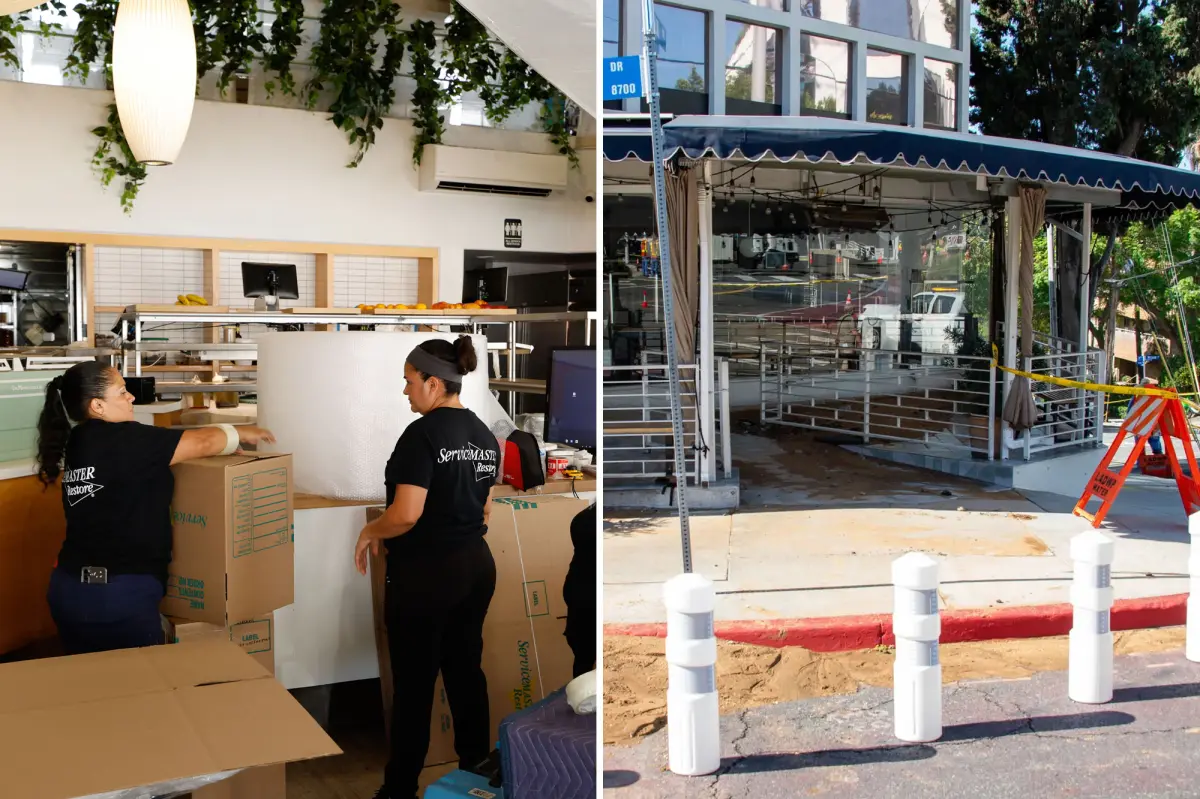
West Hollywood knew the exact texture of a summer morning: the hushed quiet before the city fully wakes, the first shaft of golden light cutting through the canyon, the whistle of steam and the reassuring crunch of the espresso machine at Dialog Cafe on Holloway Drive. For eighteen years, that corner had been the neighborhood’s true living room, a place where actors nursed headshots beside composers with laptops, where two friends resolved ancient feuds over burritos, where the staff knew exactly how you took your coffee and exactly how much small-talk you could endure. And then, in a single, horrifying instant, that entire world was buried alive. It happened in the first weeks of July, when a 36-inch water transmission trunk line beneath Sunset Boulevard finally gave way with the kind of awful, genuflecting groan the earth makes when it has been holding on too long. An estimated 17 million gallons of water surged through the intersection, moments that turned Holloway into a churning, muddy river. The pavement buckled and fell into a vast sinkhole, cars were swallowed, sidewalks were split open, and Dialog—the warm, cluttered, unpretentious cafe that felt like the neighborhood’s own kitchen—was throttled beneath feet of mud and debris. The breakfast burritos vanished under silt. The photographs darkened under the brown stain of the flood. The silence that followed was worse than the roar. For a town watching its beloved landmarks close one by one, this felt less like an infrastructure failure than a personal loss, the kind of loss that leaves a hole in your own calendar where a coffee sit used to be.
So when Dialog Cafe announced it would reopen on Oct. 3 in a temporary residency inside The Sun Rose West Hollywood hotel on the Sunset Strip, the news came to a community that was breathless with hope and relief. The resurrected cafe will carry its full menu, and remarkably, it will be staffed by the same cooks, baristas, and servers who made the old room feel like a security blanket. “Our corner on Holloway is a big part of what makes Dialog feel like Dialog, and we love it as much as you do,” the restaurant wrote in an Instagram post, the words heavy with the weight of weeks spent shoveling mud out of what used to be a breakfast counter. “The damage there was extensive, and rebuilding it properly is going to take time. But Holloway is coming back.” Those words worked on the city like oxygen after too long underwater. The Sun Rose will be a home for now, but not the home, and the owners were careful to say they want the temporary space to carry the same soul: low lights, worn-in chairs, the shelf of affection where frequent customers feel like regulars and regulars feel like family. It was a promise, not just an announcement—a pledge that the heartbeat hadn’t stopped, only moved temporarily under a different roof, waiting for the day it could return to the corner where the whole thing began. The feeling in the air was not just optimism; it was a kind of emotional resurrection, proof that some beloved institutions still have another chapter to live.
But that other chapter cannot rewrite the damage of July. The original Dialog location remains in the far distance, its future as uncertain as the reconstruction of a shattered home. The damage, as the restaurant described it, was extensive—not the kind of water damage one mops up with towels and good cheer, but the deep, structural damage that attacks foundations, walls, the electrical system, and the plumbing, everything a restaurant needs just to turn on a single light. Rebuilding properly means months of permits, inspections, engineers, and patience; it means going through the ritual grief of returning to mud-filled rooms and making inventory lists of everything that cannot be saved. This is the unglamorous, slow, heart-sore half of the story, the part with dust masks and dust, the long afternoons that no one photographs. And yet there is something deeply human in the decision to keep going anyway—the decision to set up a temporary coffee cart a few blocks away from the ruins and just keep serving. Holloway Drive has been more than a physical location for the cafe; it has been its identity, its address in the lovers’ map of this town. People fell in love at the plywood patio, argued over crossword puzzles at the high-top tables, tucked in their children in strollers on weekend mornings. To lose that corner was to lose a landmark that had become synonymous with a feeling of safety. The promise that “Holloway is coming back, even if it takes time,” offered the only sane way to grieve: letting the emptiness stand for now, holding the memory tightly, and carrying the coffee elsewhere until the walls are rebuilt.
The reaction to the announcement was immediate, emotional, and utterly human. Comments flooded the social media page like the returning tide of hope that floods a shore long bereft of water. “There are too many WeHo staples that have shut down lately—we don’t want to see you gone too,” read one comment that captured the twinning fear and relief of the moment, for the city, tasting the fragility of all its cultural anchors. Another remark read simply: “So pumped! Makes me so happy to hear this,” one fan wrote. Another declared, “Dialog is the embodiment of character and resiliency. We all love you guys and we can’t wait to see you!” Those messages were never really about the food alone—they were about continuity, the unsung glue of everyday life. told in the testimony of a breakfast place that kept its doors open through tough times and better seasons. The cafe was a third place, the texts, the non-home where people felt known. It was the kind of neighborhood where, for many, the barista was the first person to learn about the pregnancy, the promotion, the redundancy, the new flat. The comment section held all those stories in shorthand: “The community needs this! WeHo feels incomplete without Dialog.” This underscores how much of a city’s emotional architecture is built not in civic centers or grand monuments but in unassuming rooms that smell of fresh coffee and frying tortillas, filled with the murmur of regular conversation and the clatter of ceramic cups. And it explained, at least a little, why a breakfast place on this kind of corner matters more than its square footage: it is the place you go when you need to belong.
In another unexpected revelation that quieted the cynics and renewed even stubborn hearts, Dialog announced it will refund every dollar donated to its post-flood GoFundMe campaign. The page had initially sought $500,000—a figure that sounds astronomical unless your entire business is underwater and buried in sediment, and you’re trying to keep your staff whole and fed. The fundraiser ultimately drew more than $55,000 from several hundred donors gone from across the city and beyond, each donation carrying with it a small message that read as a love letter. The decision to return every cent was a quiet, devastating act of generosity during a moment when the cafe could easily have accepted the support—the money would have gone straight to payroll and emergency expenses, to replace equipment, to a staffing fund, to rebuilding. But instead, Diallog chose to take a deep breath and look outward. The refund spoke to a particular kind of grace: the recognition that their own lifeline had been offered, and rather than clutch it on the strength of others, they would find another way forward, trusting that their customers need their support, and the community need not pay further for the rescue that charity had already provided. In an age when businesses are often clutching survival with both hands, returning money feels like a radical act; but it also reflects the foundational ethos of a restaurant whose room was built on belonging, where loyalty went both directions. The refund is both an apology and a thank you, a card in the mail, a refusal to monetize affection. It reminds us that behind the counter there were human hearts, and those humans had decided that integrity is a menu item served daily, regardless of circumstances. The donation, too, though, ironically affirmed what it funded: honest relationships matter more than money.
The road to the original Dialog may still be long, and there is no definitive timetable, no definite completion date on the calendar when Holloway will once again open its familiar doors. In the meanwhile, the residency at the Sun Rose, with Sunset Strip foot traffic and the devoted old-timers lining up to taste the same burrito with the same sour cream, coffee of familiarity and conversation, will serve as the lighthouse. The owners have made it clear that they see this chapter as a new room, transitional, a home, not necessarily a permanent destination, but a necessary way, a sanctuary built on loyalty. That resilience is equal to the resilience of the community itself, which has seen enough of its anchors drift away and won’t let good things disappear quietly. The doom that hung over the flood has been replaced by humbled hope, by measured joy, by the sense of a new beginning even as the old home remains under reconstruction. There is something deeply reassuring about a city that shows up every morning to have its eggs and toast and a redemption simple as a new cup of joe. Dialog Cafe’s survival story means more than the survival of one restaurant, more than the saving of a beloved brand. It is testament that a cafe is not its walls, the mud-caked room, nor the number espresso, nor the copper piping. A cafe is a place in the heart of a neighborhood, with a life that runs on its own in the permanent memory of its own memories. And as long as the coffee is warm, and Longtime regulars shuffle in and take a seat, the spirit of the place will keep its promise to return home again. The town is holding its breath in that promise, standing in line, a cup waiting for morning to return. It’s coming. Holloway is set to return. And whenever it does, it will find its family waiting there, with open hands and hearts, still, that first bell.