





Paragraph 1: The Discovery on the Shore
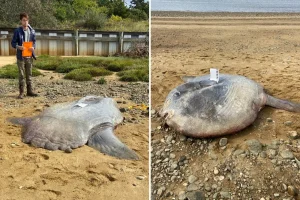
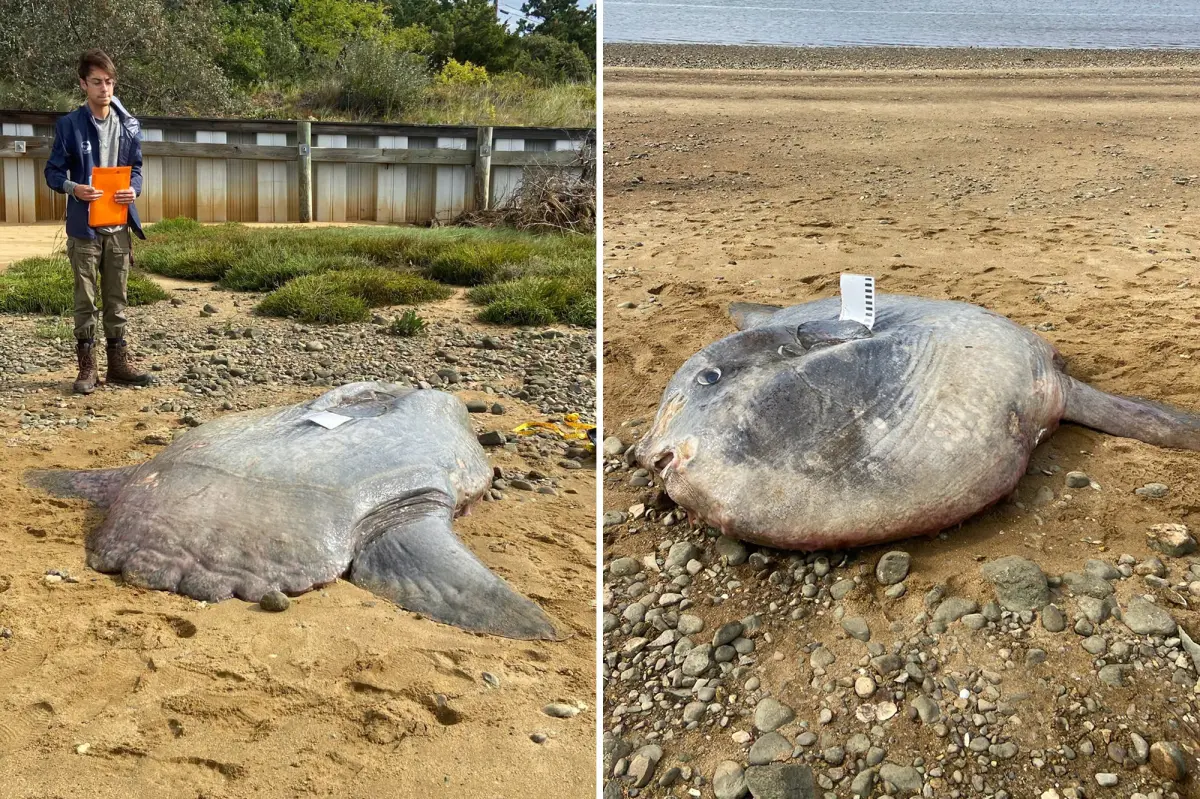
It was an ordinary autumn morning on Cape Cod, the kind where the salt air carries a crisp chill and the low sun paints the bay in shades of pewter and gold. A solitary walker, perhaps hoping to spot a seal or simply to clear their mind, made a discovery that would stop anyone in their tracks. There, at the mouth of the Herring River in Wellfleet, lay what looked like a colossal, glistening boulder that had somehow drifted ashore. But as the tide receded and left the creature fully exposed, the truth became clear: this was no stone, but a fish—a truly enormous ocean sunfish, one of the most enigmatic and gentle giants of the open sea. Weighing in at over 900 pounds, the adult female was a sight of both awe and profound sadness. She had come to rest on the sand, her great dorsal fin standing like a flag, her large, curious eye now lifeless, fixed on the horizon she would never cross. For the beachcomber, and for all who would later learn her fate, this was a moment of deep poignancy—a stark encounter with the immense power and tragic fragility of the natural world, a story written in the debris of a migration gone terribly wrong.
Paragraph 2: A Gentle Giant of the Open Ocean
To understand the magnitude of this loss, one must appreciate the very nature of the ocean sunfish, scientifically known as Mola mola. These are not the sleek, fearsome predators one might imagine; rather, they are slow-moving, almost ethereal creatures that spend their lives basking at the surface, as if sunbathing, before making astonishing dives into the cold, dark depths to hunt for jellyfish, small fish, and crustaceans. Their name, “sunfish,” comes from their habit of lounging on their sides at the sea surface, wings of gray-brown skin raised to catch the warmth of the sun and allow seabirds to pick off parasites. Ranging across tropical and temperate oceans worldwide—from the icy waters of Iceland to the coasts of Chile—these fish are true global nomads. The specimen found in Wellfleet, while an impressive giant at roughly 900 pounds, was actually a relative lightweight in her species’ terms. Mature females can reach more than 2,000 kilograms, or about 4,400 pounds, making them one of the heaviest bony fish on Earth. Even her ovary, a testament to her potential for motherhood, weighed an astonishing 13.2 pounds. To see such a creature beached is to witness a collision between two worlds—the vast, mysterious realm of the pelagic ocean and the finite, changing shore.
Paragraph 3: The Deadly Trap of Cape Cod Bay
When the ocean sunfish washes ashore on Cape Cod, it is rarely a random event. These gentle giants undertake a long and perilous seasonal migration each fall, moving southward along the Atlantic coast to warmer wintering grounds. Yet the journey is fraught with obstacles, and one of the deadliest lies in the hook-shaped geography of the Cape itself. As these open-ocean fish swim south, following the shoreline, they can be funnelled by currents into the great bay that forms the inner bend of Cape Cod. Here, the peninsula’s curved arm and dramatic tidal swings create a natural dead zone. The mighty tides of Cape Cod Bay, among the most powerful in the world, race through narrow channels and sweep across vast mudflats, drawing water outward with incredible force. For a fish accustomed to the unbroken depths of the Atlantic, this maze of shallow, sinking harbors becomes a trap from which there is no escape. As the tide recedes, it leaves behind deep-water creatures stranded in a matter of hours. The 900-pound female was one such casualty, caught in the rapidly draining shallows of Wellfleet Harbor, a magnificent creature of the deep left floundering in a few feet of water, her weight eventually grounding her on the sand as the sea retreated without her. It is a heartbreaking scenario that plays out all too often in this region, a tragic intersection of instinct and geology.
Paragraph 4: A Volunteer’s Race Against Time
When the stranding was reported, it fell to a grassroots organization of dedicated volunteers to respond—the New England Coastal Wildlife Alliance, or NECWA. For these men and women, the sight of a beached ocean sunfish is an all-too-familiar sorrow. Every year, during the seasonal migration, they receive such calls, and each time, they must set aside their grief and spring into action. There is a quiet urgency to their work, a sense of reverence for the fallen animal. They arrive with gear and clipboards, tape measures and scalpels, knowing that while the life is gone, the body can still yield precious secrets. Approaching the enormous corpse, they take detailed photographs, documenting every scar and barnacle, every clue about the creature’s life before its untimely end. They collect tissue samples, carefully preserving them for genetic analysis and toxicology studies that could unlock mysteries of the species’ biology and ecology. The work is not glamorous; it is patient, methodical, and deeply compassionate. As they work, the volunteers often speak in hushed tones, acknowledging the tragic poetry of the moment. They are not mourning a pet or a person, but they are honoring a life that mattered, a keystone species in the oceanic web whose death is not just a loss, but an opportunity to learn.
Paragraph 5: A Vulnerable Species, A Fertile Paradox
Why does this death matter beyond the tragedy of a single animal? The answer lies in the precarious conservation status of the ocean sunfish. On the IUCN Red List, the world’s most comprehensive inventory of extinction risk, Mola mola is classified as “Vulnerable.” This designation means the species faces a high risk of extinction in the wild in the medium term, threatened by bycatch in commercial fisheries, plastic pollution, and the looming impacts of climate change on their prey species. Yet, in a curious twist of nature, these gentle giants are also among the most prolific breeders on Earth. A single mature female like the one found in Wellfleet can release an estimated 300 million eggs in one reproductive cycle—a staggering number, far exceeding the reproductive output of almost all vertebrates on the planet. This paradox, the sheer abundance of offspring against the fragility of their adult population, is a reminder that in the ocean, survival is a numbers game. Very few of those millions of eggs will ever become adults, buffeted as they are by predators and the whims of the current. The death of a large female, then, is a particularly heavy blow to the population, for she carries the potential for countless future generations within her. Her 13.2-pound ovary was not just an organ; it was a constellation of unrealized possibilities, a biological reservoir now vanished beneath the sand.
Paragraph 6: Turning Sorrow into Science
In the aftermath of the stranding, NECWA officials echoed a sentiment that transcends the usual desolation of such a discovery. “So sad to see that she died,” they posted, “but her death is not in vain.” This is the core of their mission. The data they collect, the tissue samples, and the photographs are shared with scientists worldwide, contributing to a growing body of knowledge about a species that still holds many mysteries. Where exactly do Cape Cod sunfish go in winter? What are their diving patterns, and what routes do they take across the vast Atlantic? How are they affected by shifting ocean temperatures and the proliferation of jellyfish blooms in a warming world? Each stranding offers a rare, albeit heartbreaking, window into an existence that is usually hidden in the blue. The enormous fish that washed ashore in Wellfleet was not just a tragedy to be mourned; she was a teacher, her body a trove of information that could help protect her species for generations to come. For the volunteers who answered the call, and for all of us who hear her story, her fate is a poignant reminder of the interconnectedness of our own actions with the fate of the ocean. As the fall winds blow and the sun sets earlier over Cape Cod Bay, we are left to reflect on the quiet, determined efforts of those who work to make sense of such losses. In the end, this magnificent creature’s journey did not conclude on a lonely beach; it lives on in the laboratories and lecture halls where her remains are studied, a silent advocate for the mysterious, vulnerable, and deeply beautiful world beneath the waves.