





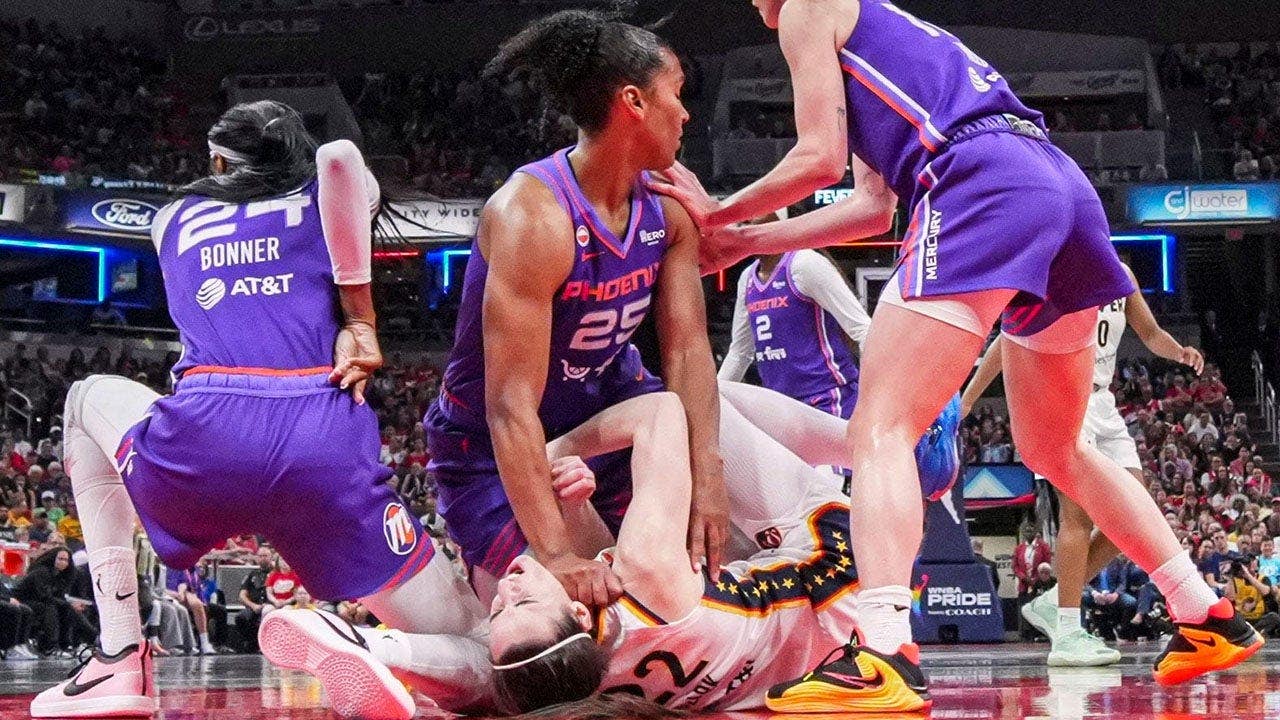
The modern sports landscape is no stranger to sudden, explosive controversies, but few moments in recent memory have ignited the cultural zeitgeist quite like the physical altercation between WNBA All-Star Alyssa Thomas and rookie phenom Caitlin Clark. During a highly contested Wednesday night matchup, the intensity boiling underneath the surface of the court spilled over in a split second. Thomas delivered a hard hit to Clark’s throat during a physical scramble—a sequence that skipped past the eyes of the referees in real-time but was instantly captured, digitized, and broadcast to millions via social media. Within hours, a slow-motion video of the hit became the center of a raging firestorm, pouring high-octane fuel onto an ongoing, deeply polarized national debate regarding the physical, often bruising treatment Clark has faced since entering the league in 2024. For Thomas, the immediate administrative consequence was a swift, one-game suspension handed down by the WNBA, which officially classified her action as “reckless” and a “non-basketball act.” Yet beyond the immediate disciplinary action and the wave of online condemnation, the incident thrust Thomas into an unwanted spotlight, casting her as the ultimate villain in a narrative dominated by protective fandoms, while leaving the public to wonder about the real woman behind the infamous block.
To truly understand the unrelenting, physical force that Alyssa Thomas brings to the hardwood, one must look back to the foundational layers of her childhood, where combativeness was cultivated as a core survival skill. Her introduction to the game of basketball at the tender age of five was not a moment of instant, poetic passion; rather, it was marked by a monumentally dramatic protest. When her mother, Tina, first signed her up to play, a young Alyssa threw an absolute “hissy fit,” physically throwing herself down the stairs and along the hallway in open rebellion against the idea of hitting the court. That initial resistance, however, was quickly met by a parenting philosophy that refused to coddle or yield. In the Thomas household, even a simple, colorful board game like Candyland was transformed into a proving ground of competitive grit. Tina and her husband operated under a strict rule that they would never intentionally let their daughter win, believing that shielding a child from defeat only left them unprepared for the inevitable battles of real life. This demanding upbringing, mirroring the famously unforgiving competitive lessons taught by the father of New York Yankees legend Derek Jeter, instilled in Alyssa a belief that nothing in this world is given freely, and that if you fall down, you simply get up and keep fighting.
This relentless, fight-first mentality eventually became not just a psychological trait, but a absolute physical necessity for Thomas to survive in professional basketball. Behind her reputation as one of the league’s most aggressive defenders lies a quiet, agonizing physical reality: Thomas plays the game with torn labrums in both of her shoulders. The structural damage is so severe and painful that she completely lacks the shoulder integrity required to lift her arms and execute a traditional, fluid, high-release jump shot. Instead of letting these devastating injuries end her career, Thomas engineered a remarkable mechanical adaptation, developing a unique, rigid, one-handed pushing motion initiated directly from her chest just to get the basketball to the rim. Because she cannot rely on the luxury of spacing the floor with outside shooting, her entire offensive and defensive identity had to be rebuilt around sheer physical dominance. To score, she has no choice but to drive directly into the teeth of opposing defenses, actively seeking out and absorbing heavy, bone-jarring contact in the paint on nearly every single possession. This brutal, high-collision style of play is the only way she can compete, and it has paradoxically transformed her into a legendary powerhouse—a six-time All-Star, three-time First-Team All-WNBA selection, Olympic gold medalist, and the undisputed triple-double queen of the league.
Away from the high-stress crucible of professional sports and the violent collisions of the paint, Thomas possesses a remarkably distinct, almost contradictory set of interests that humanize her far beyond the simplistic “bruiser” label. Had she not found her calling on the basketball court, the self-proclaimed fighter admits she likely would have pursued a career in actual combat sports, imagining a life spent inside the boxing ring or the mixed martial arts cage where physical confrontations are governed by a different set of rules. Yet, in a fascinating juxtaposition to her physical outer shell, Thomas has also harbored a lifelong, passionate infatuation with dentistry. Since she was a child, she genuinely loved visiting the dentist’s office, fascinated by the precise, clinical world of oral hygiene and the meticulous, soothing process of teeth cleaning. This unexpected duality reveals a complex individual who exists at the intersection of raw, chaotic physical power and quiet, structured precision—a player who can anchor a team’s defense with bruising intensity while simultaneously dreaming of the calm, hygienic order of a dental clinic.
Nevertheless, the nuanced reality of her physical journey and personal interests was quickly overshadowed by the fierce wave of public retribution that followed the throat punch on Clark. The backlash was immediate and institutional, led by Indiana Fever Head Coach Stephanie White, who used her postgame press conference to demand systemic accountability. Unloading on both Thomas and the game officials, White labeled the missed call absolutely unacceptable, accusing Thomas of routinely crossing the line from aggressive, physical defense into dangerous, non-basketball violence. The institutional outrage grew the following day when Fever President Kelly Krauskopf issued a formal public statement thanking the league office for its swift suspension of Thomas and emphasizing that player safety must remain paramount. The controversy also quickly transcended the boundaries of sports talk radio, bleeding directly into the broader cultural and social wars, as prominent conservative activists and commentators claimed that the incident represented a double standard, arguing that if the racial or positional roles of the players had been reversed, the play would have been publicly condemned as a hate crime.
Ultimately, the firestorm surrounding Alyssa Thomas serves as a stark reminder of how easily the complex realities of professional athletes are flattened under the weight of modern media narratives. In the court of public opinion, Thomas was quickly cast as a physical antagonist, a symbol of a league supposedly hostile to its rising superstar. Yet, when the noise of the news cycle fades, what remains is the portrait of a deeply resilient athlete who has spent her entire life adapting to pain, defying physical limitations, and fighting for every inch of ground she has ever occupied. The very same unyielding, unapologetic toughness that led to a controversial suspension is the precise quality that allowed her to overcome double shoulder injuries and etch her name into the history books as one of the most uniquely dominant players of her generation. As the WNBA continues to grow and navigate the intense, often hyper-reactive spotlight of its new era, the story of Alyssa Thomas stands as a testament to the complicated, gritty, and fiercely human drive that fuels greatness at the highest level.