





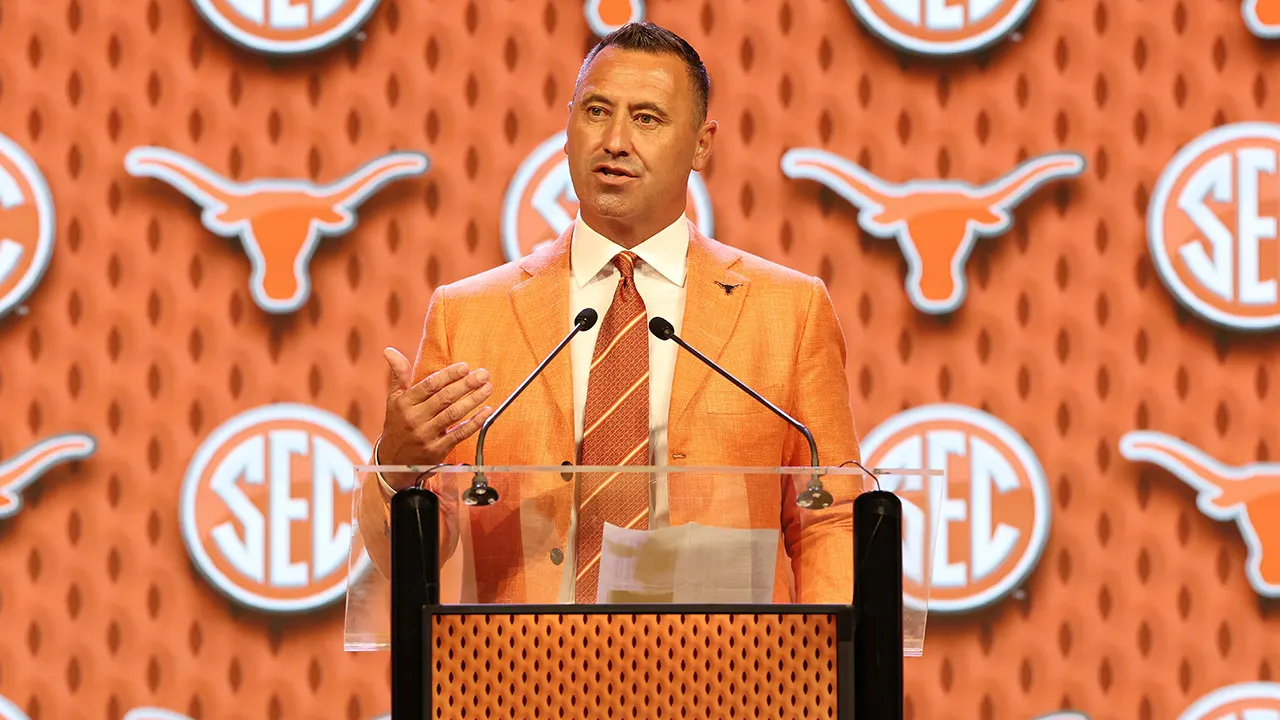
College football has always been as much about the theatrical off-field drama as it is about the actual tactical battles waged on Saturdays. Recently, Texas Longhorns head coach Steve Sarkisian found himself standing directly in the crosshairs of a fiery Ole Miss fanbase after dropping a playful yet highly controversial comment about academic rigor. In what quickly became a massive viral sensation, Sarkisian made a passing jab implying that earning a degree from the prestigious University of Texas at Austin is vastly more demanding than navigating the academic hallways of other universities across the collegiate landscape. To illustrate his claim, he dragged the Oxford, Mississippi institution into the discussion by invoking the classic, ultimate cliché of easy college courses: basket weaving. Instantly, the college football world erupted in sheer disbelief. Ole Miss fans, who are never ones to back down from a fight, took to social media to defend their beloved university, while commentators from coast to coast relished the sudden, unexpected friction between two of the sport’s most high-profile programs. It was the kind of modern sports drama that makes the offseason so incredibly entertaining, humanizing these multi-million-dollar coaches as real, sometimes petty, individuals who are not above using a little academic snobbery to gain a psychological edge. Even journalists and casual observers found themselves tempted to look up whether actual basket weaving classes were available for registration, turning a simple offhand remark into a national conversation about academic integrity and athletic privilege. This verbal sparring match, while amusing on the surface, revealed the deep-seated cultural divisions and intense competitive rivalries that define the current era of collegiate athletics. It showed that in the high-stakes world of the Southeastern Conference, absolutely nothing is off-limits, and even a coach’s theoretical curriculum choices can become weaponized. Every single word a coach utters is now magnified, analyzed, and thoroughly picked apart by passionate observers. This relentless spotlight ensures that no comment, regardless of how innocent or sarcastic, remains private for more than a few moments.
Recognizing that his lighthearted remarks had indeed burned a few too many bridges, Sarkisian used his appearance at the Houston Touchdown Club to cool the flames and offer a much-needed explanation of his true intent. Far from wanting to ignite a genuine academic war with the Rebels, the Texas head coach clarified that his comments were taken wildly out of context and were meant as a friendly, internal ribbing between close companions. Sarkisian pointed out that his choice of Ole Miss as an example was born strictly out of his deep personal and professional relationships with Rebels head coach Lane Kiffin and defensive coordinator Pete Golding. He explained that because of these friendships, he knew firsthand how talented their coaching staff was at recruiting players, bringing them into the program, and successfully guiding them toward graduation. The “basket weaving” reference, he admitted with a grin, was a poor choice of words when he could have easily used more conventional subjects like microeconomics or even yoga—which, as he dryly noted, is actually offered as a class at the University of Texas. The real, substantive point Sarkisian was trying to articulate was the stark difference in institutional transfer policies and degree requirements across different universities. At Texas, a student-athlete must complete a rigorous minimum of 60 hours of coursework directly on the Austin campus to secure a degree, a strict academic hurdle that complicates the easy integration of multi-year transfer portal athletes. In contrast, other institutions operate under more flexible credit-transfer frameworks, allowing student-athletes to graduate after taking a far smaller fraction of their total credits at their final school. By bringing this up, Sarkisian was completely shedding light on the hidden administrative headache that modern coaches encounter daily behind closed doors as they try to balance competitive roster construction with stringent, school-specific academic standards. This dynamic makes it increasingly difficult for programs like Texas to navigate the modern roster management landscape without facing significant challenges that other schools never even have to worry about whatsoever at all.
Yet, as fascinating as the academic banter and basket-weaving jokes might be, they merely scratch the surface of a far more serious, existential crisis currently threatening to dismantle the traditional model of college sports. Below the entertaining surface of coach rivalries lies a chaotic landscape where the rules of the game are shifting faster than athletic departments can keep up. The primary catalyst for this massive instability is the historic House v. NCAA settlement, which has opened the floodgates to a decentralized system of revenue-sharing and cash flow that looks less like traditional college amateurism and more like an unregulated corporate marketplace. Suddenly, universities find themselves locked in an aggressive financial arms race, desperately competing to construct the most lucrative Name, Image, and Likeness (NIL) packages to secure elite high school recruits and coveted transfer portal players. Crucially, this rapid evolution has occurred in a complete vacuum of consistent oversight, leaving athletic directors and conference commissioners to navigate a wild terrain with virtually no boundaries or unified enforcement. The traditional framework of the NCAA, which once held absolute authority over player compensation and eligibility, has been rendered almost entirely toothless in the face of persistent legal challenges. Coaches are no longer just teaching schemes and calling plays; they are effectively operating as general managers of highly lucrative franchises, constantly worrying about payrolls, contract negotiations, and the looming threat of rosters being raided by wealthier competitors. This unprecedented shift has created a palpable sense of anxiety across campuses nationwide, as leadership groups realize that the current trajectory of unchecked spending is fundamentally unsustainable and could permanently alter the collegiate sports landscape over the next five years. With the financial stakes reaching such astronomical heights, the pressure to secure top-tier talent has forced colleges to reconsider their core missions and structural priorities, transforming what was once a relatively straightforward amateur endeavor into a complex, high-stakes corporate enterprise that requires constant navigation through incredibly complicated legal and economic realities on an extremely critical, daily basis instead of just focusing on winning games.
The logistical nightmare of this new reality is further compounded by a deeply fragmented legal environment that varies from one state border to the next. As Sarkisian pointed out during his Houston address, coaches are currently tasked with offering complex contracts and financial arrangements to players under a patchwork of 39 distinct and often contradictory state laws. A school operating in Texas must navigate a radically different set of legal parameters regarding player compensation and institutional involvement than a school located in California, Louisiana, or Florida. This total lack of a unified national standard has created a highly unequal playing field, leaving both athletic departments and the governing bodies in a state of perpetual frustration. When the NCAA does attempt to enforce its traditional guidelines or penalize a school for violating established codes of conduct, the accused programs quickly bypass the organization entirely. Instead, they run to their local hometown courtrooms to secure legal injunctions that restore player eligibility and halt any disciplinary actions in their tracks. This frequent weaponization of local legal systems has completely stripped the NCAA of its regulatory power, making it nearly impossible to police the very rules that the member institutions originally agreed to follow. Sarkisian argued that this legal chaos is the true driving force behind the growing speculation that the nation’s premier football programs might eventually break away from the NCAA altogether. The motivation behind such a drastic split is not necessarily to escape oversight or hoard wealth, but rather to establish a functional, practical, and centralized governing body that is legally capable of enacting and enforcing a singular set of rules for everyone involved. Without this major centralized power, the sport risks falling into complete lawlessness, where only the wealthiest programs can successfully survive. If coaches, athletic directors, and legal professionals cannot find common ground on how to establish reliable, fair guardrails, the entire system faces an imminent and potentially destructive collapse that could forever ruin the structural integrity of these treasured academic athletic entities.
As the frustration peaks, the power brokers within the sport’s two most dominant conferences, the SEC and the Big Ten, are actively exploring how they might take matters into their own hands and bypass federal inaction entirely. For years, college sports administrators have traveled to Washington, D.C., pleading with Congress to step in and pass bipartisan federal legislation that would establish clear, national standards for athlete compensation, antitrust exemptions, and transfer rules. However, with federal lawmakers consistently prioritizing other national issues, athletic leaders are beginning to accept the harsh reality that a government-sponsored life raft is simply not coming anytime soon. This slow realization has prompted a significant shift in rhetoric, with high-profile figures like University of Georgia President Jere Morehead openly warning that conferences must prepare to govern themselves on an individual basis. Speaking ahead of the SEC’s landmark spring meetings in Destin, Florida, Morehead declared that the continuous and unpoliced “wild west” environment is entirely unacceptable and cannot be permitted to drag on indefinitely. His willingness to push for localized SEC-specific mechanisms and binding conference rules reflects a growing consensus among university presidents that self-preservation must take precedence over traditional, nationwide consensus. If the SEC and the Big Ten choose to draft and enforce their own unique sets of regulations, they will effectively create a super-league format that dictates the future direction of the entire sport. This potential restructure represents a massive gamble, but for athletic directors who see their operating models crumbling under the weight of endless litigation, it seems like the only logical way forward to restore some semblance of balance and order. By taking this extremely bold, independent path, these two massive, dominant powerhouse conferences could completely rewrite the rules of college athletics, essentially leaving the NCAA as a mere historical relic of sports history. While some worry this would permanently divide the sports community, many collegiate directors believe that establishing self-regulated control is the only viable method to prevent complete, uncontrollable financial collapse across all their various athletic programs.
Ultimately, what started as a humorous offseason debate over basket-weaving classes has illuminated the profound, historic transformation sweeping through the heart of college athletics. The age of innocent, amateur collegiate sports exists now only in the nostalgic memories of older fans, replaced by a cutthroat, multi-billion-dollar business that demands professional-grade leadership and sophisticated regulatory frameworks. While coaches like Steve Sarkisian and Lane Kiffin will continue to trade playful barbs and lighthearted jokes to feed the endless media machine, they are simultaneously carrying the immense burden of guiding their historic programs through some of the stormiest educational and financial waters the sport has ever seen. The challenges ahead—ranging from implementing equitable revenue-sharing models to maintaining the academic mission of these institutions amid professionalized rosters—are infinitely more complex and high-stakes than any academic curriculum. Navigating these deep structural shifts will require a level of cooperation, vision, and legislative compromise that the leaders of college sports have rarely demonstrated in the past. As fans settle in to watch another thrilling season of college football unfold on the field, the real, landscape-defining battles will continue to be fought silently and fiercely behind closed doors, in courtrooms, and in administrative boardrooms. Whether the sport succeeds in finding its footing or fractures into an entirely new corporate entity remains to be seen, but one thing is absolutely certain: the cozy, predictable world of college football is gone forever, and the road ahead will require far more than basic weaving skills to survive. Ultimately, the decisions made today by administrators, athletic directors, and politicians will echo for generations, determining whether collegiate athletics can preserve its traditional soul or completely surrender to commercial interests. This transitional period represents a crucial turning point, calling for steady guidance, honest dialogue, and courageous leadership from everyone involved. Fans can only watch and hope that the sport they love so deeply emerges stronger from this tumultuous period of creative destruction, preserving the unique collegiate tradition that makes it so uniquely special to millions of passionate supporters.