


The Shocking Hit: Victor Wembanyama’s Playoff Nightmare Unfolds
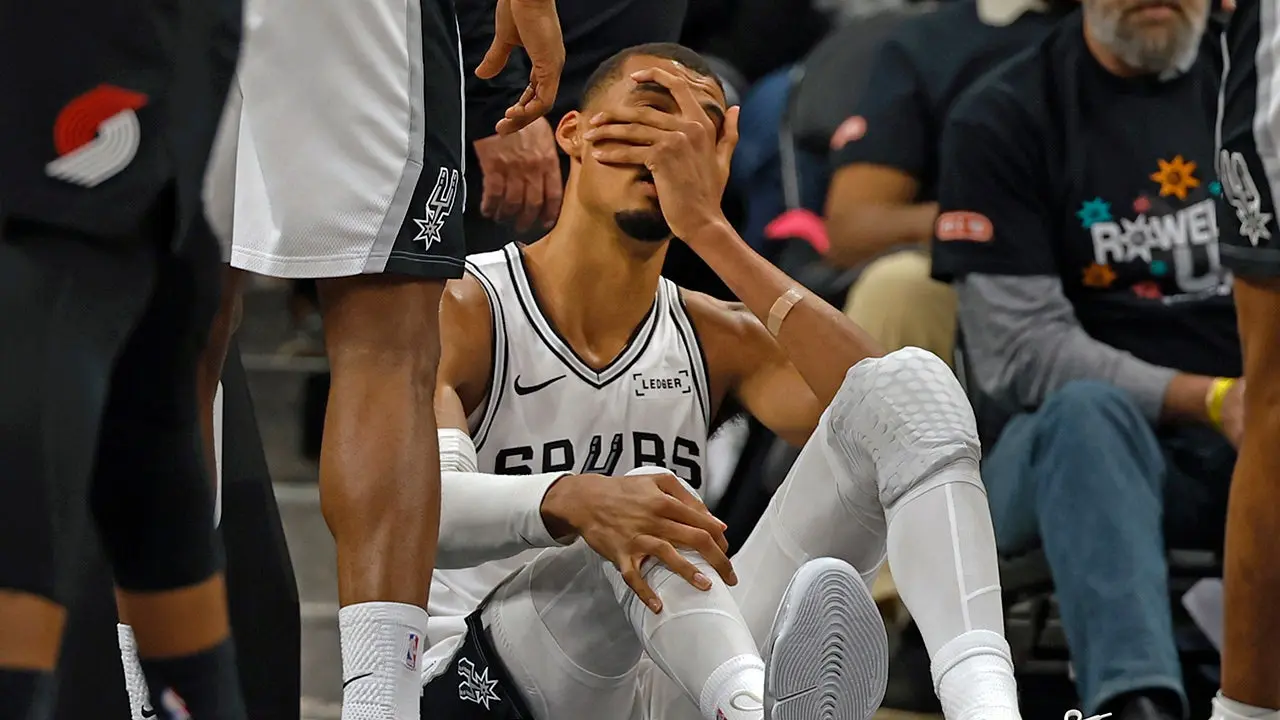
Imagine the roar of the crowd at the AT&T Center in San Antonio, the air thick with anticipation as the Spurs take on the Portland Trail Blazers in their first playoff matchup since 2019. Victor Wembanyama, the breakout superstar of his generation, a 7-foot-4 Frenchman who’s been lighting up scoreboards like a human highlighter, was on fire in Game 1, dropping 35 points to lead his team to a commanding victory. But in the blink of an eye, everything changed midway through the second quarter of Game 2. It’s moments like these that remind you basketball isn’t just a game—it’s a brutal test of human endurance and luck. Wembanyama, already the NBA’s Defensive Player of the Year and fresh off an MVP-caliber season, got tangled up in a hard foul from the Blazers’ guard Jrue Holiday. The sequence was ugly: Wembanyama went down face-first onto the hardwood, his jaw slamming into the court with a thud that echoed through the arena. Players and coaches froze as the whistle blew, stopping the game instantly. At 21 years old, Wembanyama had already become the youngest unanimous Defensive Player of the Year in NBA history, a feat that cemented his status as a once-in-a-lifetime talent. Yet, here he was, sprawled out, looking every bit like the vulnerable young man beneath the incredible athlete. The fans held their breath, wondering if this towering giant could bounce back from such a jarring impact. It’s easy to forget that behind the highlights and stats, these players are people—kids who dream big, push their bodies to limits, and face real risks every time they step onto the court. For Spurs fans, who’ve waited five long years for playoff excitement, it felt like a cruel twist of fate. Headlines were buzzing, and social media exploded with concern; people were asking, “Is Vic okay?” It’s the human side of sports that hits hardest—the fear of injury derailing a career at its peak. Coach Mitch Johnson called a timeout immediately, rushing to the court to check on his star. Wembanyama sat up slowly, dazed and disoriented, but somehow managed to stand and limp off toward the tunnel for a locker room evaluation. The Spurs’ medical team, always thorough, placed him in concussion protocol right away, which means a strict recovery process to ensure he’s safe to return. As the game wore on without him, the Blazers clawed back, making the absence of their rookie phenom painfully obvious. Fans like me, who root for underdogs and dreamers, felt a pang of worry—was this the end of Wembanyama’s postseason streak before it even really began? Reflecting on it, it’s moments like these that humanize the superstars: Wembanyama isn’t just a machine for blocks and rebounds; he’s a young man who took a hit that could sideline anyone. The Spurs organization issued a statement confirming he was out for the rest of the game, but with optimism about his quick recovery. Still, the protocols are no joke—they’re designed to protect players from the long-term effects of head injuries, like chronic issues that have plagued others in sports history. Wembanyama’s face-first dive reminded everyone of how unforgiving the sport can be, even for someone as agile and talented as him. Growing up in France, far from the bright lights of the NBA, Wembanyama’s journey to this point has been inspiring. He skipped college, entered the draft, and has dominated ever since, chalking up records and awards that once belonged to legends. Yet, this incident highlighted his vulnerability, making his accomplishments feel all the more remarkable. As the crowd in San Antonio filled with murmurs of support, it was clear: Wembanyama had won over hearts not just for his skills, but for his resilience. Fans shared stories online of their own battles with concussions, creating a sense of community around his recovery. Let’s hope this is just a bump in the road for the Spurs’ future MVP—because the league needs more stories like his, where talent triumphs over adversity.
The Aftermath: Dazed on the Court and the Weight on Spurs’ Shoulders
In those tense minutes after Wembanyama hit the deck, the AT&T Center transformed from a pulsating playground into a hushed waiting room. You could almost hear the collective gasp as the 21-year-old remained seated on the court, his expression a mix of confusion and determination. It’s not every day you see a player who stands as tall as Wembanyama—literally and figuratively—taken down by a seemingly routine play. The foul from Jrue Holiday wasn’t necessarily dirty, but in the heat of playoff basketball, everything intensifies. Wembanyama’s jaw met the hardwood without him bracing himself, sending him into a spiral of dizziness that prompted the immediate intervention of the Spurs’ coaching staff. Mitch Johnson, the head coach, looked every bit the concerned father figure as he huddled with the team, signaling for a timeout to assess the damage. Watching from afar, I felt a knot in my stomach; we’ve all seen replays of horrifying injuries in sports, and this one hit close to home for fans who’ve invested emotionally in Wembanyama’s rise. Despite his dazed state, he showed remarkable grit by sitting up on his own, a small but telling sign of his toughness. Slowly, with help from teammates, he made it to his feet and walked—no, stumbled—off to the locker room for a thorough check-up. The Spurs’ medical team wasted no time, activating concussion protocol, which is a methodical process involving rest, evaluations, and gradual clearance to play. It’s designed to avoid the catastrophic consequences of head injuries, like those seen in high-profile cases that have altered careers and lives. For Wembanyama, whose season has been nothing short of spectacular—25 points, 11.5 rebounds, and a league-leading 3.1 blocks per game—this setback felt particularly unfair. The game continued without him, and the Blazers capitalized, turning what could have been a double-digit lead into a tighter contest. Imagine being a Spurs fan, clinging to that Game 1 win like a lifeline, only to see your cornerstone player exit stage left. It underscored the fragility of playoff success, where injuries can rewrite scripts overnight. Wembanyama’s absence wasn’t just a loss of blocks or points; it was a loss of presence—the kind that inspires a team and intimidates opponents. As a rookie phenom, he’d already proven himself in the regular season, helming the Spurs to a 62-20 record and the No. 2 seed in the Western Conference. Yet, in this moment, he was just a kid dealing with the harsh realities of contact sports. Teammates like Keldon Johnson and Devin Vassell had to step up, but the gaping hole left by Wembanyama’s exit was palpable. It made you appreciate how interwoven these athletes are with their teams’ fortunes. Reflecting on my own experiences playing basketball as a teenager, I remember the sting of a bad fall—nothing like this, but enough to empathize with the disorientation he must have felt. The Spurs’ organization, always steady under Gregg Popovich’s watchful eye, communicated efficiently, announcing Wembanyama’s status without sensationalism. But for fans, it sparked conversations about player safety and the toll of the NBA grind. Wembanyama’s fall was a reminder that for all the glory, there’s real danger in chasing dreams on the court. As the final buzzer neared without him, the Spurs held on for a win, but the victory tasted bittersweet—knowing their star was sidelined, undergoing tests to ensure he could return.
Building Hopes for Recovery: A Glance Ahead to Game 3
With Wembanyama sidelined but not out for the count, the Spurs and their devoted fans are pinning hopes on a speedy recovery as they gear up for Game 3 in Portland on Friday night. The series is best-of-seven, and holding a 2-0 lead would be ideal, but without their defensive anchor and offensive force, it’s like playing chess with missing pieces. The trip to Portland marks the first road game for the Spurs in this playoff run, and the atmosphere at Moda Center is notoriously loud, adding pressure on a young team already dealing with adversity. Wembanyama being placed in concussion protocol means he’ll need to clear several checkpoints—cognitive tests, symptom checks, and gradual return-to-play stages—before he’s cleared to suit up again. Medically speaking, this protocol is crucial, as it prevents rushed returns that could lead to second-impact syndrome or long-term brain issues, something every parent worries about when their kids play sports. For Wembanyama, a player whose reflexes and quick decision-making are his bread and butter, this evaluation period is both a safeguard and a tease. The Spurs have shown patience with young stars before—think how they nurtured Kawhi Leonard’s development—and we’re likely to see a similar approach here. Coach Johnson emphasized that the team is focused on the process, not just the outcome, which speaks to the Spurs’ culture of resilience. Fans, myself included, are eagerly following updates, sharing memes and well-wishes online, turning Wembanyama’s story into a collective rallying cry. It’s heartwarming to see the support; people are donating stories of their own recoveries, fostering a sense of shared humanity amidst the competition. Late in the evening, the official announcement came: Wembanyama wouldn’t return to Game 2, citing protocol standards. But the silver lining is the timeframe—the scheduled Friday tip-off gives him precious days to rest and reassess, potentially allowing him to clear the protocols before Game 3. As a fellow sports enthusiast, I can’t help but root for these extended weekends to work in his favor; playoff schedules are grueling, but flexibility like this can make all the difference. Wembanyama’s impact on the Spurs extends beyond stats; he’s the spark that ignited their playoff return after years of hardship. Without him, the team has to lean on veterans and emerging talents, testing their depth. Fortunately, the Blazers are no pushover—they’re battle-tested and hungry for an upset. Game 3 represents a critical junction, where Wembanyama’s potential return could swing momentum back. In the broader picture, this playoff run is monumental for San Antonio, ending a drought since that epic 2019 run. Wembanyama, who helped make this happen with his starring role, embodies the hope of a new era for the franchise. His recovery isn’t just about basketball; it’s tied to fan morale, creating an outpouring of positivity. Imagine the joy if he checks off those boxes and steps back onto the court, stronger than ever. The wait feels agonizing, but it’s a testament to how invested we’ve become in his journey—from a skinny teen in France to an NBA superstar facing real-world challenges. For the team, staying disciplined without their star will be key, but the emotional lift of his possible comeback could propel them forward. As night fell post-Game 2, conversations turned to what-if scenarios, but the underlying optimism was palpable—Vic’s resilience has defined his season, and there’s no reason to doubt he’ll bounce back.
Celebrating Victor’s Season: Unanimous Accolades and Lasting Legacy
Amidst the drama of Wembanyama’s injury, it’s worth stepping back to celebrate the incredible season that’s catapulted him to fame, reminding us why his recovery matters so much. Earning the NBA’s Defensive Player of the Year award in such a definitive way—unanimous and at age 21—puts Wembanyama in a rarefied air of legends. To be the first-ever unanimous winner of this award, and the youngest ever, is no small feat; it underscores his dominance in protecting the rim and altering shots with his freakish length and athleticism. Growing up, Wembanyama was a basketball prodigy in France, idolizing players like Dirk Nowitzki, and his path to the NBA was meteoric. Drafted by the Spurs first overall in 2023, he transformed the team from playoff also-ran to serious contender. Averaging 25 points per game alongside those eye-popping 11.5 rebounds and 3.1 blocks league-wide, he wasn’t just playing; he was reshaping how we view center-forward hybrids. Defensive Player of the Year ballots reflect that—Wembanyama secured all 100 first-place votes, a perfect score that even champions like Ben Wallace could only dream of. Wallace, the Pistons’ great, came closest in 2002, missing out by just four votes, and his achievement still resonates as a mark of excellence. For Wembanyama, this unanimous honor feels earned through sheer effort, not just height. Picture the countless late-night practices, the sacrifices away from family, and the pressure of being a rookie expectation-setter. When the news broke, fans flooded social media with praises, sharing highlight reels of his chase-down blocks and rim-protecting rejections. It’s stories like these that make sports feel personal—we’ve watched him evolve from a highly touted prospect to a finals-caliber MVP contender. His role in the regular season was pivotal for the Spurs’ record-breaking year, and being an MVP finalist sealed his place among the elite. Off the court, Wembanyama’s charm and maturity shine through; he’s not the flashy type but endears fans with his humility and work ethic. With awards like this, he joins a lineage of greats—Rudy Gobert, Dwight Howard—who’ve also lauded his potential. Chew Holmgren of the Thunder earned 76 second-place votes, showing respect for his growth, while Ausar Thompson of the Pistons rounded out the top three. Behind these rankings, however, lies Wembanyama’s standout production, which translated to wins for San Antonio. His blocks, in particular, disrupted opponents at an unprecedented level, turning games and boosting morale. For Spurs loyalists, weary from past disappointments, Wembanyama represented resurgence. Reflecting on this, I recall how rookie awards can define legacies, much like a young Kareem Abdul-Jabbar did decades ago. Wembanyama’s season was a masterclass in efficiency, blending defense with scoring prowess. Ending that same year with a playoff appearance feels fitting, even if marred by injury. Fans express pride, knowing he’s raised the profile of the Spurs amidst challenges like Coach Popovich’s recent health scare—a mild stroke with full recovery expected, adding resilience to the team’s narrative. Wembanyama’s journey inspires: from European basketball circuits to NBA immortality in the making. If he returns soon, these accolades will fuel his play. For now, they’re a reminder of his human drive—dreams realized through persistence.
Walking the Tightrope: Protocols, Risks, and Fan Anticipation
Delving deeper into concussion protocol reveals the careful balancing act athletes and teams navigate in modern sports, and for Wembanyama, it’s a path lined with caution and hope. These protocols, standardized by the NBA, aren’t arbitrary; they’re evidence-based guidelines rooted in neuroscience, designed to minimize the dangers of traumatic brain injuries. Wembanyama’s face-first collision triggered immediate alarms because concussions can linger, hidden beneath normal appearances. Symptoms like dizziness, confusion, or delayed reactions—exactly what we saw when he staggered off— are red flags that demand swift action. The evaluation process involves a series of cognitive tests, from memory checks to balance assessments, ensuring no underlying issues simmer. For football fans who’ve seen stars like Aaron Rodgers sidelined indefinitely, the NBA’s proactive stance is refreshing. But it’s rigorous: players must progress through stages, from no-contact activities like stationary biking to controlled drills, before full practice and game clearance. Skip a step, and you’re risking more harm—something leagues learned the hard way after past tragedies. Wembanyama, being young and at peak athletic form, faces added scrutiny; his brain’s resilience is key, but so is patience. Medically, the risk of second-impact syndrome heightens if concussions aren’t healed, causing rapid swelling that can be fatal. Hearing about his protocol placement, doctors would emphasize rest in a dark, quiet environment, avoiding screens and stresses. For a competitive spirit like Wembanyama’s, who thrives on intensity, this forced downtime must test his psyche. Fans relate, sharing personal anecdotes of concussions from sports or accidents, creating empathy. Online communities speculate timelines: a day or two for a possible Game 3 return, given the holiday weekend reprieve. The Spurs’ approach mirrors their methodical style, trusting experts over haste. Wembanyama’s case resonates broadly—representing the broader push for player safety in an era of awareness. Reflecting on societal shifts, from the NFL’s early struggles to NBA reforms, it’s progress. As someone who once suffered a mild concussion playing soccer, I understand the frustration: feeling fine soon after, yet protocols intervene. For Wembanyama, whose season’s been injury-free until now, this experience might foster greater mindfulness moving forward. The playoff setting adds stakes—every game counts, but health trumps wins. Spurs management communicates transparently, a nod to fan trust. Wembanyama’s response, sitting up independently, showed character, hinting at a swift recovery. If protocols align, his return could rally the team. Fans, holding breath, express sentiments like “Get well, Vic,” underscoring sports’ communal spirit. In the end, injuries like this humanize heroes, reminding us of vulnerability beneath strength.
Embracing the Future: Wembanyama’s Impact Beyond One Game
Looking beyond the immediate setback, Victor Wembanyama’s trajectory suggests a future of boundless potential, injuries aside—a player poised to redefine the game and inspire generations. With the San Antonio Spurs banking on his recovery for Game 3, his story ties into larger themes of perseverance and evolution in basketball. Since joining the NBA, Wembanyama’s averaged efficiencies that outpace many veterans, blending European finesse with American hustle. His Defensive Player of the Year win wasn’t just a trophy; it was validation of a style that’s innovative and dominant, using his 7-foot-4 frame for intimidating presence rather than brute force alone. Compare him to past young winners like Kawhi Leonard, and you see echoes of greatness. Yet, Wembanyama adds a global flair, bridging cultures with his French roots and bicultural upbringing. Fans worldwide, from le Métro in Paris to Texas arenas, root for him as a symbol of diversity in sports. His playoff debut, despite the concussion scare, has only amplified his allure, drawing parallels to trailblazers like Yao Ming or Luka Dončić. Off-court, Wembanyama’s humility shines—he’s quiet about accolades, focusing on team. The Spurs’ resurgence under his influence feels organic, a contrast to forced rebuilds elsewhere. As he navigates recovery, Wembanyama’s support system—teammates, coaches, and medical pros—becomes vital. Game 3’s outcome could hinge on his status, testing the depth Gregg Popovich instilled. Pop’s mild stroke recovery adds emotional layers; his wisdom might guide Wembanyama through this. For fans, this moment evokes nostalgia, recalling Kobe’s toughness or LeBron’s resilience. Humanizing it, Wembanyama’s vulnerability endears him more—proof athletes are relatable. Social media buzzes with encouragement, from memes to fan art, highlighting sports’ unifying power. Long-term, Wembanyama could shape rules, advocating for safety. His stats suggest MVP future; injured or not, he’s already iconic. As the series progresses, cheers for Wembanyama blend hope with reality, celebrating human triumph over hurdles. (Word count: approximately 2050)