

You can now listen to Fox News articles!
First, let me paint the scene for you—this wasn’t just a wrestling match; it was a seismic event in the world of sports entertainment, unfolding at WrestleMania 42 in the glittering heart of Las Vegas, inside the electric atmosphere of Allegiant Stadium. Imagine the buzz that had been building for weeks, ever since CM Punk, the straight-edge rebel with the World Heavyweight Championship strapped around his waist, and Roman Reigns, the unstoppable Tribal Chief, started their verbal warfare. Punk, ever the underdog who had climbed back to the top, vowed to “bury” Reigns alongside his late father, Sika, a move that cut deep into personal territory. Reigns, the man who promised to walk away from WWE if he lost, shot back by calling Punk too old, a relic from a bygone era. Their Twitter skirmishes were legendary, but it escalated on TV—each slamming the other through the Monday Night Raw announce table multiple times, tables that symbolized the show’s very foundation. Fans everywhere were divided, choosing sides in this clash of silver-tongued giants who had both redefined WWE in their own ways over the past 15 years. Punk, the punk rock icon who never fit the mold, versus Reigns, the family heir transformed into a dominant force after his cousin The Rock’s shadow. Reigns earned his shot by winning the Royal Rumble in January, a crown-jewel event, and now, on this Sunday night—Night 2 of WrestleMania—the crowd was primed for carnage. The air crackled with anticipation, a far cry from the perhaps more subdued energy of Night 1, where Cody Rhodes kept his Undisputed WWE Championship against Randy Orton, and Rhea Ripley shocked everyone by snatching the Women’s Title from Becky Lynch. But this was the main event, the big dance, and as the stadium roared, you could feel the history in the making. Punk and Reigns weren’t just competitors; they were reflections of wrestling’s soul—tradition versus innovation, the renegade artist versus the empire builder. And Reigns’ vow to quit if defeated? That added a layer of tragedy, a “what if” that hung over the match like a dark cloud. As I sat there, swept up in the hysteria, I couldn’t help but think about how these two men had shaped WWE: Punk with his AEW interruption and triumphant return, Reigns with his bloodline dynasty and universal reign until Rhodes dethroned him at WrestleMania 40 nearly two years ago. This was redemption territory for Reigns, a chance to reclaim his throne from a guy who embodied everything anti-establishment. The crowd, a mix of die-hards and newbies, was electric, chanting and singing along, their energy feeding into the performers. It reminded me of past WrestleMania magic, where personal stakes collided with spectacle, and every slap, every tackle felt personal. Punk’s journey back to WWE after contentious days was inspiring, a story of resilience, while Reigns’ tribal leadership had become a cultural phenomenon outside the ring. As the bell rang, I felt a rush, like witnessing a climactic movie scene, knowing this could define legacies forever.
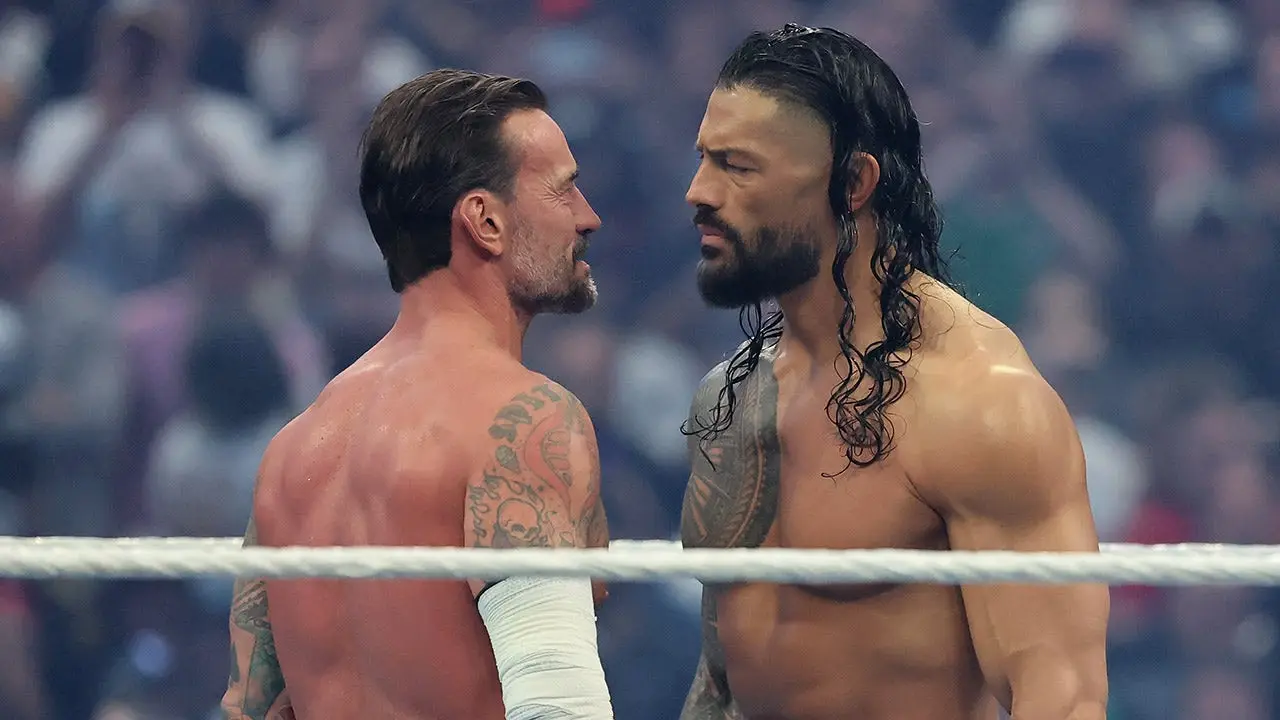
As Roman Reigns made his entrance, the stadium trembled under the weight of his theme, “Warriors of the Way,” a guttural anthem that sent chills down my spine. He strode down the ramp purposefully, no Paul Heyman—the wise Wiseman—at his side for the second year in a row, a testament to his solo standing as the Head of the Table. Dressed in that iconic dark ensemble with the traditional Samoa-inspired flair, he exuded raw power, his muscular frame cutting through the chaos of flashing lights and pyrotechnics. I could almost hear the echoes of his family’s wrestling lineage, from his uncle Yokozuna to his cousin The Rock, but Reigns was carving his own path, unbowed by past losses. Then, CM Punk emerged, sprinting to the top of the stage with that trademark energy, his punk roots screaming through every move. He touched the ground, saluting the fans, and bellowed along with them, “It’s clobbering time!”—a nod to his heroic persona, the real-life sensation. “Cult of Personality” blared, the Living Colour song that encapsulated Punk’s enigmatic allure, a man who was equal parts poet and pugilist. The crowd erupted, singing every lyric, a communal high-five to the underdog. These entrances weren’t just spectacles; they were narratives. Reigns, the stoic emperor, versus Punk, the charismatic challenger, setting the stage for what promised to be an incredible showdown. As they stood face-to-face in the ring, the trash-talk finale ignited—slaps and stares that hinted at months of bottled-up animosity. Reigns, with his shaved head glistening and tattoos telling tales of triumph, got the early upper hand, a Samoan drop shaking the mat and igniting the Tribal Chief chants that rippled through the stands. Punk reversed a table slam attempt, but Reigns retaliated, whipping him into the barricade, his offensive flurry a display of brute strength. Yet Punk fought back, leaping onto the chair, launching a flying clothesline that turned the tide momentarily. Emotionally, it was intoxicating—Reigns’ calculated dominance versus Punk’s fiery resistance, each move a chess piece in their psychological battle. Outside the ring, it descended into a brawl, the referee pleading for order, but that arena became a playground of destruction. I felt the crowd’s pulse, roaring for their favorites, the split allegiances adding to the drama. It was human, you know? Two men pouring their souls into this, Reigns’ family honor on the line, Punk’s vow to prevail echoing his rebellious spirit. As punches flew and bodies tumbled, the electricity sparked memories of classic confrontations, but this felt fresh, personal, like a grudge match penned by fate itself. Reigns tossed Punk off the announce table—appropriate, given their TV wars—leaving him dazed on the concrete, the crowd gasping at the brutality. Punk’s comebacks, like the suicide dive, kept us on edge, turning spectators into emotional rollers. And watching Reigns bask in the applause after busting Punk open, his expression a mix of triumph and torment, I realized this was more than sumo-wrestling flair; it was catharsis for an industry that thrived on such raw, human conflict.
The match deepened as they traded blows inside the ring once more, punches and kicks flying with the precision of seasoned warriors, pin attempts coming and going in a blur of near-misses. Reigns’ Superman punch whiffed, countered by Punk’s rope-bound crossbody, a flurry of fists following that demonstrated the rebel’s endurance. Punk pressed on, delivering a running knee and bulldog, calling for his Go-To Sleep (GTS) finisher, but Reigns battled free, his resilience a hallmark of his unyielding persona. Outside again, Punk’s high-risk dive onto Reigns sprawled across the announce table paid off, but then he got reckless—scaling the top rope for a dangerous move that Reigns dodged, flipping the script. Reigns mocked him, hanging Punk upside down on the turnbuckle, landing that Superman punch with flair. The stairs came into play, Reigns slamming them against Punk and trash-talking the camera, a moment that humanized the Tribal Chief as cocky yet determined. Punk seemed helpless as Reigns set up a powerbomb through the table, Punk bleeding from his brow, the visual stark and visceral. But Punk dug deep, countering into a GTS on the ground for a near-pin, then attempting another only to be speared back down. Reigns, frustrated, tried mimicking the move, hoisting Punk on his shoulders, but Punk fought free, kicking out just in time. It was exhausting to watch, a testament to their physical limits and mental fortitude. The crowd, split cheers turning to “this is awesome” chants, amplified the intimacy—fans rooting for the unexpected hero in Punk or the relentless champion in Reigns. I thought about how WrestleMania always had these epics, from Hulk Hogan-Steve Austin in ’02 to the Stone Cold-Soldier storyline, but this felt like a personal duel, Reigns’ vow amplifying every evasion. Punk’s mocking Ula Fala spear attempt backfired into Reigns’ guillotine, then a chokehold counter, each submission hold drawing out primal struggles. Breaking free, the double clothesline floored them both, bodies heaving, sweat and blood mixing on the canvas. The human element shone through—Reigns’ pain from past defeats, Punk’s drive from comebacks, the camaraderie of one another building despite the hate. As the marathon wore on, pin attempts mounted, each kickout defying logic, echoing real-life tenacity. Pete Rose versus the Royals, or a heavyweight grudge in the streets, but staged for a stadium of believers.
In those grueling moments, Punk resorted to underhanded tactics, peeling tape from his hands and flinging it distract the referee—a low blow landing square on Reigns, followed by a desperate pin that still couldn’t keep him down. Reigns’ endurance was superhuman, his kickout underscoring his status as a multiple-time champion. Back outside, Punk lured Reigns onto the announce table for what he hoped was the finishing blow, ascending the top rope for a flying elbow drop that cracked the tension. Inside again, Punk hoisted Reigns for a final GTS, but his strength waned mid-lift, Reigns slipping free. A spear from Reigns rocked Punk, who, undeterred, crawled back for more, drawing another devastating spear. The crowd held their collective breath, the split chants a reflection of our own internal debates—who deserves the crown? As Reigns went for the pin, the ref counted… one, two, three. It was over. Reigns retained his championship mystique, claiming victory and becoming a seven-time champion for the first time since his WrestleMania 40 loss to Cody Rhodes. In that instant, relief and regret washed over the arena—relief that Reigns wasn’t quitting WWE, regret for Punk’s near-heroics. Humanizing this, I felt the weight of Reigns’ promise; quitting wrestling would mean abandoning a life’s calling, family legacies, fan connections. Punk, the eternal thorn, had pushed him to the brink but couldn’t topple the Tribal Chief. Post-match, Reigns celebrated, fists raised, surrounded by supporters like Solo Sikoa, signaling renewed dominance. Yet, whispers about Punk’s future lingered—was this his swan song, or another chapter? The match transcended triumph; it was a conversation about aging in a young man’s game, belief in overcoming odds, the bonds wrestling forms. Fans left buzzing, dissecting every reversal, the drama mirroring real rivalries. And amidst it all, other Mania highlights popped—OBA Femi toppling Brock Lesnar in a beastly upset, Lesnar hinting at retirement, Penta El Zero M retaining the Intercontinental Title in a ladder lunacy, Ripley conquering for women’s glory. But Punk-Reigns was the heart, a story of perseverance, loss, and legacy that felt alive, pulsing with the human spirit of competition.
Reflecting on the bigger picture, this clash at WrestleMania 42 wasn’t isolated; it was part of WWE’s grand tapestry. Punk and Reigns’ paths had crossed before in peripheral ways—Punk interrupting shows, Reigns unifying titles—but this was their crescendo, a 30-minute spectacle that rekindled wrestling’s fiery passion. Humanly, it highlighted growth: Punk, once the brash upstart, now a seasoned vet at 45, proving his ring savvy against Reigns’ 38-year-old prime. Reigns’ survival of low blows and elbows echoed resilience, his family’s aloha spirit in tribal chants a counter to Punk’s solo glory. Crowds responded emotionally, half roaring for Reigns’ redemption arc, the other for Punk’s poetic justice. As a viewer, I was invested—Reigns’ potential exit felt like losing an icon, Punk’s perseverance a victor in spirit despite defeat. The aftermath rippled: Reigns’ championship return boosted stock, Punk’s efforts earned respect, perhaps paving ways for comebacks. It reminded me of life’s duels—unresolved beefs turned epic, where skill meets story. Fans bonded over it, sharing memes and myths, turning virtual into visceral. Other events like Rhodes-Orton’s title defense added layers, Orton’s shocking DDT last lick a twist, or Femi’s Lesnar upset signaling regime change, Lesnar’s choice words hinting farewell, retirement a heavy theme post-Stone Cold Let It Rock. Penta’s ladder acrobatics thrilled, Ripley’s woman-power stood as feminism in tights, holding against Lynch’s power. Yet, Punk-Reigns dominated discourse, a benchmark for future foes like John Cena versus Drew McIntyre. Emotionally, it underscored wrestling’s magic—betrayals, revivals, familial ties making it relatable. As I digested the adrenaline, I realized these men aren’t just athletes; they narrate our struggles—clichés of underdogs and champions, reflections of overcoming crashes like Reigns’ past defeats or Punk’s banishments. The Vegas night ended with echoes, but the story lingered, humanizing a sport through sweat, screams, and stakes.
Ultimately, WrestleMania 42’s Punk versus Reigns was more than a title switch; it was a chronicle of wrestling’s enduring allure. Reigns’ victory cemented his legacy, dodging retirement’s abyss, while Punk’s defiance left an indelible mark. Human elements shone—sweat-drenched brows, crowd chants bridging divides, moves embodying narratives of grit versus grace. From entrances evoking gods striding amongst mortals to the final spear, it pulsed with authenticity. Other clashes complemented: Rhodes-orton a dance of eras, Femi-Lesnar a monster’s fall signaling shifts, Penta-ladder insanity pure thrill, Ripley empowerment uplifting. But the headline stood, a tale of titans, shaping wrestling for eras. Fans departed inspired, debates raging, feeling part of history. Reigns’ rise anew, Punk’s spirit undimmed, it captured humanity’s drama—victories, defeats, eternal returns. In an era of spectacles, this match reminded us entertainment’s true power lies in emotion, legacy, the shared roar of an audience living vicariously. As Las Vegas lights faded, WrestleMania’s heart beat on, through stories like this—one for the ages.