





For the millions of devoted supporters of Paris Saint-Germain, the final whistle of the Champions League final against Arsenal was supposed to signal the dawn of a golden era, a long-awaited moment of pure, unadulterated sporting euphoria. For decades, the French capital had yearned for this ultimate European crown, and the dramatic victory on the pitch delivered a collective rush of adrenaline that instantly vibrated through the historic veins of Paris. In living rooms, local bistros, and crowded bars across the city, strangers embraced, tears of joy were shed, and the initial wave of celebration was filled with the beautiful, unifying magic that only football can inspire. Yet, almost as quickly as the triumph was secured, the atmosphere began to curdle. What started as a symphony of car horns, singing, and triumphant flag-waving steadily degenerated into a chaotic night of unrest, proving once again that in the modern cultural landscape, the line between passionate celebration and destructive civil disturbance is perilously thin. As the night wore on, the narrative shifted from PSG’s historic achievement on the pitch to a grim tale of street battles, shattered glass, and a city once again forced to reckon with the volatile fire of its own ecstatic crowd.
By the time the clock struck mid-evening, the iconic Champs-Élysées and the grand shadow of the Arc de Triomphe had transformed from a theater of joy into a dense, smoky battleground. Thousands of fans, clad in the deep blue and red of their beloved club, flooded the wider avenues, setting off bright red marine flares that cast an eerie, surreal glow over the historic stone facades. The deafening chorus of celebratory chants was gradually drowned out by the metallic screech of spinning tires, the shattering of bottles, and the ominous static of police radios. Underneath the bright lights of the capital, the sheer volume of humanity quickly overwhelmed the initial security cordons, prompting the Paris police prefecture to mobilize heavy reinforcements. Riot police, equipped with shields and tear gas launchers, formed formidable barriers to contain the swelling tide of people, trying desperately to prevent the celebratory energy from splintering into localized riots, as the prestigious boulevard became choked with heavy smoke and the relentless blaring of car horns.
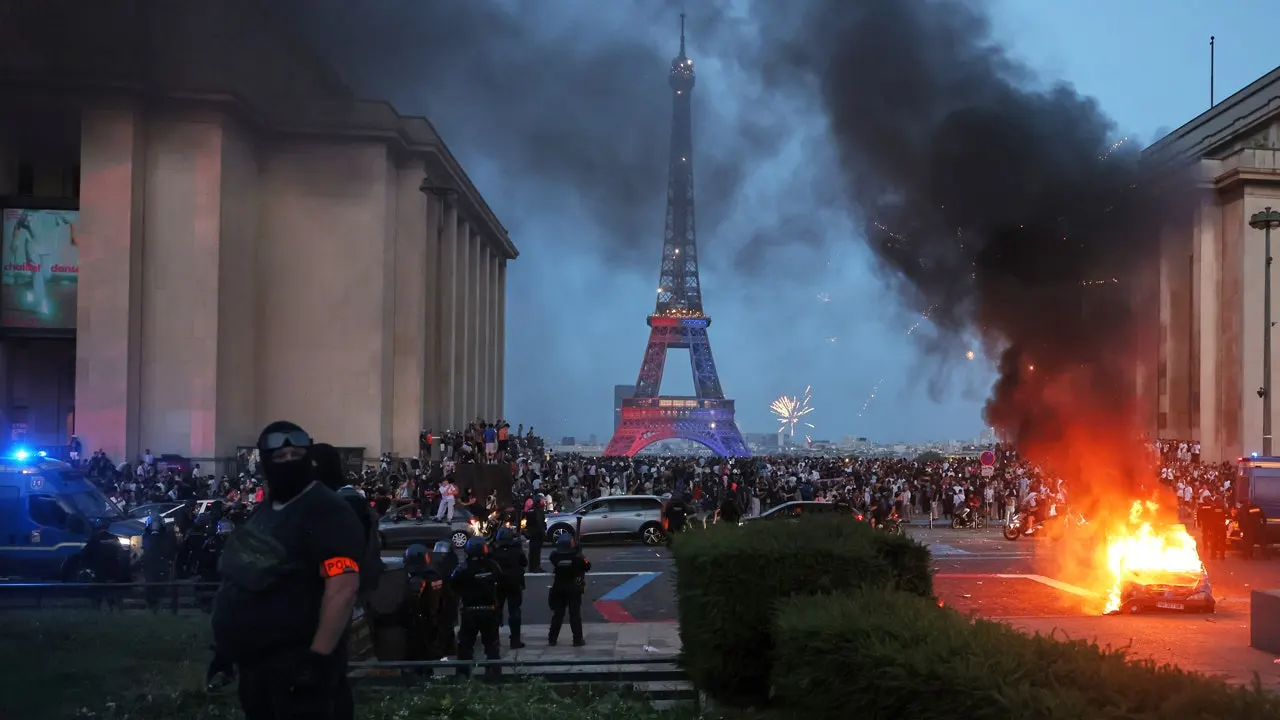
For the ordinary citizens, small business owners, and workers of Paris, the unfolding chaos was not a theoretical debate about football culture, but a frightening and costly reality that knocked directly on their doors. As specialized groups of agitators began to peel away from the main body of celebrants, the night took a distinctly destructive turn, targeting the very fabric of the local community. A neighborhood bakery, which had spent the week serving daily baguettes to residents, and a popular local restaurant had their windows smashed and interiors damaged, leaving business owners to survey the wreckage of their livelihoods amidst the smell of smoke. Nearby, several passenger vehicles were overturned and torched, sending thick columns of black, toxic smoke billowing into the Parisian night sky, while a group of individuals boldly attempted to storm a local police station. The chaos even spilled onto the Boulevard Périphérique, the vital ring road that encircles Paris, where a crowd briefly blocked traffic and brought the city’s geographic heartbeat to a complete standstill before being dispersed by law enforcement, highlighting how rapidly a sporting party can disrupt the functional life of an entire metropolis.
The burden of restoring order fell squarely on the shoulders of the French gendarmes and police officers, who found themselves navigating a hostile, rapidly shifting environment where any attempt to enforce the law was met with intense resistance. Engaging with crowds that are fueled by a volatile mixture of alcohol, youthful adrenaline, and victory-induced hysteria is one of the most perilous assignments in modern policing, requiring an agonizingly delicate balance of restraint and decisive force. During these intense scuffles, officers faced volleys of glass bottles, firecrackers, and debris, resulting in at least one police officer sustaining injuries while defending public property. By 10:00 p.m. local time, as the smoke began to settle slightly and rain cleared the warmer air, authorities had detained at least 45 individuals, dragging them from the chaotic streets into police custody for offenses ranging from vandalism and arson to direct violence against law enforcement. This rapid escalation highlighted the immense vulnerability of the city’s public safety infrastructure when the sheer scale of a crowd outmatches the physical capacity of the streets to contain them.
To understand the intensity of Saturday night’s unrest, one must look at the deep-seated, historically turbulent relationship between French football culture and societal expression, where major sporting events often serve as a lightning rod for broader tensions. This weekend’s violence was not a sudden anomaly, but rather a echoing refrain of past triumphs; indeed, when Paris Saint-Germain claimed their previous Champions League title, the aftermath was catastrophically larger, resulting in over 201 injuries in Paris alone and more than 500 arrests across the country. In France, the football stadium and the street have long been places where the marginalized, the passionate, the rebellious, and the destructive gather under a single banner, utilizing the cover of a massive public gathering to vent frustrations that extend far beyond the parameters of a ninety-minute athletic match. This recurring pattern of destructive celebration raises difficult, ongoing questions for municipal leaders and sporting organizations alike, who must grapple with the reality that their greatest victories on the field are almost guaranteed to trigger a parallel crisis of public order on the streets.
As the sun rose over Paris the next morning, illuminating the sweeping broom strokes of municipal workers clearing away piles of green glass, charred metal, and plastic cups, the mood of the city was decidedly bittersweet. PSG had finally conquered Europe, achieving a monumental milestone that should have dominated the headlines with stories of athletic brilliance and civic pride, but instead, the global conversation was dominated by images of burning cars and riot police. For the true fans of the sport—those who dream of spectacular goals rather than broken storefronts—the night left a lingering sense of melancholy, a quiet frustration that the beautiful game had once again been hijacked by a destructive minority. Yet, despite the scars left on the pavement and the storefronts, the resilient spirit of Paris remains unbroken, as the city sweeps up the debris, heals its injured, and continues to search for a way to celebrate its historic sporting triumphs without sacrificing its peace, safety, and community warmth in the process.