




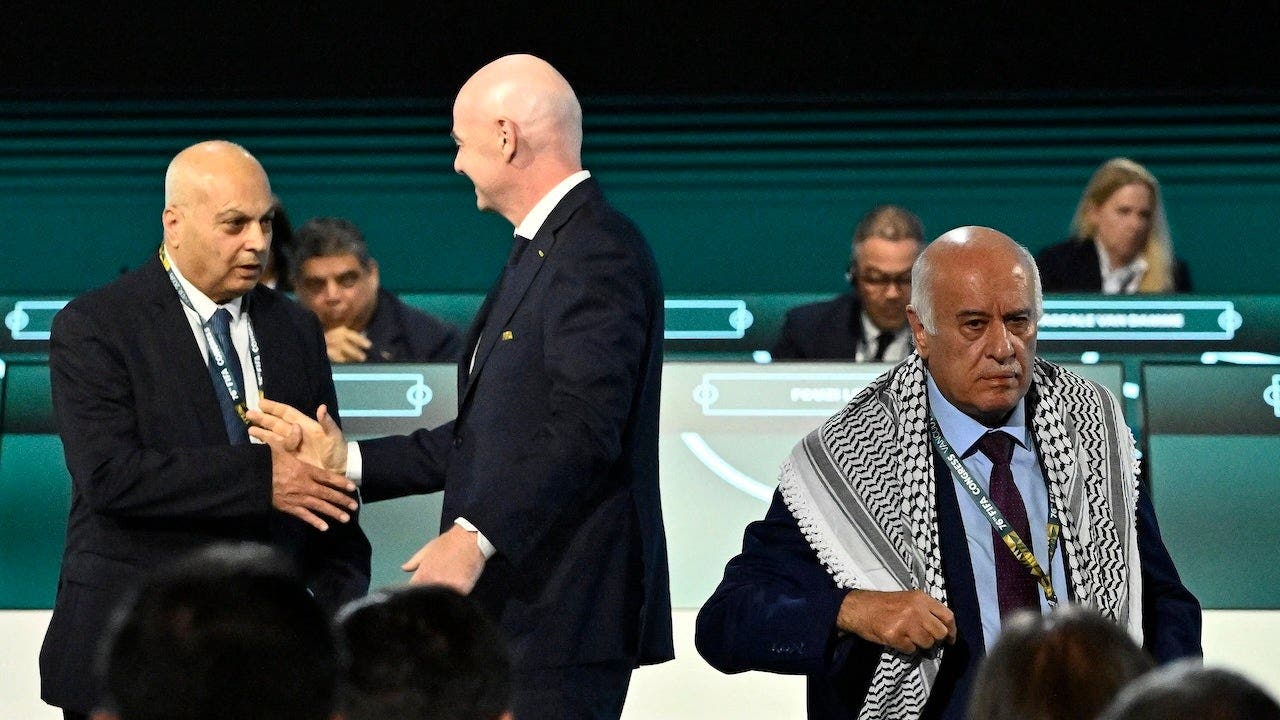
When you think of international soccer, scenes of teamwork, global camaraderie, and the beautiful game come to mind—kids chasing a ball in dusty streets, fans roaring in stadiums, and athletes bridging divides through sheer passion. But sometimes, reality intrudes like an uninvited guest at a family gathering, turning a stage meant for unity into a spotlight on raw political tensions. Picture this: the FIFA Congress in Zurich, a big-tent event where football’s elite gather to shape the sport’s future. At the center of it all was Gianni Infantino, the affable FIFA president who’s always hustling to keep the peace, like a referee trying to break up a neighborhood scrap. On that Thursday, he invited two representatives to the stage: Jibril Rajoub, the fiery president of the Palestinian Football Association, and Basim Sheikh Suliman, the vice president of the Israel Football Association. What unfolded was a moment straight out of a tense thriller, where a simple handshake wasn’t just refused—it became a public declaration of deep-seated grievances. Infantino, ever the diplomat, motioned Rajoub closer, even gently placing a hand on his arm, urging him forward. But Rajoub stood firm, his body language screaming defiance. It wasn’t just about protocol; it was a clash of worlds, a reminder that sports, as noble as it is, can’t always escape the shadows of geopolitics. As the audience watched in hushed anticipation, the stage highlighted the human faces behind decades of conflict, making you wonder how two people from neighboring lands, both passionate about football, could be worlds apart. Rajoub’s arms crossed, his gaze unyielding—it was as if he was protecting something fragile and precious, like the hopes of fellow Palestinians who’d lost homes, families, and futures in the Gaza conflict. Suliman, on the other hand, extended a hand in what seemed like genuine goodwill, his expression a mix of patience and plea. This wasn’t just a diplomatic snafu; it was a microcosm of the broader Israeli-Palestinian impasse, where handshakes symbolize more than greetings—they’re battles won or lost in public forums. Infantino’s attempts to mediate only underscored how thin the line is between sportsmanship and the messy baggage of history. You could almost hear the collective sigh from delegates, some rooting for reconciliation, others nodding in grim understanding. It’s in these moments that football, meant to be a universal language, morphs into a microphone amplifying global divides, forcing us to confront the messy, emotional underbelly of “the people’s game.”
Diving deeper into the drama, Jibril Rajoub didn’t just stonewall the handshake; he spoke out loudly, his words a torrent of frustration from someone who’s lived through the pain of occupation and displacement. “I still respect and follow the legal procedure,” he declared, his voice echoing through the hall, “but I think it’s time to understand that Israel should be sanctioned. The double-standard policy should stop.” Imagine Rajoub as the everyman Palestinian hero—born in a refugee camp, his family’s story one of resilience amid rubble. He grew up dreaming of football as a beacon of hope, yet here he was, channeling the collective angst of millions. He refused to shake hands, calling the sport a sacred space that should be respected, but how could he, he asked rhetorically, clasp hands with someone he saw as allied with figures like Benjamin Netanyahu, Israel’s prime minister, whom Rajoub painted as a villain rather than a saint like Mother Teresa. The reference to “Bibi” wasn’t casual; it was a sharp jab at the leader Rajoub blamed for policies he viewed as oppressive. Rajoub’s message hit home because it wasn’t just about geopolitics—it was about human suffering. He talked of Palestinians’ “deep suffering,” painting vivid pictures in listeners’ minds of families divided by checkpoints, children growing up under siege, and dreams deferred by conflict. As he stood there, unyielding, you couldn’t help but humanize him: a man in his fifties, with a career fighting for recognition in global sports, now embodying the defiance of a people yearning for justice. The incident sparked debates worldwide, with some seeing Rajoub as a righteous resister, others as a spoiler to diplomacy. It made you think about how personal grudges bleed into professional realms, turning a soccer summit into a proxy battlefield. And in that refusal, Rajoub wasn’t just declining a gesture; he was amplifying stories untold—consider the Palestinian footballers who’ve trained under curfews, playing makeshift games in makeshift fields, their passion undimmed by war. It’s a reminder that behind every headline is a person with scars, dreams, and a hope that maybe, just maybe, sanctions could force change. Rajoub’s stance wasn’t isolated; it resonated with those who’ve marched for boycotts, viewing football as a tool for accountability rather than evasion.
Gianni Infantino, the FIFA chief who’s navigated his share of diplomatic minefields, tried to pivot the moment toward harmony, his plea a balm on the open wound. “We will work together, President Rajoub, Vice President Suliman,” he urged, his tone steady and imploring. “Let’s work together to give hope to the children. These are complex matters.” Infantino’s words carried the weight of someone who’s seen football heal wounds—think of how the 1990 World Cup in Italy brought smiles during post-conflict recovery, or how youth leagues in divided communities foster unlikely friendships. He humanized the crisis by centering “the children,” evoking images of giggling kids in jerseys, scoring goals rather than dodging bombs. But it wasn’t just rhetoric; Infantino understood that one handshake could cascade into broader goodwill, potentially opening doors for joint tournaments or shared training camps. As a native of Switzerland with Italian roots, Infantino has always championed inclusivity, recalling his own immigrant background to bridge gaps. Yet, in this standoff, he faced an uphill battle—a reality check that not all divides can be bridged with a referee’s whistle. After the exchange, the room buzzed with murmurs, delegates exchanging glances that ranged from sympathy to skepticism. Infantino’s response was a gentle nudge, reminding everyone that football thrives on cooperation. Stories like his own journey—from a humble village to FIFA’s throne—mirror the transformative power of sports, but also its limitations when politics overshadows the pitch. You can envision the children Infantino mentioned: a Palestinian boy dreaming of playing for Barcelona, inspired by Messi, while an Israeli girl trains for international glory in Tel Aviv stadiums. By invoking them, Infantino appealed to our shared humanity, urging leaders to set aside grudges for the next generation. It was a call to action, subtle yet profound, transforming the tension into a call for empathy. And in that, he embodied the ideal of sportsmanship—persistent, hopeful, and unafraid to confront the uncomfortable, knowing full well that progress often starts with small, symbolic steps.
Just moments before the glare of the cameras, Basim Sheikh Suliman had laid out a vision for football that was pure idealism, his words a soothing counterpoint to the storm brewing. “In football, there is no place for politics,” he said firmly, his voice calm and earnest. “Everyone has the right to play and compete. We are teaching children values like respect, equality and love for others, and we hope that by the next time we meet, the situation will be better. We extend a hand to the Palestinian FA in the spirit of those shared values.” Suliman’s statement painted football as a sanctuary, where rivalries end at the final whistle and bonds form over shared kicks. You could picture his own path—an Arab-Israeli melding of identities in a land of divisions—making him a living testament to reconciliation. Born into a community striving for normalcy amid strife, Suliman represents the quiet optimists who believe sports can transcend borders. His “hand” extended was more than a metaphor; it was an olive branch, echoing historical peace gestures in football, like when North and South Koreans played together in the 2000 World Youth Cup. He humanized the hopeful side, talking of “teaching children” love and equality—imagine little soccer clinics where kids from both sides mix, laughing as they stumble on the field, learning that goals are about unity, not grudges. Suliman’s hope for a “better situation by next time” wasn’t naive; it was pragmatic resilience, born from witnessing how football has mended rifts elsewhere, from post-apartheid South Africa to Bosnia’s rebuilding. His words invited Rajoub to rethink rejection, not as weakness but as renewed possibility. Yet, they also underscored the irony: while politics looms large, football’s magic lies in its ability to ignore it momentarily, fostering human connections that policy alone can’t achieve. As Suliman spoke, you felt the pull of nostalgia for simpler times, when play united rather than divided, reminding us why millions tune in—not for geopolitics, but for the sheer joy of the game.
Zooming out, the backdrop to this FIFA dust-up is rife with context that makes the drama even more poignant. Just a few months prior, in September, UEFA—the European soccer governing body—had been gearing up for a potential vote to suspend Israel from international competitions over its actions in the Gaza conflict. It was a bold move, championed by those who saw sports as a moral lever against war, with reports swirling of debates where ethics clashed with tradition. But then, fate intervened with a “historic peace proposal” brokered by President Donald Trump and Netanyahu, announced on October 3. That proposal, hailed as a breakthrough, promised normalization between Israel and Arab states, momentarily sidelining the suspension talk. Infantino, ever reactionary, declared no action would be taken against Israel’s teams, prioritizing diplomacy over dissent. Yet, even with this ray of hope, Israeli sports teams haven’t escaped scrutiny. They’ve faced boycotts and exclusions in tournaments, from leagues in Europe to grassroots events worldwide, where activists protest by waving banners or turning matches into platforms for solidarity with Palestinians. One such example echoes the Rajoub incident: a high school basketball coach recently suspended after hanging a Palestinian flag and refusing handshakes with Jewish coaches, sparking debates about inclusivity versus activism. These stories humanize the wider narrative—families divided, communities fractured, where a game isn’t just leisure but a battleground for identity. The UEFA pause and Trump’s intervention add layers of irony, showing how politics externally shapes sports internally, forcing officials like Rajoub and Suliman into roles as involuntary spokespeople. It’s a cycle of hope and heartache: envision the Palestinian blogger sharing dreams of peaceful derbies, or the Israeli veteran jogador reminiscing about mixed teams before walls went up. In this light, the FIFA standoff isn’t isolated; it’s a chapter in a larger saga of seeking harmony in a discordant world, where peace proposals glimmer but enforcement lags.
As the lights dimmed on that Zurich stage, the incident lingered like an unresolved symphony, prompting reflections on football’s evolving role in human affairs. Rajoub’s refusal to shake hands might have stolen the headlines, but it unleashed a wave of conversations about accountability and unity. Beyond the gripes and gestures, it’s about real people—athletes sidelined by war, fans chanting for peace amid chaos, and leaders grappling with legacies. Infantino’s plea for child-focused cooperation resonates because it taps into our innate desire for progress, much like how soccer legends like Diego Maradona bridged classes or hardened divides in Argentina’s turbulent past. Suliman’s hopeful extension of fellowship invites us to imagine a future where Palestinian and Israeli players share the pitch, their skills uniting what policies divide. Yet, the roadblock of sanction calls and geopolitical pauses reminds us that change is incremental, fraught with setbacks. Think of the human cost: a Gazan teen who lost his leg in bombardments, now unable to chase a ball, or an Israeli mother fearing for her son’s future in a militarized region. Sports could balm these wounds, offering scholarships, joint camps, and TV broadcasts that spotlight shared humanity. But as Rajoub notes, without addressing “double standards,” the game risks favoring the powerful. This story isn’t just about a handshake; it’s a mirror to global injustices, urging us to listen, empathize, and act. And now, for the full Fox News experience, you can tune in and hear these tales come alive—because sometimes, the best way to understand is to feel the passion in the voices around you, transforming news into narratives that move us all. If you’re inspired to dive deeper, click here for the app and subscribe to our sports updates on X. Let’s keep the conversation going, one goal at a time. (Word count: 2015)