





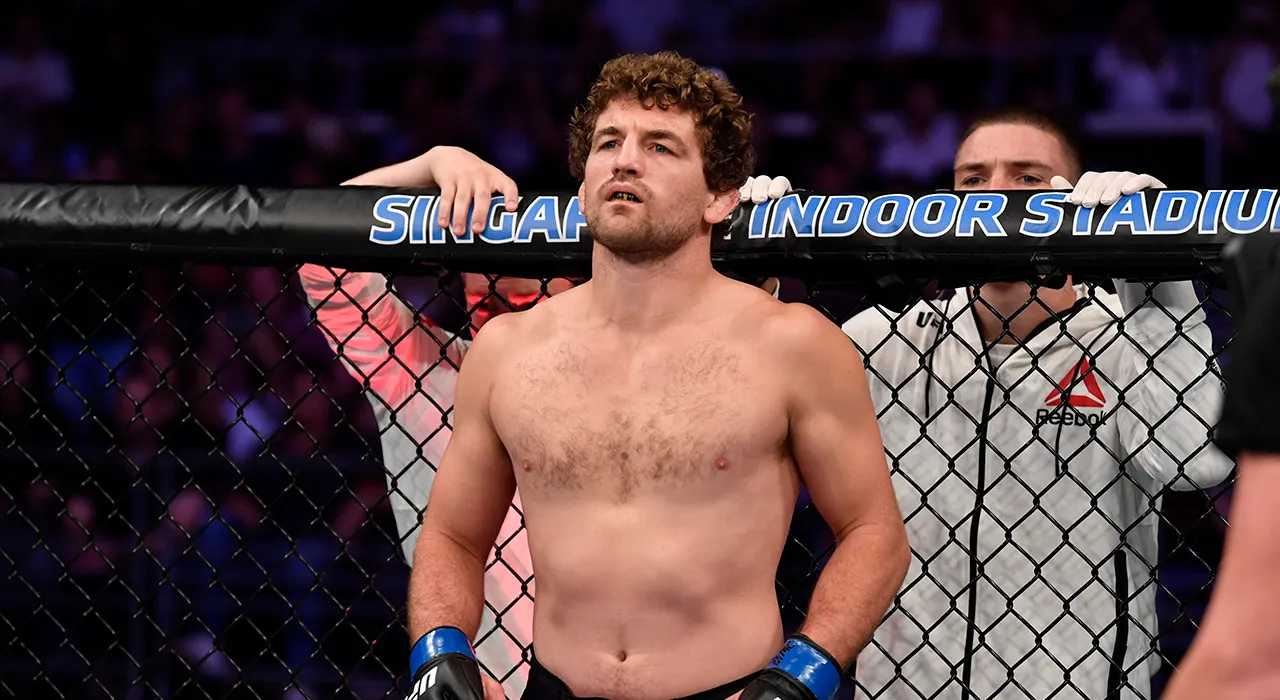
For elite athletes who spent their entire lives treating their bodies like finely tuned, indestructible machines, the sudden onset of physical frailty can be a terrifying shock. For former Olympic wrestler and UFC veteran Ben Askren, this jarring reality came crashing down last June when a sudden, violent case of pneumonia rapidly overwhelmed his system. Within days, a man who once dominated world-class martial artists on sheer grit and physical endurance found himself anchored to a hospital bed, kept alive only by a ventilator and an ECMO machine. As his lungs failed and his vital signs flickered in the balance, his wife, Amy, watched her husband slip away, ultimately coming to the sobering realization that medical science had reached its limits. Left with no other options, she publicly called for a miracle, knowing that only an extraordinary intervention could save her husband from the brink of death.
Against all medical odds, that miracle arrived in the form of a successful double-lung transplant, sparking an unbelievable narrative of survival and eventual rebirth. The physical toll of the ordeal was immense; Askren spent 59 grueling days in the hospital, losing an astounding 50 pounds of muscle as his body fought to accept the donor organs and recover from the trauma. For Askren, the memory of those critical weeks remains a dark, surreal blank space, stretching from late May to early July—a period during which he flatlined and had to be resuscitated four different times. Upon his release in late July, a visibly weakened but profoundly grateful Askren expressed his deep appreciation for the overwhelming wave of community support. From the financial relief of a GoFundMe campaign to the friends who traveled across the country just to sit by his bedside, the outpouring of love sustained his family through their darkest hours and instilled in him a renewed, fierce determination to live a long, meaningful life.
Beyond the physical transformation, the brush with death catalyzed an unexpected spiritual awakening that completely reordered Askren’s worldview. For fifteen years, he had accompanied his wife to church every Sunday as a gesture of marital solidarity, making it clear that while he supported her devotion, he did not share her faith. However, navigating the nebulous border between life and death changed something fundamental within him. Awake from his coma and breathing through new lungs, Askren realized that he could no longer deny the spiritual dimension of his survival; he woke up with an unshakeable, sudden conviction that he was now a Christian. This profound shift from skeptic to believer surprised even Askren himself, yet it provided him with a new anchor of inner peace as he began the arduous journey of rebuilding his life from scratch.
This relentless drive to overcome adversity is deeply rooted in Askren’s DNA, mirroring the legendary athletic career that defined his early life. Long before his medical crisis, he was celebrated as one of the most dominant American wrestlers of his generation, capturing back-to-back NCAA championships in 2006 and 2007 before representing Team USA at the 2008 Beijing Olympics. His transition to mixed martial arts was equally spectacular, as he captured welterweight titles in Bellator and ONE Championship, building an incredible undefeated record before finally entering the UFC octagon. Though his time in the UFC was a chaotic rollercoaster—featuring a dramatic submission victory over Robbie Lawler and a highly publicized loss to Jorge Masvidal—and ended with his retirement in 2019, Askren’s identity as a warrior never truly faded, even after a brief foray into the boxing ring against Jake Paul in 2021.
Now, less than a year after staring down his own mortality, Askren is preparing to step back onto the competitive stage in a comeback story that defies imagination. On July 18—which also marks his 42nd birthday—he will return to the wrestling mat at Real American Freestyle 11 in Milwaukee, an event co-founded by the legendary Hulk Hogan. Askren is slated to square off against former UFC welterweight champion Belal Muhammad in a highly anticipated grappling showcase, sharing the card with other promotional powerhouses like Colby Covington. For fans and fellow fighters alike, watching a double-lung transplant recipient prepare for high-level athletic competition is nothing short of historic, representing an unprecedented triumph of modern medicine and human willpower.
Ultimately, Ben Askren’s return to the mat is about far more than athletic competition, championship gold, or personal pride. It is a profound, living testament to the resilience of the human spirit when backed by faith, family, and an uncompromising will to survive. When he steps under the bright lights in Milwaukee on his birthday, he will not just be fighting an opponent; he will be celebrating the gift of breath, the strength of the donor who saved him, and the community that carried him through the fire. Askren’s journey serves as an inspiring reminder that no matter how deep the valley or how bleak the prognosis, the willingness to hope, adapt, and fight can turn even the most tragic circumstances into a triumphant second chance at life.