




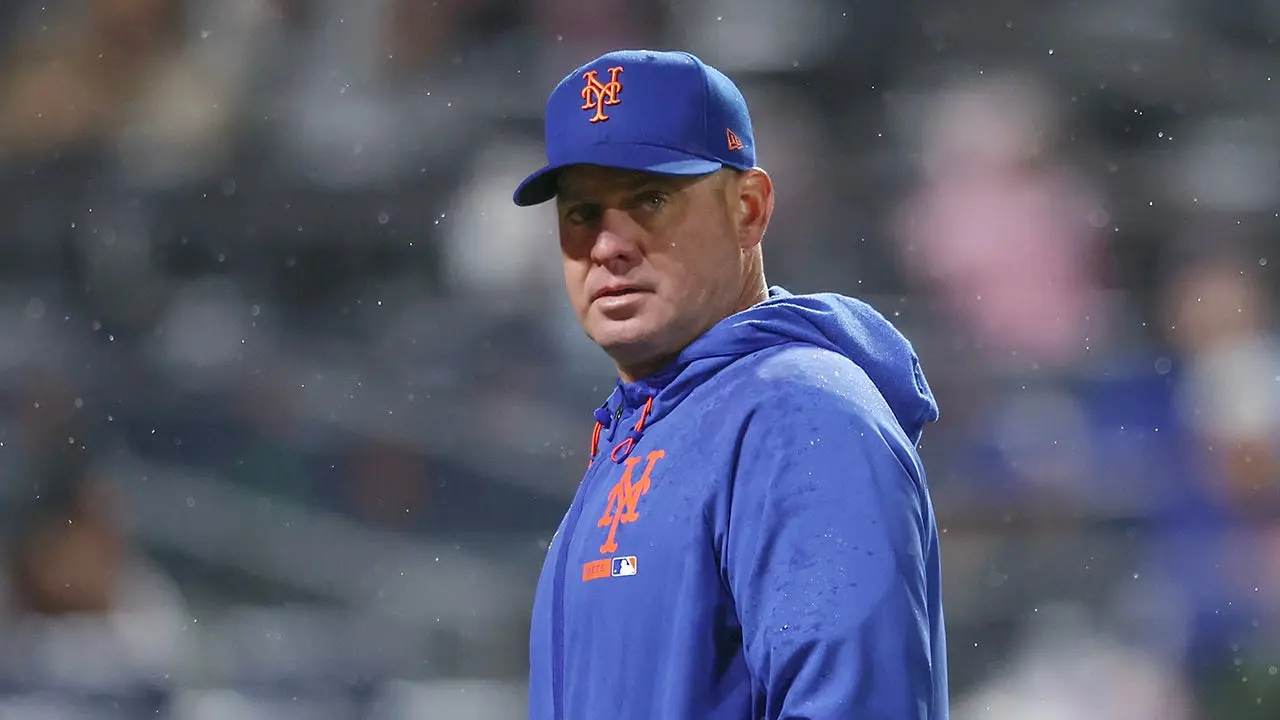
There is a unique brand of heartbreak that only baseball can deliver—a slow-burning, relentless agony that begins with the unbridled optimism of spring training and ends in the cold, harsh light of a mid-season collapse. For the New York Mets and their long-suffering fan base, that heartbreak has officially manifested as rock bottom, culminating in the abrupt and painful firing of manager Carlos Mendoza. Only a year ago, Mendoza was the celebrated toast of Queens, a charismatic rookie manager who captured the hearts of fans by guiding the team through a magical, unexpected run all the way to the National League Championship Series in 2024. Today, those triumphant memories feel like a lifetime ago, completely replaced by the grim and exhausting reality of a nightmare season that has spiraled entirely out of control. The final breaking point arrived on a humid Thursday night in Chicago, where the Mets were mercilessly swept in a demoralizing four-game series by the Cubs, putting a definitive exclamation point on a disastrous six-game losing streak. During this brutal stretch, the Mets were not just beaten; they were thoroughly outclassed and humiliated, outscored by a shocking margin of 58-22, leaving them a staggering 13 games under the .500 mark. Since the middle of June last year, this team has put up a dismal 72-102 record, a long-term stretch of mediocrity that has eroded any remaining goodwill. The fall is particularly bitter because the Mets boast the largest payroll in the history of the sport, hovering at nearly $330 million, an astronomical investment that was supposed to purchase a perennial contender but has instead financed an epic disaster. A brutal 12-game losing streak back in April set a toxic tone for the year, establishing a psychological hurdle that this clubhouse simply could not jump over, proving that in the pressure cooker of New York sports, when a highly-paid roster fails, the manager is always the first to pay the price.
The tragedy of this season is deeply rooted in a series of calculated, analytical gambles by the front office that stripped the team of its emotional core and left it feeling hollow. Last winter, President of Baseball Operations David Stearns embarked on a radical roster overhaul that seemed to prioritize cold, database-driven run prevention over the organic, intangible chemistry of a beloved locker room. In a series of moves that shocked and saddened the fan base, the Mets allowed franchise cornerstones and fan favorites Pete Alonso and Edwin Diaz to walk away in free agency, while trading away long-time mainstays Jeff McNeil and Brandon Nimmo. In their place, Stearns brought in a highly touted group of new acquisitions, including Jorge Polanco, Luis Robert, Bo Bichette, Devin Williams, and Luke Weaver. On paper, it was a bold, forward-thinking reimagining of the team, but in practice, it has been an absolute disaster defined by bad luck, injuries, and immense regression. Jorge Polanco has been sidelined since mid-April, and Luis Robert followed him to the injured list shortly after, depriving the lineup of critical power and fielding presence. Meanwhile, Bo Bichette, buckled under the suffocating weight of New York expectations, has fallen into a devastating slump, pacing toward what is statistically the worst full season of his professional career. In the bullpen, high-profile reliever Devin Williams has struggled mightily, carrying a bloated 4.44 ERA that echoes his previous post-season difficulties under the bright lights of the Bronx. Amidst this sea of disappointment, only pitcher Luke Weaver has emerged as a genuine bright spot, defying the team’s downward trajectory with a stellar 2.12 ERA, standing as a solitary figure of resilience and grit on a roster that has otherwise completely lost its way.
To watch the Mets play this season is to witness a profound, systemic breakdown in the fundamental mechanics of the sport, a collective crisis of confidence that has infected every single aspect of their game. The team’s statistics read like an absolute horror story: the offense possesses the second-lowest OPS in all of Major League Baseball at a paltry .675, while the starting pitching staff has struggled to a 4.90 ERA, the third-worst mark in the league. Even more damning is the fact that despite Stearns’ explicit offseason mission to prioritize defensive efficiency and run prevention, the Mets have accumulated the third-most errors in the league. The absolute nadir of this defensive ineptitude occurred during a harrowing doubleheader on a Wednesday night, an evening that will live in Mets infamy for decades to come. The team committed a shocking six errors, culminating in a historic embarrassment: for the first time since 1962—the franchise’s very first year of existence as a notoriously loveable but highly incompetent expansion team—every single starting infielder committed an error in the same game. As the baseball repeatedly slipped through the fingers of highly paid professionals, the frustrated fans at Citi Field let their voices be heard, their boos echoing through the stadium in a chorus of pure, unadulterated disappointment. In a poignant, heartbreaking moment of collective grief, the crowd began loudly chanting the name of Pete Alonso, the departed homegrown hero whose heavy bat and infectious energy formerly defined the team. This visceral fan reaction highlighted the deep disconnect between the sterile, spreadsheet-managed front office and the flesh-and-blood human beings who fill the stands, desperate for a team they can actually believe in, rendering Alonso’s absence a painful reminder of what was sacrificed in the pursuit of cold, metrics-driven efficiency.
In the wake of this historic slide, Carlos Mendoza became the first to pay the price, a decision that was clearly met with heavy hearts within the organization’s upper management. Unlike many managerial firings in professional sports that are fueled by rancor, finger-pointing, and behind-the-scenes division, Mendoza’s departure was wrapped in a sense of profound sadness and mutual respect, highlighting the brutal nature of the baseball business where personal affection cannot override poor results on the scoreboard. David Stearns spoke of Mendoza with genuine warmth, noting that he had led the organization with passion and grace, earning the adoration of everyone who worked alongside him on a daily basis. Stearns acknowledged that Mendoza’s impact on player development, the coaching staff, and the overall clubhouse culture over the last three seasons had been truly transformative, bringing stability during a time of great upheaval. However, his statement carried the cold, hard reality of professional sports: the organization was falling shockingly short of its standards, and an immediate structural change was deemed necessary to salvage any resemblance of a future. Owner Steve Cohen echoed these sentiments, expressing his deepest gratitude for Mendoza’s unwavering commitment and the integrity with which he represented the franchise through thick and thin. Cohen’s comments also came with an apology of sorts to a passionate fanbase that has financed this expensive experiment, acknowledging without hesitation that the season has been a monumental disappointment and that the fans deserve far better than the substandard, lackluster product that has been delivered to them day in and day out. It was a rare, sobering admission of failure from a billionaire owner, illustrating just how deeply the wounds of this season run, and proving that in New York, even the most beloved leaders can be written out of the script overnight if the wins do not follow.
Into this emotional vacuum steps Andy Green, a baseball lifer who had been quietly working in the relative anonymity of the Mets’ front office, who now must shoulder the immense burden of steering this listing ship as the interim manager. Green, who previously managed the San Diego Padres, understands the volatile, unpredictable nature of the job, but nothing in his career quite prepares a person for the sheer intensity of taking over a failing, high-profile New York club in the middle of a historic tailspin. He inherits a locker room that is visibly fractured, emotionally exhausted, and burdened by the weight of their own underperformance and the relentless, hostile boos of their home crowd. For the players, the firing of a beloved manager like Mendoza is a stark, jarring reality check—a loud and clear message that no one’s job is safe and that the grace period has officially expired. It is up to Green to somehow find a way to patch together the broken pieces of a roster that has been decimated by injuries and plagued by psychological paralysis, restoring some sense of pride to a group of men who currently look defeated before they even step onto the field. He must also find a way to quiet the deafening noise from the outside, ignoring the endless media scrutiny and the valid anger of a fan base that feels thoroughly betrayed by ownership’s empty promises of a championship-caliber team. The task ahead of him is not just structural, but deeply psychological; Green must rebuild trust, manage fragile egos, and somehow get highly-paid veterans to play for something larger than their contracts, attempting to inject life back into a locker room that has seemingly resigned itself to failure under the unforgiving spotlight of the world’s most demanding sports market.
As the Mets reach the exact midway point of their grueling 162-game schedule, their record stands at a depressing 34-47, a mathematical reality that puts them on pace to win fewer than 70 games for the first time in over two decades, drawing uncomfortable comparisons to the dismal 2003 season. This is a staggering, unfathomable fall from grace for a franchise that, just last summer, owned the best record in all of baseball before undergoing one of the most agonizing collapses in recent memory to miss the postseason on the very final day of the year. The human cost of this collapse goes far beyond the wins and losses column; it lives in the quiet desperation of a clubhouse that has forgotten how to win, and in the growing apathy of a fanbase that is slowly beginning to tune out. This season has become a cautionary tale for the rest of Major League Baseball, proof positive that a massive payroll and a collection of high-profile acquisitions cannot buy the intangible qualities of chemistry, resilience, and heart. For the Mets, the second half of the season will not be about chasing a playoff spot that has long since vanished over the horizon, but about a grueling, fundamental search for their lost identity, trying to prove to their fans, and perhaps more importantly to themselves, that they are still capable of playing the game with the dignity and passion that their uniform demands. Whether Andy Green can spark a miracle or simply oversee a dignified conclusion to a ruined season remains to be seen, but the road ahead is long, steep, and fraught with the heavy realization that in baseball, as in life, no amount of money can guarantee a happy ending.