





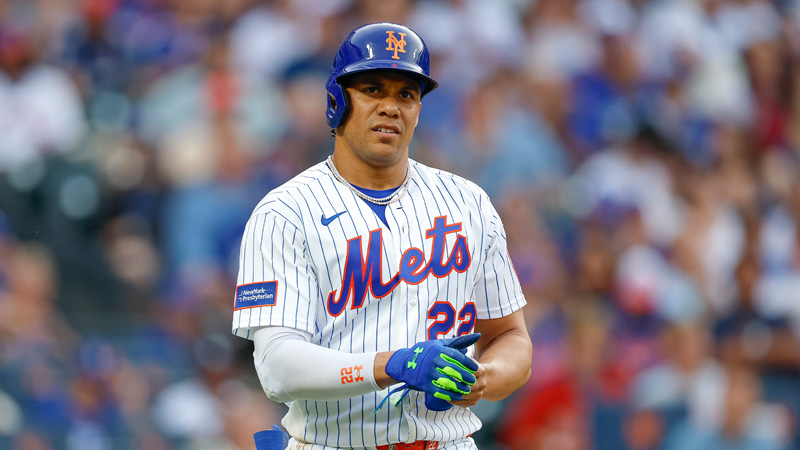
The announcement came with the quiet efficiency of a mid-August transaction, but for the New York Mets, it felt like a thunderclap. On Saturday afternoon, the club confirmed what legions of exhausted, hopeful fans had been desperately waiting for all week: Juan Soto, the prodigious slugger and the living embodiment of the franchise’s massive financial commitment, had been activated from the 10-day injured list. The setting was perfect—a home game against the formidable Houston Astros, a marquee matchup that demanded the presence of a marquee talent. As the afternoon sun baked the Citi Field grass, the energy in the stands shifted from the resigned apathy of a team mired in the cellar to a tangible buzz of anticipation. Soto, slated to hit second and serve as the designated hitter, was not just returning to the lineup; he was returning to his role as the emotional anchor for a fanbase that has endured a hellish 2024 campaign. The news was simple—he was healthy enough to swing, run, and do what he does best—but the subtext was massive. This was a reprieve from the monotony of defeat, a reason to tune in, a reason to believe that despite the standings, there was still artistry to be witnessed in Queens. For the first time in weeks, the Mets’ dugout had its heartbeat back.
The road back to this moment was grueling, both physically and mentally. Soto, a man who makes hitting a baseball look as natural as breathing, spent much of 2024 engaged in a frustrating battle not against opposing pitchers, but against his own body. The first alarm sounded in early April when a calf strain forced him to the sidelines for roughly three weeks, a bitter interruption to a season that was supposed to be a triumphant coronation in his second year under that historic, jaw-dropping contract. He returned to action with his typical bravado, but the lingering vulnerability of that muscle proved to be a ticking time bomb. In late July, during the dog days of summer, the calf tightened and gave out once again, sending him back to the injured list with a familiar, sickening dread. For an athlete of Soto’s caliber, whose entire swing relies on the explosive, rotational torque of his lower half, a calf injury is not just a physical setback—it is a psychological war. Every sprint to first base is accompanied by a nagging, intrusive fear of hearing that dreaded “pop.” Every step in the outfield becomes a calculated risk. The rehabilitation was painstaking, filled with underwater treadmills, deep tissue massage, and agonizingly slow progressions from light jogging to full-speed sprints. But Soto, known for his obsessive film study and meticulous preparation, attacked his recovery with the same intensity he uses to launch a 98-mph fastball into the bleachers. He was determined not just to return, but to return without a lingering limp, fully understanding that a premature return could jeopardize not just the remainder of this lost season, but the remaining 14 years of his tenure with the team.
Of course, baseball is a business of cold, hard mathematics, and Soto’s return necessitated a human sacrifice. To create a spot on the active roster, the Mets optioned infielder Eric Wagaman back to Triple-A Syracuse. One can only imagine the bitter-sweetness of that phone call for Wagaman—getting called up to the show, living the dream for a fleeting moment, only to receive the inevitable “pack your bags” notice when a superstar’s injury heals. It is the unspoken cruelty of the sport, a poignant reminder that for every multi-millionaire icon, there are hundreds of anonymous, hungry players fighting for a sliver of security. But such are the consequences of having a generational talent on the payroll. Looking at Soto’s numbers prior to the injury, it becomes abundantly clear why the franchise is so desperate to see him walk to the plate. In just 84 games, he has amassed 21 home runs and driven in 52 runs. Yet raw totals only scratch the surface. His slash line sits at an impressive .283/.408/.539, a testament to his unparalleled ability to combine patient, disciplined at-bats—leading to that gargantuan .408 on-base percentage—with devastating, game-changing power. This isn’t just production; it is a masterclass in modern offensive baseball, a blend of old-school hitting intuition and new-age analytical discipline. Even while battling through the nagging calf issue, Soto managed to produce at a clip that most major leaguers could only dream of in their healthiest prime.
For the casual fan, the traditional stats are impressive enough, but for the analytically inclined, Soto’s numbers are bordering on absurd when considering the physical turmoil he has endured. His 164 OPS+ is a monstrous figure, meaning he has been 64 percent better than the league-average hitter this season. His wins above replacement (WAR) sits at 2.7—a highly respectable number when you realize he has missed significant chunks of the season. But the most breathtaking metrics come from Statcast, the league’s cutting-edge tracking technology. Soto ranks in the 93rd percentile in average exit velocity at 92.5 miles per hour. He sits in the 92nd percentile in barrel rate at 14.3 percent, meaning he hits the ball with the sweet spot of the bat at optimal launch angles more consistently than almost anyone on the planet. Even his hard-hit percentage (48.6 percent) ranks in the 89th percentile. What does this translate to in purely human terms? It means that even when Soto is operating at 85 percent physical capacity, he is absolutely destroying the baseball. Opposing pitchers are terrified of him, not merely because he walks a lot, but because when he decides to swing, the ball leaves the bat with the force of a meteor, often finding gaps or clearing fences in ways that demoralize entire pitching staffs. His simple presence in the batter’s box changes the calculus of the opposing manager, forcing them to pitch around him or risk catastrophe. His return to the lineup instantly raises the floor of the Mets’ offense, giving the team a legitimate chance to win every single night, even when the starting pitching struggles.
But here lies the grim, undeniable paradox: Soto is returning to a team that is, by any measurable standard, a disaster. The Mets entered Saturday’s game having lost three straight and four of their last five. Their record sits at a highly disappointing 60-75, placing them dead last in the National League East, far behind the Philadelphia Phillies, Atlanta Braves, Washington Nationals, and even the surprising Miami Marlins. The season, which began with grand championship aspirations, has devolved into a series of bullpen meltdowns, defensive miscues, and anemic hitting from virtually everyone not named Juan Soto. The decision to slot him in as the designated hitter rather than right field is a clear indication of the club’s cautious approach; they want to shield his legs from the wear and tear of running on the outfield grass, using him as a pure bat until the calf is fully stabilized. It is a smart, protective move, but it also symbolizes the lost year. A player of Soto’s caliber should be anchoring a playoff push, engaging in high-stakes divisional clashes, not serving as a lone attraction in meaningless late-summer games. Yet, watching him step to the plate is still an event, a brief escape from the surrounding misery. He carries himself with a swagger that seems almost out of place in a losing clubhouse, a professional’s unyielding pride that refuses to let the surrounding mediocrity drag him down. He does not sulk, he does not give up on at-bats; he treats every single pitch as if it were Game 7 of the World Series. This quality endears him to managers and coaches, but it also highlights the vast, cavernous disparity in talent and focus between him and many of his current teammates.
Ultimately, Soto’s return is about far more than just a single Saturday afternoon in late August. It is about the enormous, suffocating shadow cast by the 15-year, $765 million contract he signed in the winter of 2024. That contract, the largest in the history of professional sports, has weighed heavily on his shoulders, both literally and figuratively. When you are paid to be a savior, every strikeout is magnified under the bright lights of New York media, every missed game is scrutinized as a dereliction of duty. The pressure to live up to that financial and cultural benchmark is immense, yet Soto has largely absorbed it with a stoic, unshakable grace. Now at 27 years old, he is entering the prime of his career, and this injury, while frustrating, is just a small footnote in what promises to be a legendary decade-and-a-half in Queens. The Mets are out of the playoff picture—that much is painfully clear—but the long-term puzzle is what matters most to the front office. Soto needs to shake off the rust, find his timing, and exit the season healthy, both physically and mentally. For a team that will inevitably rebuild, reorganize, and come back stronger next year, having a healthy, motivated Juan Soto is the single most critical piece of the puzzle. The fans understand this intuitively. When he steps into the box this afternoon, the crowd will roar not just for the immediate at-bat, but for the promise of the next 14 seasons. He is the franchise. He is the hope. And for one glorious afternoon, amidst the sweltering heat of a lost summer, his presence on the field reminds everyone why baseball, at its core, is still a game of beautiful, individual brilliance amidst collective struggle. His calf is healed, his spirit is intact, and for the New York Mets, that is the only victory that truly counts today.