





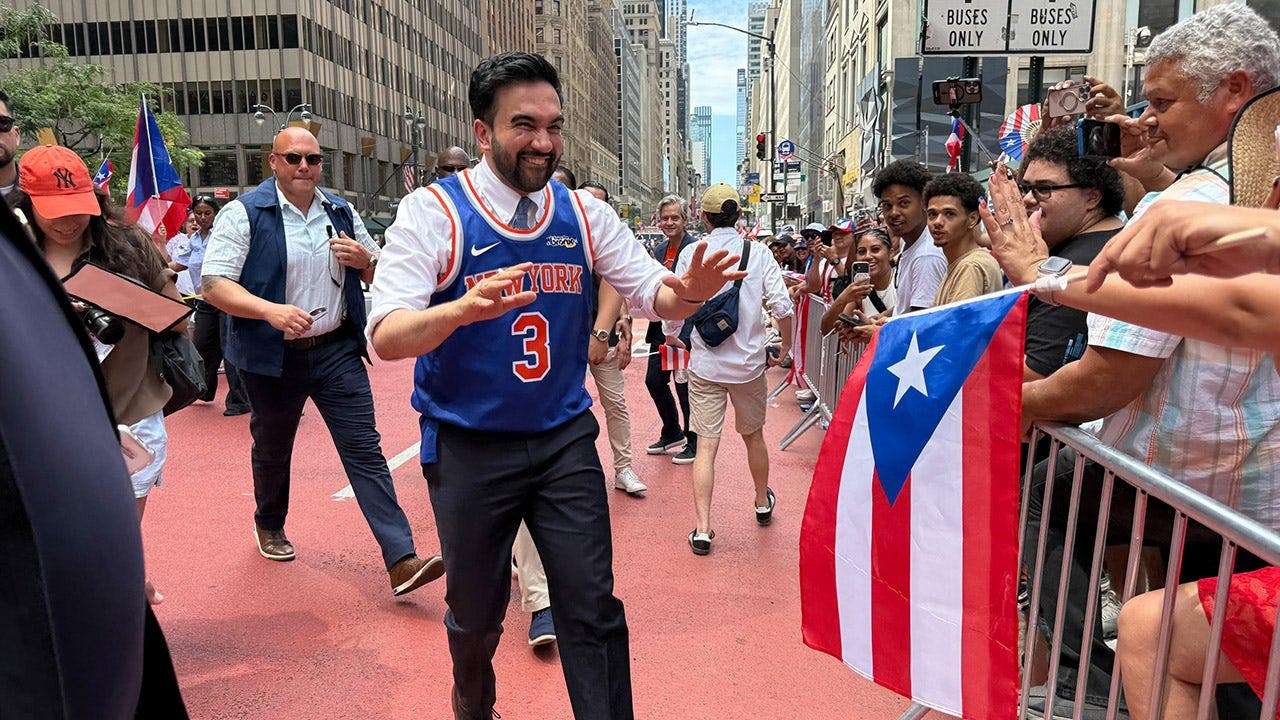
There is a unique kind of electric current that runs through the five boroughs of New York City only when its beloved Knicks are winning—a dormant, powerful frequency that can lie quiet for generations but never truly burns out. On a bright, sun-drenched Sunday, that current didn’t just flicker; it erupted into a full-scale, beautiful storm of collective joy, washing away fifty long years of sports-induced heartbreak with the suddenness of a summer rain. Just hours prior, the New York Knicks had secured their first NBA championship since 1973, a legendary triumph achieved through sheer, unyielding defensive grit and a nail-biting 94-90 victory over the San Antonio Spurs in Game 5 of the Finals. For New York City Mayor Zohran Mamdani, a man who carries the heavy, daily responsibility of leading this sprawling, chaotic metropolis, the morning offered a rare and beautiful escape from the standard pressures of city hall. Stepping out into the vibrant summer air, Mamdani found himself swept up in a historic wave of euphoria, getting an authentic taste of what it truly feels like to be a champion as he celebrated alongside the very players who made the impossible happen. The city had not merely won a basketball game; it had collectively exhaled, reclaiming a piece of its athletic soul that had been lost to history. The streets were determined to celebrate this hard-fought resurrection with every ounce of breath they could muster, transforming the concrete grid of Manhattan into an open-air theater of dreams where politicians, athletes, and ordinary citizens stood on equal ground, bound together by a shared history of struggle and an overwhelming sense of ultimate sports redemption.
At the absolute heart of this whirlwind of emotion was Jose Alvarado, a player whose very journey to the NBA embodies the relentless, never-say-die spirit of New York itself. Born and raised in Queens, where he honed his legendary toughness on the hardcourts of Christ the King High School, Alvarado is of Mexican and Puerto Rican descent, proudly representing Puerto Rico on the international athletic stage. After the final buzzer sounded in San Antonio, capping off a breathless series defined by double-digit comebacks, Alvarado barely had time to let the reality of his achievement sink in before boarding a red-eye flight back to the Big Apple. Landing in the early morning light, exhausted but fueled by pure, unadulterated adrenaline, the hometown hero bypassed sleep altogether and headed straight to the streets to join the annual Puerto Rican Day Parade. This iconic cultural event, always a kaleidoscopic explosion of salsa music, dancing, and deep communal pride, quickly became the perfect backdrop for Alvarado’s triumphant homecoming. As he stepped onto the parade float, shirtless, draped in flags, and radiating an infectious, childlike joy, he wasn’t just an elite athlete holding a championship trophy; he was a neighborhood kid returning to his roots, showing every youth shooting hoops on rusty playground rims that the wildest dreams are entirely reachable if you play with enough passion.
The scene atop the parade float was nothing short of cinematic, capturing a raw, unfiltered slice of New York life that no movie director could ever adequately replicate. Surrounded by billowing flags and the deafening cheers of an adoring crowd lining the streets, a celebratory, shirtless Alvarado danced with the uninhibited freedom of a man who had finally conquered his personal Everest. Beside him stood Mayor Mamdani, shedding the typical stiffness of political office to join the revelry, completely captivated by the infectious rhythm of the afternoon. The emotional peak of the parade arrived when the speakers blasted the bass-heavy, nostalgic opening notes of Ja Rule’s 2004 classic “New York,” a throwback anthem that has recently been revitalized as the spiritual battle cry for this championship Knicks squad. Without missing a beat, Alvarado grabbed the microphone, passionately rapping Jadakiss’s legendary, gravel-voiced verse, while Mayor Mamdani sang right along with him, their voices merging with the roar of thousands of spectators pressing against the street barricades. Directly beside them on the float, teammate Jordan Clarkson joined the party, sharing in the laughter and adding to the overwhelming sense of brotherhood that defined the afternoon. In that singular, beautiful moment, all dividing lines of status, age, and office evaporated entirely; there was only the music, the heat of the June sun, and the shared, roaring realization that they were the kings of the basketball world.
To understand why the crowd roared so fiercely for Alvarado is to understand the beautiful, unpredictable poetry of professional sports and the way New York adopts its heroes. When he was originally traded to the Knicks from the New Orleans Pelicans, many commentators dismissed the move as a minor, roster-filling transaction—a footnote in the grand scheme of a long and grueling NBA season. Yet, New York has an uncanny way of recognizing and elevating those who play with an underdog’s desperation, and Alvarado quickly proved to be the emotional spark plug that ignited the Knicks’ championship engine. His defining moment came in the pivotal Game 4, when the team found itself staring into the dark abyss of a devastating 29-point deficit. While others might have surrendered to the fatigue, Alvarado put on a defensive masterclass, playing nearly every grueling second of the fourth quarter, harassing opponents, diving for loose balls, and infusing his teammates with a relentless, contagious belief that ultimately fueled one of the greatest postseason comebacks in franchise history. Sharing the celebratory float alongside his teammate Jordan Clarkson—another crucial piece of this hard-nosed championship puzzle—Alvarado looked out at the sea of smiling faces and realized that his legacy was forever secure in the concrete archives of New York sports lore, cherished not just for his points, but for his relentless hustle.
This impromptu celebration at the Puerto Rican Day Parade highlights the deeply woven, almost sacred connection between basketball and the cultural identity of New York City’s diverse communities. Unlike other sports towns where championships are celebrated with polite applause and brief parades, basketball in New York is a modern religion, a language spoken across every block, housing project, and penthouse apartment. For fifty years, through disastrous seasons, management blunders, and heartbreaking playoff exits, the city’s faithful had kept their devotion alive, passing down stories of the 1973 championship crew to children who wondered if they would ever see a title in their own lifetimes. This victory represents a therapeutic release of half a century of accumulated tension, a glorious validation of a sports loyalty that survived the longest of winters. By blending the championship glory directly into the fabric of the Puerto Rican Day Parade, the celebration transcended the boundaries of a simple sporting event, merging seamlessly with the pride of a vibrant diaspora that has long helped define the beating heart and soul of the city. It was a vivid reminder that the Knicks do not play in a silent vacuum; they play for the working-class families, the street vendors, the subway riders, and the millions of diverse voices that compose the beautiful, chaotic symphony of New York.
While Sunday’s spontaneous parade float ride offered a deliciously chaotic, intimate preview of the celebrations to come, the grand finale of this championship run is still on the horizon. The entire championship-winning Knicks roster is currently preparing to mount their official floats for the massive, city-sanctioned victory parade scheduled for this coming Thursday, where the traditional canyon of heroes on Broadway will be showered in ticker tape and roaring, historic adulation. They will look back on a grueling playoff journey immortalized by the thrilling Game 5 finale, where they overcame double-digit deficits twice against a resilient San Antonio Spurs squad to pull off a historic 94-90 victory. But no matter how grand, organized, or star-studded Thursday’s official celebration turns out to be, it will be hard to match the raw, organic magic of that hot Sunday afternoon, where an exhausted, shirtless Queens native and a joyful mayor stood side-by-side, singing a twenty-year-old rap song to a sea of crying, cheering, flag-waving New Yorkers. In that fleeting moment, the true spirit of New York was on full display—resilient, loud, incredibly diverse, and, after fifty long years of waiting, undeniably victorious.