





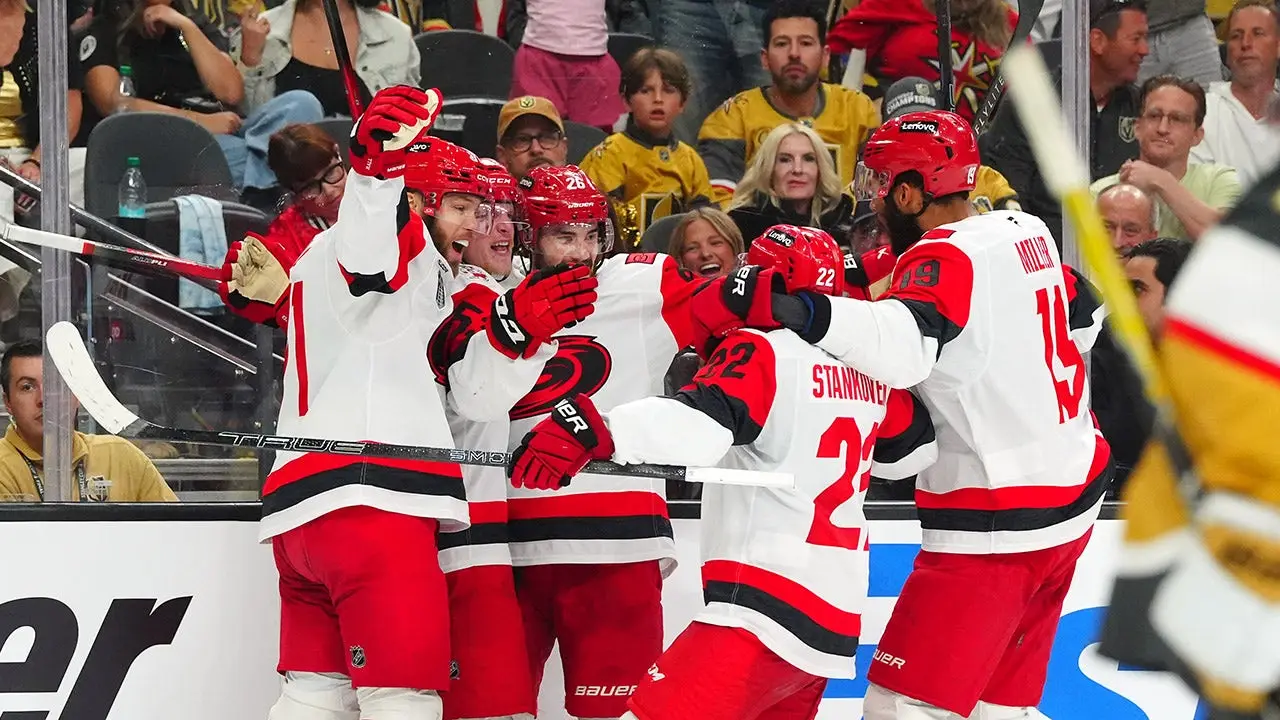
The desert air of Las Vegas is known for its dizzying heat and high-stakes drama, but on a historic Sunday night, it was the cool, calculated storm of the Carolina Hurricanes that swept through T-Mobile Arena, clinching their first Stanley Cup championship in two long decades. In a stunning 3-0 shutout in Game 6, the Canes did what many thought impossible: they completely silenced the notoriously boisterous, gold-clad Vegas crowd and seized hockey’s ultimate prize. The atmosphere inside the arena was electric, vibrating with the hope of a Golden Knights comeback, but Carolina had other plans. It took just over three minutes for the Hurricanes to strike first, landing a psychological blow that shifted the gravity of the entire game. Former Hart Trophy winner Taylor Hall, a veteran who has weathered his share of career ups and downs, found the back of the net to put Carolina up 1-0. It was a goal born of pure instinct and veteran poise, cutting through the deafening noise of the Vegas faithful and injecting an immediate wave of confidence into the Hurricanes’ bench. This early lead allowed Carolina to dictate the pace of the game, transforming what was expected to be a chaotic, back-and-forth shootout into a masterclass of defensive discipline. For the fans back home watching in Raleigh, North Carolina, those initial three minutes felt like the dawn of a new era, setting the stage for a night that would forever be etched into the folklore of Southern hockey. As the first period progressed, the Hurricanes displayed a level of maturity and focus that had eluded them in postseason runs of the past, stubbornly refusing to yield an inch of ice to a desperate Vegas offense that was fighting for its playoff survival.
While the first period was defined by Carolina’s explosive start, the second frame became a war of attrition, where every inch of ice was fiercely contested and the margin for error shrunk to nothing. For much of the period, the offensive engines of both teams seemed to stall as defensive pairings on both sides laid body blows and blocked passing lanes with desperate intensity. Yet, amidst this suffocating defensive struggle, a moment of brilliant execution broke the stagnation. With just under seven minutes remaining in the second period, rookie forward Jackson Blake etched his name into Hurricanes lore by scoring a dazzling goal to extend Carolina’s lead to 2-0. The goal was a devastating blow to the Golden Knights, who had spent the period struggling to find any offensive rhythm. Indeed, the second period was a disaster of execution for Vegas, as Carolina’s relentless forecheck and suffocating neutral-zone trap limited the home team to a meager three shots on goal—a statistic that painted a vivid picture of the Hurricanes’ defensive dominance. Moving into the final frame, the specter of past blown leads hung heavy over the ice, but this Carolina squad proved they were made of sturdier stuff. When Vegas earned a crucial power play midway through the third, the Hurricanes’ penalty-killing unit rose to the occasion with fierce resolve, sacrificing their bodies to block shots and clear the zone. In a final, desperate roll of the dice, Vegas pulled netminder Carter Hart with three minutes remaining to gain an extra attacker, but the gamble backfired. Nikolaj Ehlers intercepted a desperate pass and slid an empty-net goal into the vacant net, igniting an absolute frenzy on the Carolina bench as the final seconds ticked away toward a historic shutout victory.
At the heart of this championship run was one of the most compelling and heartwarming underdog stories in recent sports history: the meteoric rise of rookie goaltender Brandon Bussi. During the grueling eighty-two-game regular season, Bussi was largely a secondary figure, appearing in less than half of Carolina’s contests and watching from the bench as veteran Frederik Andersen carried the bulk of the workload. When the high-stakes pressure of the playoffs arrived, Bussi did not see a single second of ice time through the early rounds, seemingly destined to be an observer of history rather than its author. However, when Andersen was sidelined prior to Game 3, the young, unproven netminder was thrust directly into the blazing spotlight of the Stanley Cup Finals. Faced with the biggest game of his life, Bussi did not shrink; instead, he grew monumental, delivering a series of spectacular performances that culminated in his spectacular, series-clinching shutout in Game 6. Bussi’s composure under pressure was nothing short of legendary, as he turned aside every single high-danger chance the Golden Knights threw his way, displaying a calmness that defied his lack of experience. His spectacular play stood in stark contrast to the turbulent experience of his counterpart in the opposite crease, Carter Hart. The Vegas goalie had spent much of the series dealing not only with Carolina’s lethal offense but also with a hostile Hurricanes crowd in Raleigh that tirelessly chanted “No means no” at him—chants that Hart stoically brushed off as “just noise,” but which nevertheless underscored the intense, emotionally charged environment of this hard-fought series.
This Stanley Cup Final was a psychological rollercoaster, a series defined by wild momentum swings and agonizing collapses that tested the mental fortitude of both franchises. Indeed, the road to Game 6 was paved with dramatic turnarounds, most notably of the blown-lead variety, which had heavily favored the Hurricanes throughout the matchup. In a pivotal Game 2, the Golden Knights seemed to have the series under control, holding a comfortable 2-0 lead with a mere ten minutes remaining in regulation. Yet, in a daunting display of resilience that would come to define their championship DNA, the Hurricanes exploded for three consecutive goals to snatch the lead, eventually winning the game in overtime after Vegas briefly tied it. But the drama was far from over; Game 3 saw yet another jaw-dropping twist when Vegas managed to erase a massive 4-0 Carolina lead, ultimately winning in double overtime with a goal that threatened to shift the entire momentum of the series back to the desert. The threat of another devastating collapse was a constant companion for Carolina, but instead of succumbing to the anxiety, they used those past scares to forge an unbreakable resolve. By the time the puck dropped for Game 6, the Hurricanes had developed an ironclad defensive structure that left absolutely no room for Vegas to mount a comeback. The lessons learned from those grueling, heart-stopping overtime periods had transformed Carolina from a team of talented individuals into a cohesive, unstoppable defensive juggernaut that knew exactly how to lock down a lead when everything was on the line.
No single individual embodies the soul, grit, and tireless work ethic of the Carolina Hurricanes quite like their visionary head coach, Rod Brind-Amour. By hoisting the Stanley Cup on Sunday night, Brind-Amour secured his place in the pantheon of hockey legends, becoming only the fourteenth person in NHL history to win the Cup as both a player and a head coach. Even more remarkably, he became the first person to achieve this dual feat since Larry Robinson did so with the New Jersey Devils back in 2000. The achievement is further elevated by the fact that Brind-Amour is just the seventh person to coach the very franchise he once captained to a championship, a legendary milestone that had not been reached since the iconic Toe Blake accomplished it with the Montreal Canadiens a staggering seventy years ago. Back in 2006, it was Brind-Amour who wore the “C” on his chest and lifted the Cup for Raleigh; today, his fierce leadership and demanding, team-first philosophy are etched into every aspect of this modern Hurricanes roster. His players do not just play for him; they mirror his legendary work ethic, playing with a relentless, blue-collar intensity that wears opponents down over the course of a seven-game series. Brind-Amour’s journey from a beloved player to a historic championship-winning coach is a testament to his deep connection with the organization and the city of Raleigh, proving that success in the modern NHL is built upon a foundation of loyalty, culture, and an unwavering commitment to excellence.
For the passionate fan base in Raleigh, this championship represents the ultimate catharsis, a glorious breakthrough that caps off nearly a decade of postseason frustration and near-misses. Before this triumphant run, the Hurricanes had qualified for the Stanley Cup playoffs for eight consecutive seasons, only to repeatedly fall short in the most agonizing ways imaginable, including three devastating exits in the conference finals and three more in the semifinals. Year after year, analysts picked Carolina as a favorite to win it all, only for the team to suffer heartbreaking defeats that left fans wondering if they would ever reach the mountaintop again. This year, however, the team refused to let history repeat itself, demonstrating a ruthless efficiency and a refuse-to-lose attitude that carried them through every round of the playoffs. The sheer joy and relief that swept through North Carolina as the final buzzer sounded marked the end of a long, twenty-year drought, validating the loyalty of a fan base that has stuck by their team through relocations, rebuilds, and playoff heartbreaks. As the players celebrated on the ice, dumping champagne and passing the heavy silver trophy from veteran to rookie, it became abundantly clear that this victory was about far more than just a trophy. It was a testament to the power of perseverance, a celebration of a community that has fully embraced hockey, and a well-deserved moment of glory for a team that fought tooth and nail to finally capture Lord Stanley’s cup and cement their place in hockey history.