

There was a boy on the island of Madeira who slept in a cramped bedroom with three siblings, the son of a hospital cleaner and a father who carried the invisible wounds of war and the weight of alcoholism. By the age of twelve, a decision had already been made for him: leave everything he knew and move to Lisbon, to join Sporting CP’s youth academy. Imagine that kind of leap, not from a place of comfort or certainty, but from a small house where money was scarce and dreams felt like a luxury. Cristiano Ronaldo dos Santos Aveiro was just a kid with raw talent and a stubborn heart, stepping into the unknown with no guarantee that any of it would work out. He arrived in the Portuguese capital with all the awkwardness of a boy from a tiny island, with a thick Madeiran accent and a fierce homesickness that often went unnoticed. School was a constant struggle, not because he wasn’t smart, but because his mind was elsewhere, chasing footballs and imagining stadiums. At one point, his frustration boiled over so completely that he threw a chair at a teacher and was expelled. It was a turning point, and it forced a deeply difficult conversation: he essentially begged his mother and his Sporting tutor to let him abandon formal education entirely and dedicate his life only to football. It was a gamble, an enormous one. He has admitted since that if it hadn’t worked out, he likely would have become a local fisherman, casting nets off the coast of Madeira in the same waters where he played as a barefoot child. But football was the only path he could see, and he was willing to risk everything to follow it. That willingness to bet on himself, to burn bridges and refuse to look back, was the first sign of the obsessive, relentless personality that would define his entire career.
Then, just as his future seemed to be taking shape, his body betrayed him. At fifteen, Cristiano Ronaldo was diagnosed with tachycardia, a condition that made his heart race abnormously fast even when he was completely at rest. For a young athlete whose entire life depended on physical exertion, this was terrifying news. There was surgery, there were sleepless nights, there was the very real fear that his dream might end before it truly began. But the surgery was successful, and from that moment onward, he began to understand how fragile a career can be. It was as if the scare unlocked something inside him. He became determined not just to succeed, but to control every possible variable, to shape his body and mind into an instrument that would not fail him. Here, too, is a fact that many people forget: Ronaldo is not actually his surname. He is Cristiano Ronaldo dos Santos Aveiro, and the name Ronaldo was given to him by his father as a tribute to former U.S. President Ronald Reagan, an actor turned politician who was known for his discipline, his confidence, and his comfort in the spotlight. In a strange way, the name fit perfectly. Like Reagan, Cristiano Ronaldo always understood the power of image, the importance of discipline, and the need to project strength even when the world is watching. His training regime and eating habits are almost absurdly strict, the kind of monotonous, rigid lifestyle that would drive most people mad. But it was precisely that obsession, that willingness to sacrifice pleasure and spontaneity, that gave him the physical engine to compete at the highest level for more than two decades. He transformed himself into a machine, an athlete of almost inhuman proportions, and in doing so, he built the foundation for everything that followed.
When you think about his international career, the numbers are almost unbelievable. Cristiano Ronaldo scored 146 goals for Portugal, a men’s world record. He made 234 appearances, also a men’s world record. He is the first man to score in six World Cups, and he has played at six European Championships, something no other player has ever done. Since 2004, he has scored at least one goal for Portugal in 23 straight calendar years. Those records are not just statistics; they represent an extraordinary level of consistency, durability, and sheer willpower. Every goal was a statement, even the penalties. And that is why he celebrates the way he does, with that iconic “SIUUUU” – an exaggerated, joyous expression of the Spanish and Portuguese word for yes. The celebration is theatrical, almost arrogant. He jumps, spins in the air, lands with his arms spread wide, and lets the stadium roar around him. Some people find it over the top; others find it inspiring. But what it truly represents is Ronaldo’s way of telling everyone, in that moment, that he is in charge. It is a celebration of grandiosity, yes, but also of the immense pressure he places on himself. He wants to be coronated, not just by the fans, but by the opponent, by the world. That hunger for recognition never faded. He needed the spotlight, he craved the validation, and he used it to fuel his performances. There is a perfection to Ronaldo’s football that is both inspiring and overwhelming, and his search for an almost godlike identity on the pitch has always been his greatest strength and, at times, his weakness. While Lionel Messi’s quiet genius captivated people through artistry, Ronaldo’s appeal was built on raw power, discipline, and a burning desire to be the best.
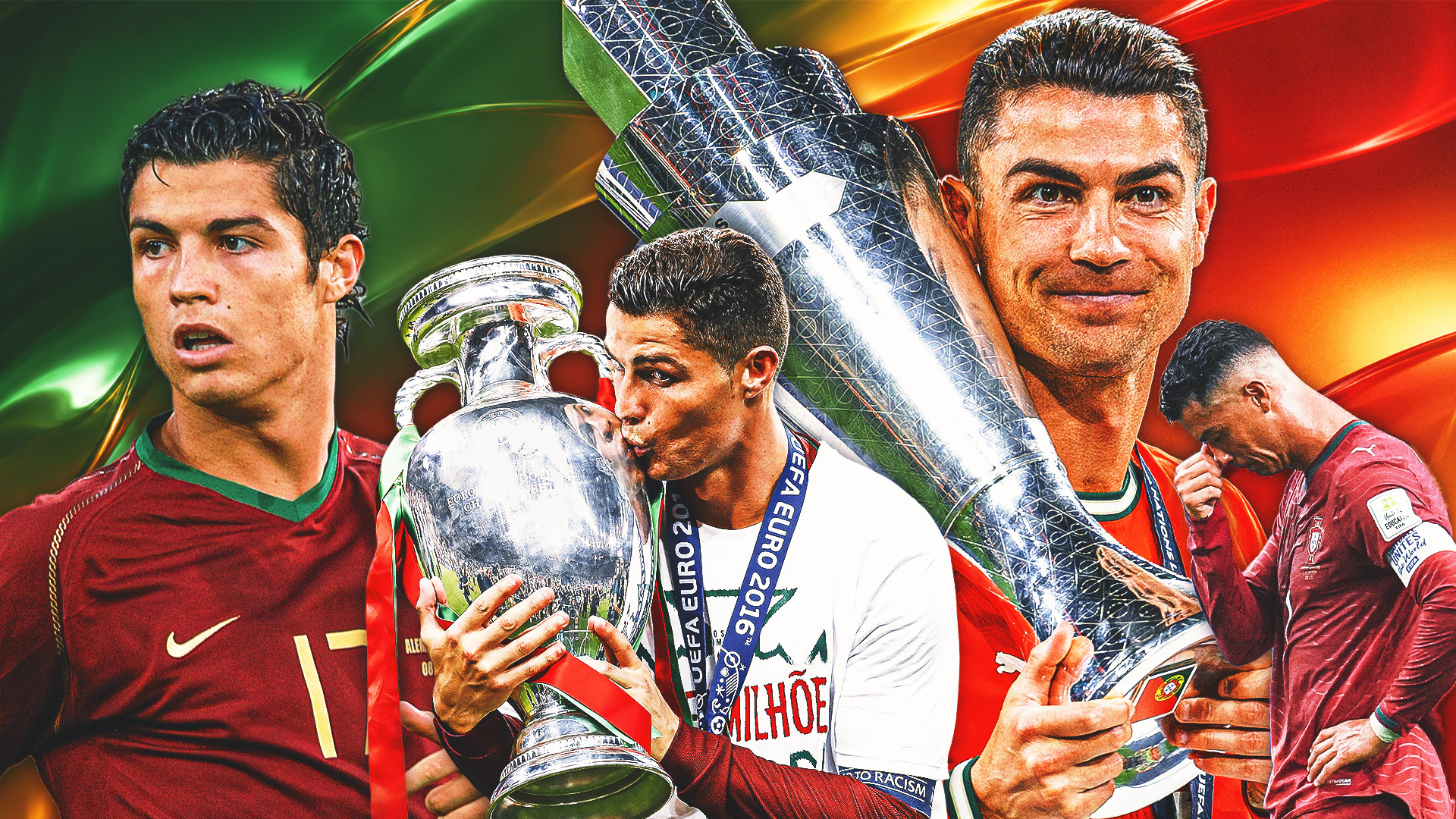
The longevity of his career is something we should pause to appreciate, because it is almost inconceivable. When Ronaldo played in his first European Championship, Lamine Yamal was three years old. Think about that. A player so durable that he was there before some of today’s young stars were even born. He is the only player to have appeared at six European Championships, and he led Portugal to glory at Euro 2016, beating host France 1-0 in a final that was tense, dramatic, and deeply emotional. That triumph was a massive achievement, but the ghost of a World Cup victory has always hovered over him. He never won a World Cup with Portugal, and that remains the one significant gap in his international resume. As he grew older, the reality of aging became harder and harder for him to accept. There was a recent altercation with national team manager Jorge Jesus after Ronaldo left camp during a previous international window, followed by a lengthy social media statement defending himself. It was the reluctance of a once-complete specimen admitting, even if only reluctantly, that his powers are dwindling. He didn’t want to come to terms with it. There is an old myth about Narcissus, who died because he was too enamored with his own reflection, and in many ways, Ronaldo’s supercilious personality often became his own worst enemy. But that same ego, that same refusal to accept mediocrity, is also what made him great. Goalscorers, by nature, have to be selfish. They need an inflated sense of self-belief to keep taking risks, to keep demanding the ball, to keep believing that they, more than anyone else, can make the difference. There has never been a higher example of that ruthless, vindictive hunger for goals than Cristiano Ronaldo.
The rivalry with Lionel Messi will be discussed for generations, and it is impossible to sum up his legacy without acknowledging it. On the international stage, Ronaldo’s numbers and Messi’s numbers are staggeringly close: Ronaldo scored 146 goals in 234 appearances, while Messi scored 126 goals in 208 appearances. Messi won the World Cup in 2022, while Ronaldo never did. Messi played in 34 World Cup games and scored 21 goals; Ronaldo played in 27 and scored 11. But Ronaldo was the first man to score in six World Cups, and he did it at a time when Portugal was not always considered a global powerhouse. He carried his national team on his back for twenty years, dragging them to major finals and giving them moments of glory they had never experienced before. It is not up to me to tell you who was greater; it is enough to remind you that in their heyday, we were all blessed with witnessing the greatest rivalry in football history, and perhaps in any sport. There was something deeply human about watching these two men, with completely different styles and personalities, push each other to unimaginable heights. Messi was the introvert, the magician, the quiet genius who seemed to play for the joy of the game. Ronaldo was the extrovert, the athlete, the relentless perfectionist who seemed to play out of sheer defiance. They made each other better, and they gave us a golden era of football that we will never see again. For those of us who grew up watching them, it was not just sport; it was art, it was drama, it was a once-in-a-lifetime spectacle.
So now we come to the end. Cristiano Ronaldo announced his retirement from international competition, leaving Portugal as the nation’s greatest ever player. The boy from Madeira, the kid who needed surgery to slow down his racing heart, has finally accepted that it is time to put on the brakes and close the curtains on the international stage. It is a deeply human moment, tinged with sadness but also with immense pride. He gave Portugal everything he had, and Portugal gave him a home. He will continue playing for his club, Al-Nassr, chasing his dream of 1,000 career goals, but the international chapter is closed. He leaves behind a legacy that is almost impossible to summarize: a man who overcame poverty, homesickness, academic struggles, a heart condition, and countless doubters to become one of the greatest footballers in history. He was not always likable, and he would probably admit that himself. He was demanding, arrogant, sometimes selfish, and often impossible to please. But he was also extraordinary, and his story is a reminder that greatness rarely comes without sacrifice. He sacrificed a normal childhood, a normal teenage life, and even a normal relationship with his own body, all in pursuit of a dream that most people thought was impossible. And he achieved it, beyond even his own wildest imaginings. As we close this chapter, we should not just remember the goals, the celebrations, and the trophies. We should remember the boy who threw a chair at a teacher, who begged his mother to let him follow football, who feared his heart would stop, and who never, ever gave up. That is the real Cristiano Ronaldo, the boy from Madeira, now a man who closes his international career knowing that he gave the world something unforgettable.