





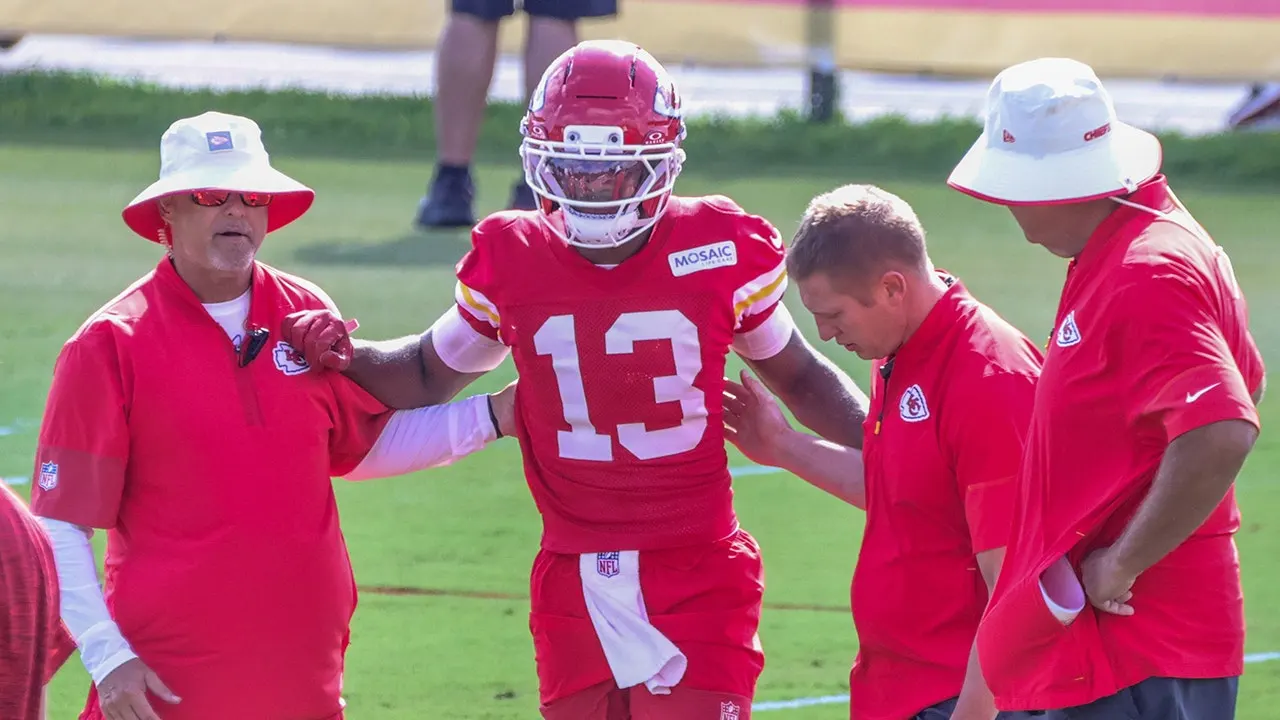
The oppressive summer heat of an NFL training camp serves as a relentless pressure cooker where lifelong dreams are forged, tested, and sometimes shattered in the blink of an eye. For rookies trying to carve out a legacy within a championship-caliber dynasty like the Kansas City Chiefs, every single representative snap on the practice field is a high-stakes gamble between a career-defining breakthrough and a devastating setback. This delicate, often terrifying balance between athletic triumph and physical tragedy was vividly illustrated during a recent weekend practice session in St. Joseph, Missouri, when young rookie wide receiver Cyrus Allen suffered a frightening collision that threatened to derail what had been an incredibly promising start to his professional career. As Allen lay motionless on the turf, a heavy silence fell over the practice complex, and the collective breath of the coaching staff, teammates, and onlookers was held in unison. In the ultra-competitive, physically punishing environment of professional football, a single misstep or an unfortunate impact can instantly rewrite an athlete’s entire life story, transforming months of grueling offseason preparation into a painful, lonely journey of medical rehabilitation. Fortunately for the young wideout and the entire Chiefs organization, the initial wave of panic was met with profound relief when subsequent medical examinations yielded highly encouraging news. Specialized tests quickly confirmed that Allen had miraculously avoided any catastrophic structural damage, showing no signs of a torn ligament or a broken bone, but had instead sustained only a severe shin bruise. While a deep bone bruise is incredibly painful and demands cautious rehabilitation, the diagnosis was celebrated as a massive victory for a young player who has been fighting with absolute desperation to secure his place on the final fifty-three-man roster. This harrowing scare serves as a stark, deeply humanizing reminder of the razor-thin margin between sporting glory and physical vulnerability that these athletes willingly navigate every single day they put on their armor and step onto the gridiron.
The agonizing incident itself unfolded during a highly intense, fast-paced special teams period—a segment of practice that demands the absolute limit of a player’s physical endurance, spatial awareness, and raw courage. The coaching staff had called for a pooch punt drill, a specialized kicking situation designed to pin the opposing team deep near their own goal line, requiring gunners to sprint down the sidelines at breakneck speeds while keeping their eyes locked on a soaring football. Lined up as gunners, Cyrus Allen and defensive back Kaiir Elam were flying down the field, their focus entirely consumed by the trajectory of the ball as they converged near the end zone. In a split-second of blinding speed and miscalculated space, the two athletes collided in a violent crash of pads, helmets, and limbs. While Elam was fortunately able to shake off the force of the impact, pick himself up, and walk away under his own power, Allen remained grounded on the grass, clearly experiencing immense physical distress. The raw, emotional weight of the moment became painfully visible to everyone present as team medical personnel rushed onto the field to tend to the fallen rookie. Before being carefully assisted onto a motorized medical cart, Allen was seen shaking his head in profound frustration and covering his face with his jersey—a heartbreakingly human gesture of vulnerability that captured the immense psychological toll of a sudden, unexpected injury. In that quiet, agonizing moment, the physical pain in his leg was undoubtedly amplified by the terrifying fear that his hard-earned progress, his momentum, and his lifelong NFL aspirations had been cruelly snatched away from him on a routine practice play.
Adding to the palpable anxiety hovering over the practice facility that afternoon, Allen’s injury was not the only scare that sent shockwaves through the Kansas City camp on that eventful Saturday. Highly touted rookie receiver Xavier Worthy, whose historic speed has captured the imagination of football fans across the country, also suffered a frightening fall during an intensive eleven-on-eleven team scrimmage period. After running a spectacular, fluid route and hauling in a beautifully thrown deep pass near the end zone, Worthy landed awkwardly and heavily directly onto his shoulder. The sight of the prized first-round pick clutching his arm in pain immediately heightened the tension on the field, particularly given Worthy’s historical struggles with shoulder-related injuries early in his career. Just last season, Worthy’s physical resilience was tested when he suffered a significant injury to his right shoulder on the very third snap of a high-stakes game against the division-rival Los Angeles Chargers, a mishap that occurred after a violent crossing-route collision with superstar tight end Travis Kelce. That injury eventually required an intensive offseason surgical procedure to fully repair and stabilize, making this latest training camp fall an incredibly alarming development for both the player and the Chiefs’ front office. The immense physical demands placed on these modern gladiators are staggering, and when young, explosive talents like Allen and Worthy suffer consecutive injury scares in a single afternoon, it underscores the constant, underlying fragility of an NFL roster. These moments strip away the glamorous shield of multi-million dollar contracts and highlight the fragile humanity of these young men, who risk their long-term health with every single jump-ball they attempt to catch.
In the sobering aftermath of these practice-field scares, Chiefs special teams coordinator Dave Toub offered a remarkably candid and empathetic perspective on the situation, reflecting the complex blend of demanding leadership and genuine fatherly concern that defines the best coaches in the league. Toub, a respected veteran coach known for his demanding standards, expressed a deep, heartfelt sorrow over seeing any player get hurt, emphasizing how painful it is to watch a young athlete suffer an injury during a special teams drill. He spoke glowingly of Allen’s work ethic, versatility, and infectious attitude, pointing out that the rookie had been making rapid strides not just on the offensive side of the ball, but also as a standout contributor on special teams as both a gunner and a kick returner. Toub’s insightful comments illuminated a fundamental, often harsh truth about the meritocracy of professional football: the road to securing a permanent spot on an NFL roster is almost always paved through the gritty, unglamorous trenches of special teams. For rookies entering the league, regardless of their draft pedigree or offensive highlights, playing special teams is a non-negotiable rite of passage—a brutal proving ground where they must prove their willingness to sacrifice their bodies before they are ever trusted with significant snaps on offense or defense. This systemic expectation places an extraordinary amount of physical pressure on young players, who must perform high-velocity, high-impact duties just to keep their professional survival alive. Toub’s high praise for Allen’s performance prior to the collision showcased the rookie’s eager embrace of this grueling challenge, proving he was willing to do whatever it took to help his team pursue another championship.
Cyrus Allen’s meteoric rise within the Kansas City organization since being selected in the fifth round of April’s NFL Draft is a compelling testament to his raw athletic talent, sharp football intelligence, and relentless competitive drive. From the very opening days of rookie minicamp and training camp, Allen set himself apart from the crowd, rapidly developing an undeniable on-field chemistry with legendary superstar quarterback Patrick Mahomes. For a fifth-round rookie to command the respect, attention, and trust of a multi-time Super Bowl MVP and future Hall of Famer is an extraordinary feat; it requires immaculate route-running precision, an exceptional catch radius, and an intuitive, rapid grasp of Andy Reid’s notoriously complex offensive system. Allen did not just participate in practices; he actively dominated them, consistently leading the entire Kansas City wide receiver room in total receptions during highly competitive eleven-on-eleven scrimmage periods. His unique ability to find soft spots in elite defensive coverages and secure difficult, contested catches in traffic quickly made him the breakout darling of training camp, skyrocketing expectations for what he could contribute to the offense in his debut season. This rapid, exciting ascendancy made his sudden injury on the special teams field feel all the more tragic to those watching, as it threatened to abruptly halt the incredible momentum of a young man who was actively turning his childhood dreams into reality. The journey of a mid-round draft pick is always an uphill battle defined by skepticism, making Allen’s early success a profoundly inspiring story of determination and merit.
Ultimately, the dramatic narrative of Cyrus Allen’s training camp injury scare is a powerful story of resilience, the inherent fragility of professional sports, and the unyielding human spirit that drives these athletes to achieve greatness. The profound relief of learning that his injury was merely a temporary, painful setback rather than a season-ending tragedy allows Allen, his coaches, and the passionate Chiefs fan base to breathe a collective sigh of relief, but the deeper lesson of the incident remains unforgettable. The pursuit of elite success in the National Football League demands a rare, almost unfathomable willingness to accept severe physical risk, to sacrifice one’s body for the greater good of the collective unit, and to repeatedly bounce back from the inevitable pain and bruising that comes with the territory. As Allen diligently rehabilitates his deep shin bruise and eagerly prepares to rejoin his teammates on the practice fields under the hot Missouri sun, he does so with a renewed sense of gratitude and a deeper appreciation for the volatile nature of his calling. Both he and Xavier Worthy will undoubtedly carry the psychological lessons of these training camp scares with them, utilizing the experience to build greater mental fortitude and physical preparation for the long, grueling season ahead. In an entertainment industry where the public spotlight almost exclusively shines on spectacular touchdown celebrations, lucrative contracts, and championship parades, it is these quiet, painful moments of physical vulnerability, the determination to overcome adversity, and the human bonds forged through shared suffering in the locker room that truly define the authentic heart of a champion.