





Modern Major League Baseball exists in a state of perpetual, fascinating tension, caught between the relentless march of technological perfection and the stubborn, beautiful chaos of human judgment. With the steady introduction of the Automated Balls and Strikes system (ABS), sophisticated high-definition camera arrays, and complex instant replay review centers, the league has actively tried to write human error out of its own script, transforming a century-old pastime into a frictionless, digitized science. Yet, as any purist of the sport will eagerly tell you, the true soul of the game cannot be fully captured by algorithms or optical tracking systems. There are moments on the diamond where the cameras fall silent and the guidelines blur, leaving players, coaching staffs, and thousands of screaming fans at the absolute mercy of split-second human decisions made by under-pressure officials on the field. This eternal struggle between the cold precision of technology and the warm, unpredictable blood of human instinct was thrust into the spotlight during a high-stakes, emotionally charged clash between two fierce American League East divisional rivals, the Toronto Blue Jays and the Baltimore Orioles. It was a game that reminded everyone watching why they fell in love with baseball in the first place—not for its sterile mathematical predictability or its cleanly resolved computer models, but for its dramatic, confounding, and deeply human inconsistencies. In the crucible of a late-summer chase for postseason positioning, a single subjective ruling in the sixth inning flipped the script of the entire contest on its head, proving that even in our modern age of fiber-optic replays, a single umpire standing in the dirt still holds the ultimate, terrifying power to shape a franchise’s destiny.
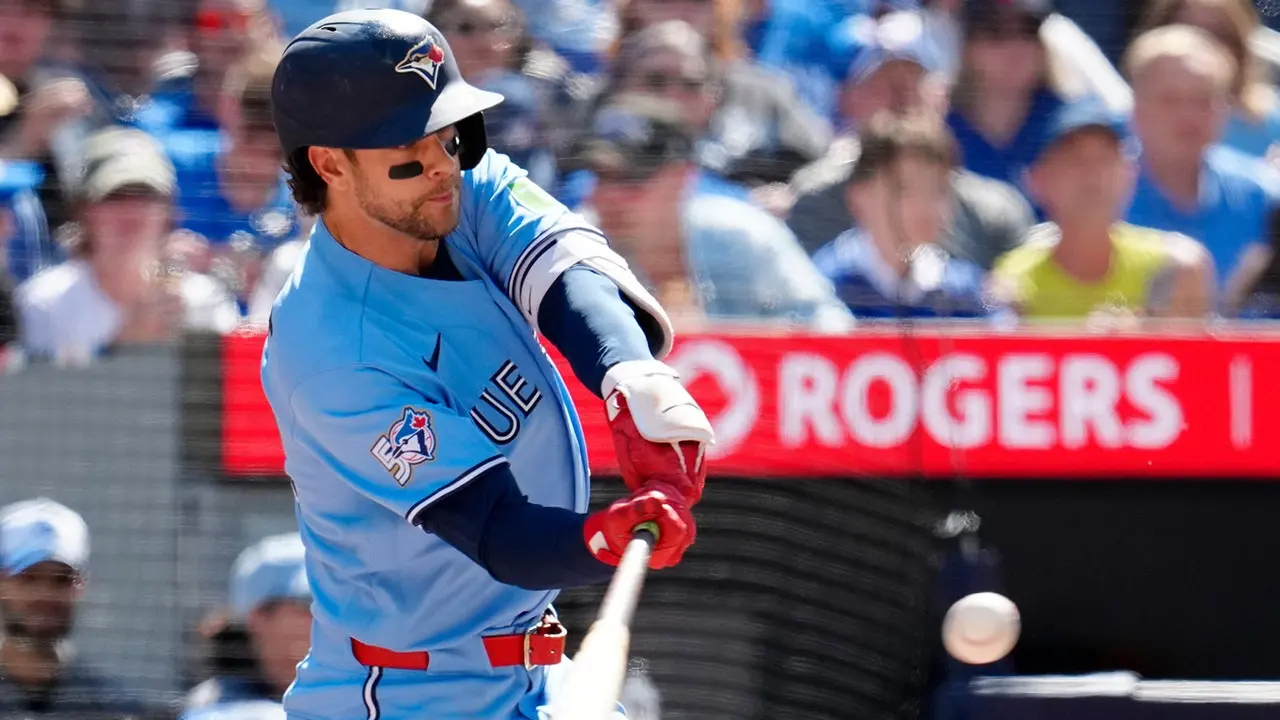
The turning point of this dramatic division clash unfolded in the sixth inning, a critical, pressure-packed juncture of the game where the visiting Baltimore Orioles held a precarious lead and sought to slam the door on a gritty, relentless Toronto lineup. With the tension in the stadium mounting with every pitch and runners in motion, Blue Jays batter Brandon Valenzuela stepped up to the plate and swung, sending a tricky, high-bouncing chopper off the dirt directly toward the reigning American League Rookie of the Year, Orioles shortstop Gunnar Henderson. As Henderson charged the bouncing ball with his trademark athletic grace and focused intensity, Toronto runner Ernie Clement was already barreling down the path toward second base, caught in a highly dangerous position directly in the line of fire. In a split-second calculation of spatial awareness, self-preservation, and pure athletic instinct, Clement executed a sudden, dramatic swerve far to his right, kicking up dust as he altered his trajectory. He was attempting to dodge Henderson, who was simultaneously fielding the baseball with one hand and reaching out with his gloved hand in a swift, desperate motion to apply a swipe tag to the passing runner. To the naked eye of the Orioles infielders, Clement had clearly run well out of the established, legal baseline to avoid being tagged out, an infraction that historically results in an automatic and uncontested out. Confident in this basic baseball tenet, Henderson quickly threw the ball to first base to complete what he assumed would be a routine, albeit chaotic, double play. Instead, the entire stadium gasped as second base umpire Nic Lentz emphatically ruled Clement safe at second, landing a devastating psychological blow to the Orioles defense.
Lentz’s unexpected decision to rule Clement safe at second base immediately ignited a massive firestorm of controversy, leaving the entire Orioles dugout utterly bewildered and searching for answers. The second base umpire’s rationale, which he later explained in precise, technical detail to a pool reporter after the final out had been recorded, hinged on a subtle but highly consequential interpretation of the rulebook regarding runner-fielder interactions. According to Lentz, Clement had not veered off-course to evade an active tag, but had instead established a legitimate, new base path designed purely to avoid interfering with Henderson’s absolute right to field a batted ball. Unlike other sports where boundaries are static and painted on the turf, a baseball baseline is a dynamic concept, only officially established when a fielder actively attempts to apply a tag. Under the rules, a runner has the right to navigate their way around an active fielder to prevent a physical collision or a potential interference penalty, which would have resulted in an automatic out anyway. Crew chief Hunter Wendelstedt went even further in defending his partner’s complex ruling on the field, colorfully describing Clement’s sudden detour in the dirt as a “very gentlemanly thing to do.” In the eyes of the officiating crew, the Blue Jays runner was simply trying to play the game the right way, giving Henderson the necessary space he needed to safely make the play towards first base rather than selfishly disrupting the defensive flow. This philosophical defense of Clement’s quick thinking highlighted the deep, fascinating gray areas that define baseball’s rulebook, demonstrating how a play that looked like a clear, rules-violating evasion of a tag to one side could be viewed as an act of pure sporting etiquette by the arbiters in charge.
Unsurprisingly, this polite interpretation of the rulebook found absolutely no favor in the Baltimore dugout, where frustration rapidly boiled over into outright exasperation. To the Orioles, the decision felt less like a gentlemanly understanding and more like a pivotal call missed at a critical juncture of a highly competitive pennant race. Gunnar Henderson did not hold back his disappointment after the game, bluntly labeling the umpire’s ruling as “super frustrating” and “not a great call.” The young shortstop’s sentiment was fiercely echoed by Orioles manager Craig Albernaz, who immediately marched onto the field to demand a heated explanation from the officiating crew in the middle of the inning, gesturing wildly with his hands to mimic the glove swipe. Albernaz was particularly baffled by the umpires’ claim that Henderson had not done enough to make a legitimate, aggressive tag attempt on the passing runner, a defense that seemed to defy common sense and the physical reality of the sport. In his post-game remarks, the skipper argued that the fundamental mechanics of baseball were being overcomplicated by the ruling, pointing out what he saw as an obvious logical fallacy in the umpires’ reasoning. “I think when you stick your glove out to tag somebody, that’s an attempted tag,” Albernaz asserted to the media, defending his player’s defensive effort with passion. “There’s no rule about how far you have to extend your arm to tag somebody.” For the Orioles, the ruling felt like an arbitrary shifting of the goalposts, leaving them to grapple with the bitter, helpless reality of a legacy sport’s subjective nature going heavily against them when they could afford it least. For a team fighting for every single win in a cutthroat division, having a pivotal out taken away by a semantic debate over what constitutes an “attempted tag” was almost too much to bear, exposing the raw emotional core of players fighting for their postseason lives.
The real tragedy of the inning, however, belonged to Orioles pitcher Shane Baz, who found himself thrust into a mental and physical nightmare following the controversial ruling. Prior to the incident, Baz had been pitching a gem, holding a commanding 4-2 lead with two outs and looking fully prepared to guide his team safely out of the sixth inning and preserve his team’s bullpen. But baseball is an incredibly psychological game of momentum, and when the defensive dam breaks due to a perceived injustice, the waters can rise incredibly fast on the mound. Forced to throw extra pitches, battle through the sweat and exhaustion of a long inning, and deal with a runner unexpectedly anchored at second base instead of sitting in the dugout, Baz’s composure began to fray under the immense pressure of the moment. Key defensive mistakes, lapses in concentration, and timely hitting from a suddenly rejuvenated Blue Jays lineup allowed Toronto to mount a fierce, multi-run rally, turning a comfortable Baltimore lead into a devastating five-run nightmare. By the time Baz was finally pulled from the mound after five and two-thirds innings of grueling work, he had surrendered five runs, though only one was officially registered as earned due to the defensive chaos. As he trudged back to the dugout, his fury was written all over his face as he openly screamed at the umpiring crew, a raw, unfiltered display of the emotional toll that subjective officiating can inflict on a starting pitcher who feels robbed of his hard work. Afterward, still visibly vibrating with anger in the locker room, Baz chose financial self-preservation over public honesty, telling reporters, “The only reason I’m not going to talk about that play is because I will get fined. That’s the only reason.”
Ultimately, the Toronto Blue Jays capitalized on their stroke of good fortune, riding the wave of their sixth-inning rally to secure a gritty 6-4 victory over their division rivals. For Toronto, the game was a testament to the importance of staying resilient, keeping a level head, and taking advantage of the breaks when they come. For Baltimore, it was an incredibly bitter pill to swallow, a stark reminder of how quickly a professional sports game can slip away when one subjective decision does not go your way. Yet, beyond the immediate standings of the American League East, this memorable afternoon served as a poetic testament to the enduring, beautiful nature of baseball itself. In an era where sports leagues are increasingly obsessed with eliminating all human elements in favor of a sterile, computerized perfection, this game proved that the true heart of baseball still beats in the messy gray areas. It is found in the heated arguments on the dirt, the desperation of a manager defending his player, the silent, burning fury of a pitcher walking back to the dugout, and the difficult, split-second decisions of umpires trying to interpret a highly complex rulebook in real-time. These human moments, filled with passion, error, and intense debate, are what give the sport its narrative weight and emotional resonance, creating stories that fans whisper about for decades. As long as base paths are run under hot summer skies and glove tags are attempted in the dust, the human element will remain the ultimate, unpredictable wildcard of the great American pastime. It is a wildcard that no camera, computer, or replay system can ever truly replace, continuing to make baseball a beautiful, flawed mirror of life itself, where rules are debated, mistakes are made, and perfection is always just out of reach.