



Imagine descending into the starlit ink of the Pacific Ocean, traveling past the boundaries of sunlight, past the twilight zone, and dropping nearly 1,800 meters into a realm of crushing pressure and absolute darkness. In this alien landscape, off the rugged underwater slopes of a Galápagos seamount, a remotely operated vehicle was slowly creeping through the cold sediment. Its high-definition cameras sliced through the eternal gloom, casting artificial light upon a world rarely witnessed by human eyes. Suddenly, the monitors aboard the research vessel flared with a brilliant, unexpected sight: a tiny, dark blue octopus, sitting placidly upon the seafloor like a misplaced gem. The researchers watching the live feed could hardly contain their delight; the creature looked so remarkably sweet and petite that one crew member endearingly compared it to those little plush toys that children clip onto their backpacks. This chance encounter, which occurred during a ten-day scientific expedition, marked the very first time human eyes had ever land-sighted this mysterious cephalopod, sparking an intense journey of scientific discovery that would eventually rewrite our understanding of deep-sea life.
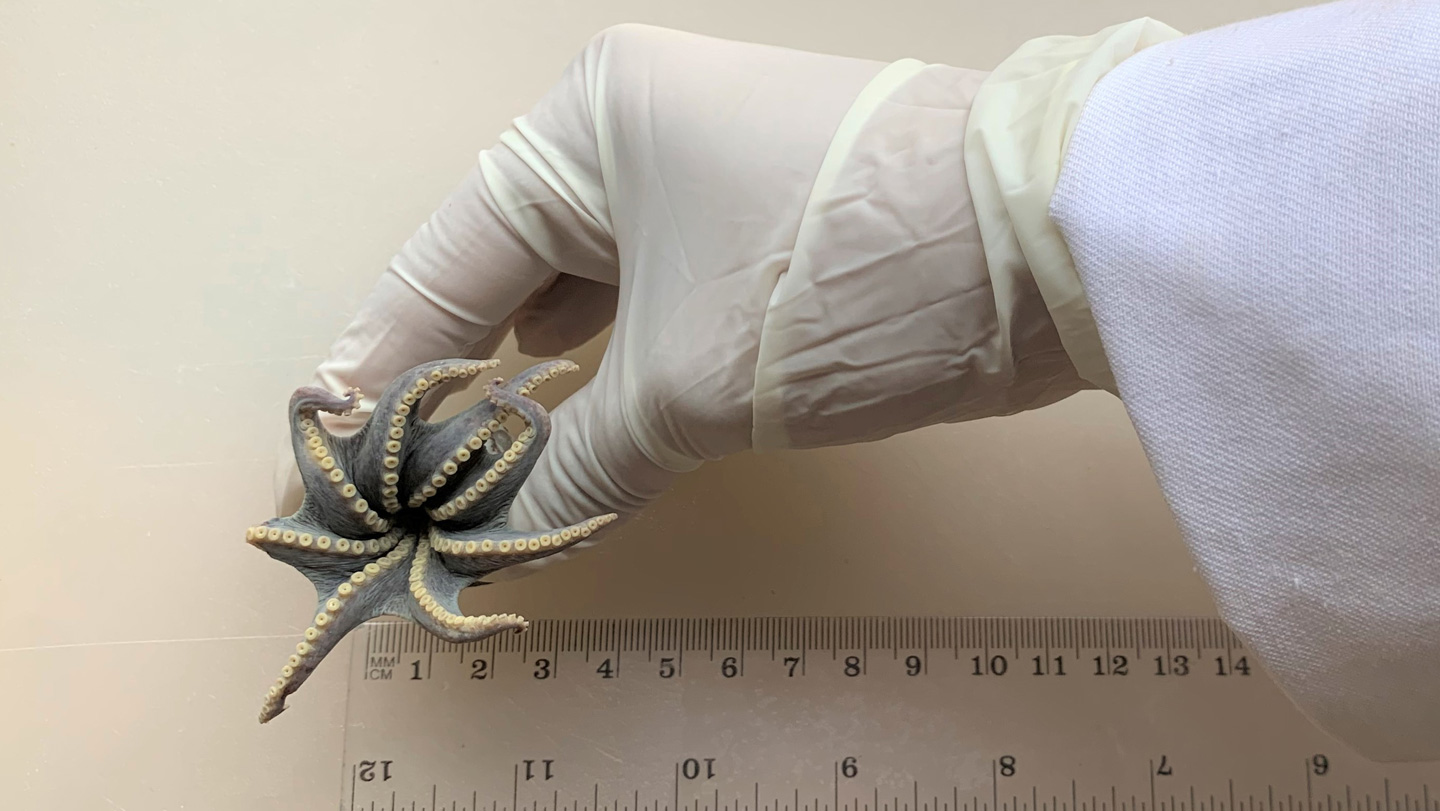
Following this extraordinary deep-sea greeting, the researchers carefully collected the specimen—a delicate creature measuring a mere ten centimeters in length—and transported it from the tropical waters of the Galápagos to the bustling laboratories of the Field Museum of Natural History in Chicago. Under the stewardship of evolutionary biologist and curator Janet Voight, scientists faced a classic taxonomical dilemma: how to thoroughly describe and verify a brand-new species when they possessed only one physical specimen to examine. Rather than relying on traditional, destructive dissection methods that would have forever altered this priceless holotypic treasure, the team turned to cutting-edge technology. They utilized high-resolution micro-computed tomography, or micro-CT scanning, to construct incredibly vivid, non-invasive three-dimensional models of the octopus’s internal organ systems. This marked a monumental milestone in marine biology, representing the first time a new octopus species had been officially described and categorized using CT scanning as the primary analytical tool. By preserving the specimen intact, the scientists honored the rarity of the creature, recognizing that while they had glimpsed three other potential members of this family during their underwater odyssey, this was the solitary individual they had successfully brought to the surface.
Officially christened Microeledone galapagensis in a publication in the journal Zootaxa, this diminutive cephalopod turned out to be an adult in its absolute prime, rather than a wandering juvenile as observers had initially speculated. When the scientists examined the digital reconstructions of her internal anatomy, they discovered a fully developed reproductive system, complete with a beautifully mature set of arm suckers and thirteen relatively large eggs nestled snugly within her ovaries. This discovery triggered a cascade of fascinating biological questions regarding the evolutionary benefits of small-scale deep-sea living. According to Janet Voight, being exceptionally small might actually be a highly sophisticated survival strategy designed to maximize reproductive efficiency. In the resource-poor, high-pressure wastes of the deep ocean, growing to a massive size requires an immense expenditure of energy and time. By bypassing a lengthy growth period and reaching sexual maturity at a size that easily fits in the palm of a human hand, Microeledone galapagensis can drastically shorten the generation time between hatching and egg-laying, thereby allowing the species to sustain its population much faster than its larger, slower-maturing cousins.
The physical adaptations of this newly found species write an elegant love letter to the power of evolutionary pressure in the dark. Beside its miniature stature, the octopus boasts unusually short, robust, and stubby arms that scientists believe are handily built for excavating the dense benthic sediment of the ocean floor. This specialized foraging technique suggests a lifestyle of active subterranean hunting, which directly relates to the creature’s stunning and contrasting color palette. The octopus possesses a pale, ghostly body accented by strikingly dark blue arms and thick, ink-colored webbing. Voight hypothesizes that when the animal digs deeply into the seafloor mud searching for a meal, its movements likely disturb small, buried organisms, stimulating them to ignite with brilliant, frantic bioluminescence. In the pitch-black abyss, a sudden glow of cold light acts as a glaring beacon to nearby apex predators; therefore, the octopus’s dark blue webbing likely acts as a natural, opaque blackout curtain, draping over the illuminated prey and shielding the telltale light from the hungry eyes of larger hunters while the octopus enjoys its meal.
This clever system of light management does not end with the octopus’s outward appearance, as its internal design is equally well-armored against the dangers of glowing food. Biologists suspect that the inner layers of the creature’s body contain specialized, dark pigment cells designed to block any residual bioluminescence from shining through its translucent skin after it has swallowed its glowing prey. This level of evolutionary tailoring showcases just how hostile and complex the deep-sea environment is, where a single slip in stealth can result in immediate demise. Beyond these immediate survival mechanics, the discovery of Microeledone galapagensis opens a thrilling window into global marine biogeography, as the only other known member of this specific genus resides thousands of miles away in the deep, warm waters off New Caledonia in the South Pacific. The vast geographic distance between these two isolated populations strongly suggests that there is a quiet, undocumented corridor of related species thriving in the vast, unexplored expanses of ocean floor that stretch between these two locations.
Ultimately, the story of this miniature blue octopus is a profound reminder of the boundless mysteries that still slumber within our planet’s oceans, far out of reach of our daily lives. As humanity continually peers outward toward distant stars and alien planets in search of strange new life, Microeledone galapagensis proves that some of the most surreal, beautifully adapted, and entirely unknown organisms are living right here on Earth, navigating the deep valleys of our ocean basins. The tireless work of researchers like Janet Voight and the collaborative efforts of institutions like the Charles Darwin Foundation emphasize that our understanding of global biodiversity is still in its infancy, with every deep-sea expedition yielding treasures that challenge our assumptions about life. Preserving these fragile ecosystems from the looming threats of deep-sea mining and climate change is paramount, ensuring that the dark, silent places of our world can continue to harbor these tiny, magnificent wonders, waiting in the quiet depths for the next gentle sweep of an explorer’s light.