





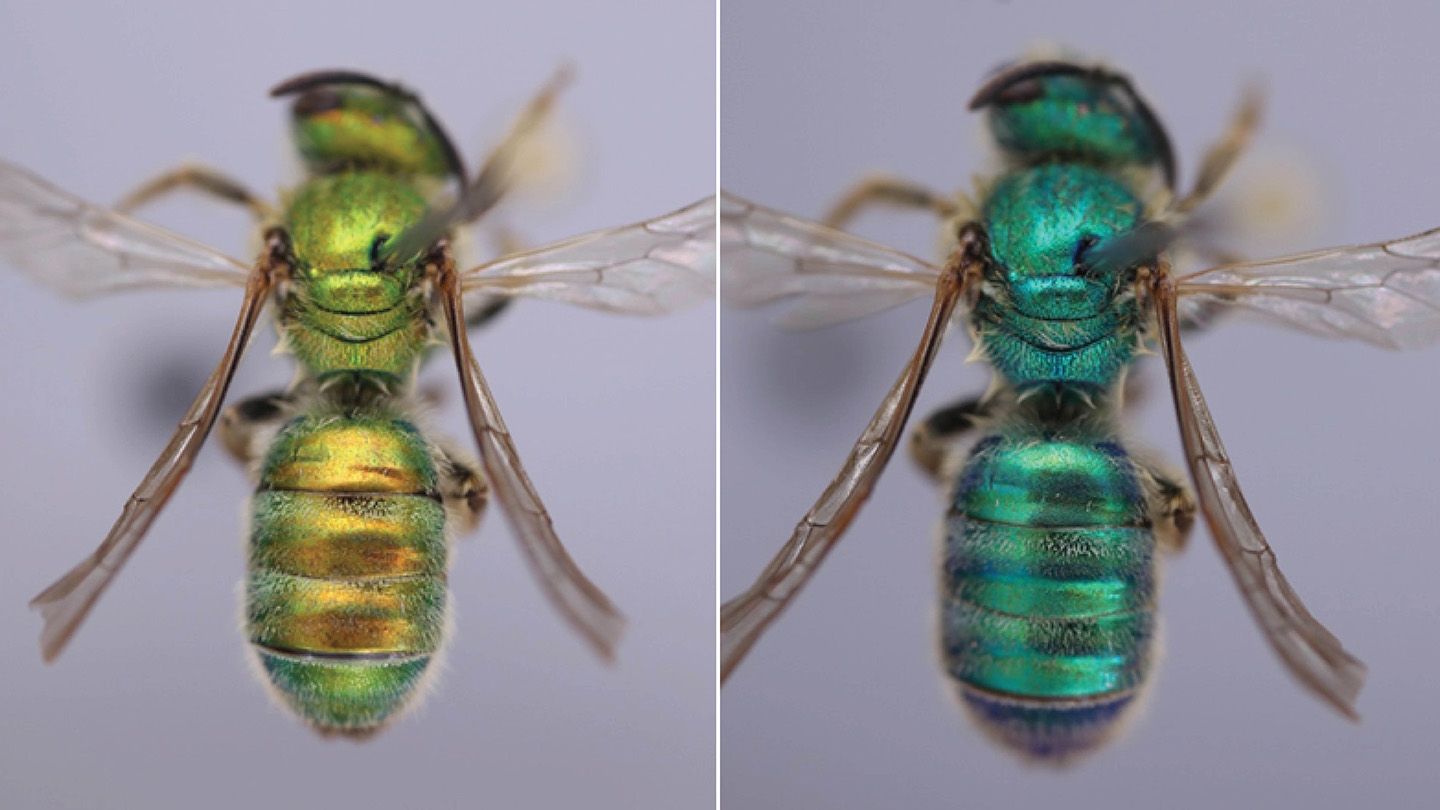
The Enchanting Color Shift of Sweat Bees in Humid Skies
Imagine stepping outside on a hot, muggy summer afternoon, the air thick with moisture, and spotting a tiny bee buzzing around a flower. If you’re lucky enough to see one of those iridescent sweat bees, you might notice something peculiar—their metallic sheen isn’t fixed. These little creatures, with their shimmering exoskeletons, actually change color based on the humidity in the air, turning from a rich blue-green in dry conditions to a softer coppery green when the dampness rises. It’s like nature’s own mood ring, responding to the weather in a way that’s both beautiful and a bit surprising. Not many people realize that insects can pull off such tricks, but for those who study them, it’s a reminder of how dynamic life on Earth can be. Scientists first started noticing this effect in museum collections, where bees would appear dramatically different after being exposed to humid environments used to soften them for preparation. What was initially dismissed as an artifact of handling turned out to be a real, natural adaptation.
Think about it: bees aren’t just busy workers in the hive; they’re also victims of the elements. Humidity might seem like a minor inconvenience to us humans, who can adjust our air conditioning or just complain about sticky skin, but for a bee, it’s a direct force that interacts with their very structure. The iridescence comes from tiny layers in their exoskeleton, which reflect light in mesmerizing ways. When the air is parched, below 10 percent humidity, these insects glow with a vibrant blue-green hue, almost like polished gems in a jewelry box. But crank up the moisture to around 95 percent, and that shine mellows into a warmer copper green, as if the bees are adapting their wardrobe for a rainy day. It’s reversible, too—just like how our hair curls more on humid days and straights when it’s dry. Researchers at places like Queen Mary University of London and the University of California, Santa Barbara, have been diving into this, and it’s fascinating how something so subtle can reveal bigger truths about adaptability in the insect world.
One undergraduate student, Jorge De La Cruz, sparked this discovery almost accidentally. While working on bee specimens at his university, he observed the color changes and thought, “This can’t just be the museum’s air—there’s something more here.” Teaming up with functional ecologist Madeleine Ostwald, who specializes in how organisms interact with their environments, they decided to investigate properly. They pulled together two dozen museum specimens of fine-striped sweat bees (Agapostemon subtilior) and created controlled conditions. Exposing the bees to both low and high humidity for 55 hours each, they photographed them at regular intervals, capturing the shift in real-time. But they didn’t stop there; to see if this happened in the wild, they combed through over 1,000 photos from citizen scientists on the app iNaturalist, matching each image with humidity data from the location and time it was taken. It was like piecing together a puzzle from everyday snapshots. In those real-world images, from sunny spots in Washington state to more humid patches elsewhere, the pattern held strong.
What causes this transformation? The scientists suspect it’s all about physics and biology working hand-in-hand. The bees’ exoskeletons are built like tiny optical devices, with layered structures that scatter light to create color, rather than relying on pigments like in paints or dyes. When humidity increases, moisture seeps into those layers, causing them to expand or swell. This changes the spacing between the layers, altering how light waves are reflected. Shorter wavelengths, like blue, get shifted toward longer ones, like green and even red, resulting in the coppery glow. It’s akin to how soap bubbles change hues as they thin out, or why CD discs shimmer in rainbows—tiny architectural changes produce big visual effects. Ostwald explains it simply: “Because we saw redder bees in more humid conditions, this fits with that scientific explanation.” Future studies might use high-powered microscopes to zoom in and confirm the swelling, but for now, it’s a clever explanation that bridges ecology and optics.
This color-changing ability might not be rare; it could be widespread among insects that use iridescence instead of plain pigments. Think of butterflies, beetles, or even certain spiders—all might have hidden environmental cues in their appearances. For bees specifically, the shift could serve practical purposes. In dry air, the blue-green might help them blend into sunlit foliage or attract mates, while the copper tone in humidity could signal readiness for flight or warn of wetness. It’s a survival hack, reminding us that color in nature isn’t static—it’s interactive. Ostwald marvels at this, saying, “Color can be really dynamic and respond to the environment in ways we didn’t expect.” We’re used to birds or chameleons changing hues, but bees? It adds a layer of wonder to backyard gardening or nature walks, where creatures we overlook hold secrets of environmental harmony.
Studying living organisms in their natural habitats is crucial, as removing them from context can warp our understanding. “It’s really important to study the color of the living organism in its natural environment,” Ostwald notes, “because as soon as we remove them from that context, the color changes.” Museum collections, while invaluable for research, might inadvertently mislead by capturing bees in altered states. That undergraduate’s curiosity and the power of citizen science iNaturalist highlight how discoveries come from unexpected places—from a student’s puzzled glance to crowdsourced photos. As we learn more, it prompts us to appreciate the interplay between weather and wildlife, and maybe even rethink our own adaptations. Next time the air feels heavy with humidity, take a closer look at those iridescent bees; they might just be showing us a flash of nature’s ingenuity.