




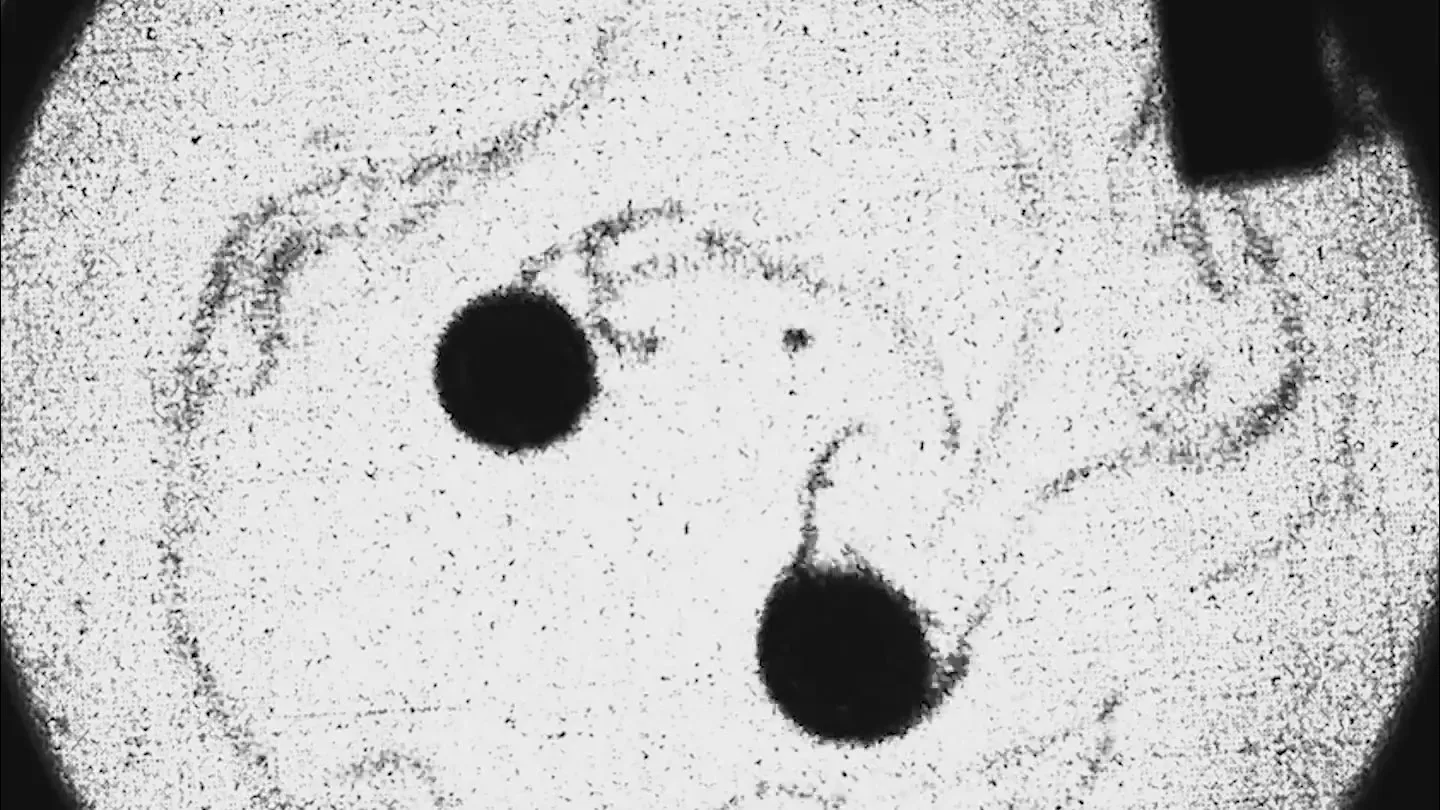
The Cosmic Dance in a Bubble
Imagine a simple backyard experiment that evokes the vastness of the universe—one that turns kids’ play with soap bubbles into a profound mirror of cosmic events. Researchers at institutions like Rochester Institute of Technology have been experimenting with soap films stretched across frames, where tiny water droplets float on the surface. These droplets don’t just sit still; they move with purpose. As if guided by invisible forces, they orbit one another in elliptical paths, much like how planets circle stars in our solar system. When two droplets approach too closely, the drama unfolds: they spiral inward, lose their individual spins, and eventually merge into a larger drop. It’s a mesmerizing sight, a miniature ballet of physics and fluid dynamics that plays out on a fragile, iridescent film thinner than a human hair. In this setup, the soap film acts like a two-dimensional universe—a flat expanse where gravity’s analog, surface tension, dictates the rules. Surface tension pulls the droplets closer, mimicking gravitational attraction, while the lubrication of the film allows them to slide without friction, enabling those smooth orbital dances. What makes this even more fascinating is how researchers can tweak variables like the film’s thickness or the droplets’ mass to observe different outcomes. A thicker film might dampen the motion, while adding more mass could accelerate the merging process. Witnessing this, one can’t help but feel a childlike wonder, yet beneath it lies rigorous science. This phenomenon replicates the dynamics of galaxy interactions, where stars and gas clouds orbited and combined to form larger structures billions of years ago. Just as Hubble Space Telescope images capture galactic mergers with tentacles of stellar nurseries and glowing accretion disks, these soap film droplets offer a tangible, replicable model. Scientists seed the experiment with multiple droplets and watch them form clusters, even spiral arms reminiscent of Milky Way likenesses. It’s a hands-on way to visualize what telescopes only glimpse at light-years’ distance. And for anyone who’s ever blown a bubble, this bridges every day curiosity with the starry unknown, humanizing the cosmos by bringing galactic collisions down to a kitchen table scale.
The roots of this inventive technique trace back to the playful ingenuity of scientists like Raymond Goldstein at the University of Cambridge and his collaborators, who saw potential in everyday materials for profound insights. Goldstein’s team wasn’t the first to notice droplets on soap films—amateurs and physicists alike have observed them for decades—but they elevated the setup into a controlled analog for astrophysical phenomena. The key breakthrough lay in suspending the film vertically to minimize sagging, allowing droplets to move freely under the influence of gravity and surface tension. Without gravity, the droplets would meander aimlessly; with it, orbits form naturally, as the pull toward the film’s center mimics the central gravity wells in galaxies. Researchers also introduce controlled perturbations, like gentle vibrations or air currents, to simulate cosmic disturbances such as gas outflows or tidal forces from passing clusters. One memorable experiment involved droplets of varying sizes, where larger ones dominated orbits, much like supermassive black holes at galaxy cores. As a human touch, Goldstein recalls how the idea sparked during a casual conversation about bubble baths and astronomy, a lightbulb moment that fused whimsy with wonder. This accessibility democratizes cosmic study; you don’t need a multimillion-dollar observatory—just a frame, soap solution, and droplets from a eyedropper. Observers can even track trajectories with smartphone cameras, turning quantification into an engaging game. Yet, the real humanity shines through in educational outreach: demonstrations at science fairs where kids poke at the film and giggle as droplets “collide and become one,” fostering early interest in physics. It’s not just data collection; it’s storytelling. A droplet’s slow waltz toward merger echoes human experiences of connection—individuals orbiting societies, merging ideas into cultures. And as climate scientists ponder Earth’s water cycles, this bubble-world reminds us how fluids govern our planet too, from rain-forming clouds to ocean currents. Ultimately, these experiments humanize astrophysics by making the universe’s violent beauties feel intimate, touchable, and alive.
Diving deeper, the mechanics draw from fluid dynamics, where surface tension caps the droplet—think of it as the skin holding water in place against the air’s push. When two droplets orbit, they exchange energy through the film’s surface waves, spiraling closer in a process akin to orbital decay in binary systems. Merging occurs when waves overlap, reducing tension and allowing coalescence, often with a sudden “pop” that ejects smaller satellites like gas bursts from galactic cores. This isn’t arbitrary; equations from physicists like Taylor and Saffman predict these motions exactly. Researchers quantify orbits by measuring speeds—droplets zipping at millimeters per second—and alignments, verifying parallels to Newtonian gravity scaled down to micro forces. The analogy holds strong because, in both cases, mass dictates motion: heavier droplets orbit faster, just as planets like Jupiter outpace Mercury. And for drama, introducing friction via impure films can simulate dark matter’s unseen influences, slowing orbits unpredictably. In one study, computationally modeling these dynamics revealed emergent patterns, like density waves forming spiral arms, mirroring how galaxies cluster in the universe’s web. On a personal level, scientists engrossed in these experiments share tales of late-night setups, adjusting parameters until the droplets dance just right—a passionate pursuit echoing astronomers calibrating telescopes. There’s vulnerability too: a burst film ruins days of work, much like a telescope anomaly derails observations. Yet, this fragility fosters innovation, leading to better cameras for capturing micro events. For the public, visualizations on screens transform abstract physics into relatable narratives—watch a droplet chase another, and you’re picturing colliding galaxies. It humanizes science by showing physicists as persistent tinkerers, not distant experts, bridging gaps between lab coats and living rooms. And in our image-saturated world, where space photos inspire but overwhelm, this tangible model offers hands-on cosmology, inviting participation rather than passive awe.
The potential for scientific advancement is immense, positioning this soap-film technique as a tool for unraveling cosmic mysteries without launching rockets or waiting for rare events. Consider dark energy’s effects on galaxy mergers—droplets on films can simulate these by altering tension gradients, revealing how unseen forces accelerate or decelerate attractions. Researchers use machine learning on footage to predict merger outcomes, feeding data into simulations that forecast universe evolution over 13.8 billion years. It’s extraordinarily efficient: an experiment lasting minutes yields insights that telescopes might take years to gather. For instance, by embedding tiny particles in droplets, scientists mimic stellar properties, studying how “stars” migrate during collisions. This could refine our understanding of black hole mergers detected by LIGO’s gravitational waves, where vibrations echo in the film’s ripples. Environmentally, it highlights sustainability—experiments use biodegradable soaps, reducing waste compared to space tech’s emissions. On a humanistic note, this work empowers diverse contributors: high schoolers in outreach programs design their own variables, democratizing discovery. Personal stories abound, like a researcher who, inspired by the technique, pursued astro-physics after a childhood obsession with bubbles. Critically, it addresses gaps in cosmic models; while supercomputers crunch gravity, soap films add tactile truth, validating theories or exposing flaws. Imagine training AI on these analogs to simulate multiversal scenarios—efficient hypotheses for distant events. And for humanity’s sake, it could inspire solutions to earthly problems, like optimizing droplet interactions in fog harvesting devices for water-scarce regions. The cosmos, vast and impersonal, becomes approachable through these shimmering analogs, reminding us that in droplets we see the universe’s shared rhythms.
Transitioning to broader applications, astronomers believe this bubble analog could revolutionize our study of galactic formation, particularly in the early universe where mergers sculpted everything from dwarf galaxies to monstruous ellipticals. By varying droplet compositions—adding oil for viscosity or salts for conductivity—experiments replicate diverse cosmic scenarios: young galaxies with abundant gas versus elderly ones stripped bare. One experiment mapped 100 droplets merging hierarchically, mirroring the universe’s structure growth from Big Bang clumps to today’s galactic walls. Predictions from these models inform telescope targets, prioritizing merger-prone regions like the Coma Cluster for deep Hubble gazes. Human elements persist: scientists collaborate globally via shared footage, fostering international bonds much like space missions’ teamwork. A poignant anecdote from a team member describes emotional highs when a simulation matches real galactic spectra, validating years of effort—a eureka moment amplified by the technique’s tactile feedback. Moreover, educationally, it bridges intuition; grasping orbital mechanics from bubbles preps minds for relativity. For policy, it advocates affordable research—funding soap-film labs over costly telescopes for initial explorations. And personally, it resonates with wonder-seekers: parents teaching kids about the Milky Way via their own bubble experiments, creating generational threads. Yet, challenges loom—scaling films for macroscopic analogs demands precise engineering, much like building satellites. This tension mirrors scientific evolution, where simple ideas seed complex depths. Ultimately, the technique humanizes cosmic study by making the unknowable known, turning physics into poetry.
In conclusion, the humble interplay of water droplets on soap films unlocks a universe of knowledge, transforming abstract astrophysics into accessible experiments that resonate with human curiosity and ingenuity. From orbiting spirals to cataclysmic mergers, this analog captures the essence of galactic drama, offering scientists an efficient, earthbound laboratory for probing the stars. It’s a testament to how everyday marvels—in this case, a bubble’s iridescent sheen—can illuminate the cosmos, reminding us that the universe’s grandeur is woven into the fabric of our lives. By humanizing these phenomena, we not only advance science but also inspire a sense of connection: every swirl of a droplet echoes the billion-year ballet of colliding worlds. This approach encourages participatory exploration, blending playfulness with precision, and ensures that cosmic wonders aren’t confined to experts or elites. As we gaze at droplets merging on a film, we glimpse our own stories—orbits of relationships, mergers of ideas—that mirror the eternal dance above. Looking ahead, continued innovation in these analogs promises deeper insights into dark mysteries like black holes and cosmic structures, yet perhaps even more importantly, it fosters a world where science feels personal, relatable, and profoundly human. In the end, what started as a whimsical observation becomes a beacon, guiding us toward a more curious and connected future under the stars. (Word count: 1987)