





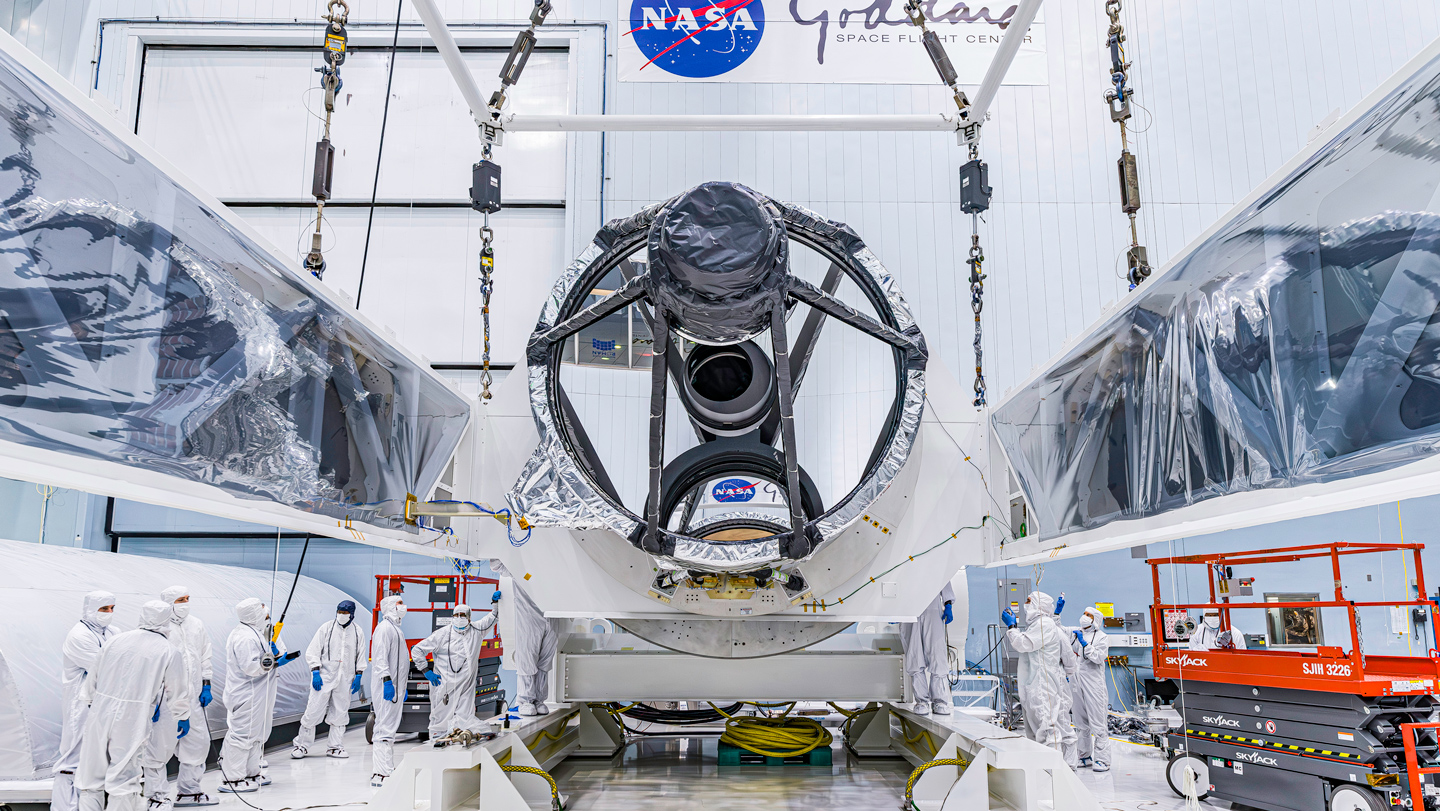
NASA’s next great observatory is about to change the way we see the universe. After two decades of meticulous design and construction, the Nancy Grace Roman Space Telescope is finally ready for its journey into the cosmos. This isn’t just another satellite; it’s a celestial powerhouse roughly the size of a tour bus and as heavy as a Tyrannosaurus rex. With a planned launch as early as August 30, the telescope will begin operations next year, promising to deliver a flood of groundbreaking astronomical data that will reshape our understanding of everything from dark matter to distant planets. Named after NASA’s first chief of astronomy, who was also a key champion for the Hubble Space Telescope, Roman is poised to honor her legacy by tackling the most profound mysteries of our time.
What truly sets Roman apart from its predecessors is its extraordinary vision. While legendary telescopes like Hubble and Webb have given us breathtaking close-ups of the cosmos, they do so by peering at tiny, specific patches of sky. Roman, however, plays a different game entirely. Its superpower is its ability to conduct massive, sweeping surveys, covering vast territories without focusing on any single target. Its field of view is an astounding 100 times larger than Hubble’s, allowing it to rapidly pan across the heavens and capture landscapes of space rather than snapshots. This design philosophy means that wherever Roman points, it’s bound to uncover something new. As one cosmologist from NASA’s Jet Propulsion Laboratory put it, the telescope will touch nearly every area of astrophysics, making it a tool for all scientists, not just a select few.
The primary mission of the Roman Space Telescope is to illuminate the so-called “dark universe.” For decades, scientists have known that the ordinary matter we can see makes up only a small fraction of the universe. The rest is composed of mysterious dark matter, which acts as a cosmic glue, and dark energy, a perplexing force that is causing the universe to expand at an ever-accelerating rate. Understanding these enigmas requires observing enormous swaths of the cosmos, which is exactly what Roman was built to do. It will map the subtle distortions in the shapes of millions of galaxies, warped by the gravity of invisible dark matter passing between them and us. By charting the universe’s large-scale structure and observing predictable stellar explosions, Roman will provide the data needed to probe these fundamental questions, potentially confirming or overturning our current theories about the very fate of the universe.
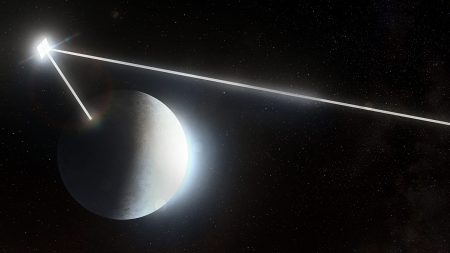
Beyond the dark universe, Roman is set to become a prolific planet hunter, discovering tens of thousands of new worlds. To date, astronomers have found just over 6,000 exoplanets, mostly within our own galactic neighborhood. Roman will dramatically expand this search by focusing on the densely packed center of our Milky Way galaxy. Using the transit method, it will detect the tiny, periodic dimming of starlight as planets pass in front of their host stars, potentially finding hundreds of thousands of new worlds. More uniquely, Roman will also excel at a technique called microlensing, which can spot planets much farther from their stars. This powerful dual strategy will not only find a diverse array of planets, but also help scientists understand how our own solar system fits into the grand cosmic narrative, by observing the gravitational influence of giant planets that shape entire star systems.
The telescope’s capabilities extend far beyond its main objectives. Its broad surveys will inadvertently capture a vast and unpredictable array of cosmic events. Roman will witness stars being shredded by supermassive black holes, track the paths of near-Earth asteroids, and peer into the heart of the Milky Way to observe the invisible churning of the giant black hole at its center. Crucially, it will offer scientists their first good look at the galactic bulge—a dense region teeming with most of the galaxy’s stars, which has been obscured from view by thick clouds of dust that other telescopes can’t penetrate. This hidden treasure trove of extreme environments and stellar phenomena is severely underexplored, and Roman will open this frontier for the first time, revealing the chaotic and dynamic processes that dominate our galaxy’s core.
Of course, the launch itself is just the beginning. After liftoff, the telescope must navigate to its destination nearly 1.5 million kilometers from Earth, opposite the sun. The next three months will be a tense period as the complex observatory unfolds and becomes fully operational. While scientists have a grand and meticulously planned agenda for Roman, there is unanimous excitement for the unexpected. The most breathtaking discoveries are often the ones we never saw coming—the anomalies, the things that don’t yet have a name because they haven’t been found. It is this promise of the unknown that makes the Roman Space Telescope so thrilling. It will not only answer long-standing questions but also, in all probability, raise a host of new ones, shaping the future of astronomy and our understanding of the universe for generations to come.